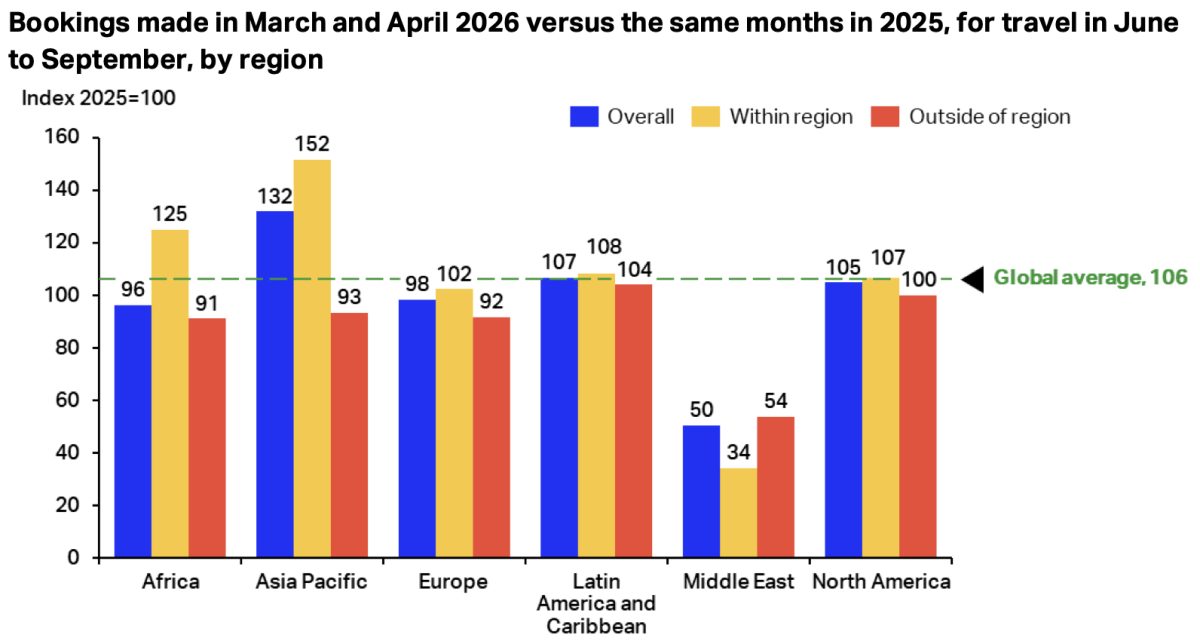
Travelers are voting with their wallets, and the message is clear: when uncertainty strikes, stay close to home. Global air passenger bookings grew by six percent in March and April 2026 for summer travel between June and September, a solid gain despite the war in Iran and soaring fuel prices that have rattled markets worldwide.
But here's where the story gets interesting. That six percent growth masks a dramatic reshuffling of travel patterns. Passengers aren't spreading out evenly across the globe. Instead, they're clustering their bookings within their own regions, and the numbers tell a tale of caution mixed with wanderlust.
Asia Pacific Leads While Middle East Nosedives
The Asia Pacific region is the clear winner, with bookings jumping 32 percent year-on-year. Europe and the Americas showed more modest gains. North American domestic travel climbed seven percent, while European travel within the region grew just two percent. Latin America and the Caribbean reported a seven percent overall increase, with within-region bookings up eight percent. Meanwhile, the Middle East suffered the worst blow. Bookings to the region collapsed by 50 percent, a direct consequence of supply chain disruptions, fuel concerns, and travel hesitation.
What binds all these numbers together is a universal truth: people prefer shorter flights when the world feels unstable. The International Air Transport Association noted that shorter regional routes consistently outpaced long-haul bookings across every region studied. Passengers aren't canceling trips entirely. They're just recalibrating their destinations, choosing cities and countries they can reach without the hassle, cost, and anxiety of a 12-plus hour flight.
Africa and Europe Chart Unexpected Paths
Africa's within-region bookings surged 25 percent, though from a smaller overall base. However, bookings leaving Africa for other continents dropped nine percent, driven primarily by fewer people heading to the Middle East and Asia. Europe presents a curious case. European airports reported 3.8% passenger growth in March 2026 despite ongoing Middle East geopolitical disruption blocking fuel supplies through the Strait of Hormuz. International travel from Europe sank eight percent, but the continent's internal flight network actually gained strength as travelers abandoned international routes and booked European city pairs instead.
Olivier Jankovec, director general of Airports Council International Europe, called the market "extremely dynamic." He noted that the loss of direct Middle East connectivity pushed passengers toward alternative routings, many of which kept them flying within Europe. Air routes adapted faster than anyone expected. When one door closed, others opened.
Crisis Changes How People Book
Travel patterns shift rapidly during geopolitical uncertainty. Consumers don't book trips months in advance when the world feels unstable. They wait. They watch the news. They check prices. They book closer to their actual departure date, hedging their bets in case things worsen. This hesitation temporarily suppresses bookings for distant destinations, while nearby regional flights benefit from last-minute decision making and shorter planning windows.
The International Air Transport Association expects conditions to evolve over the coming months. If geopolitical tensions ease, long-haul bookings could rebound. There's still time for travelers to redirect their summer plans toward distant continents. But for now, the trend is unmistakable: regional wins when uncertainty strikes. Passengers are choosing shorter flights, familiar regions, and destinations they can reach and return from quickly. The Middle East aviation sector continues adapting, but the global traveler has spoken. This summer belongs to the short haul.