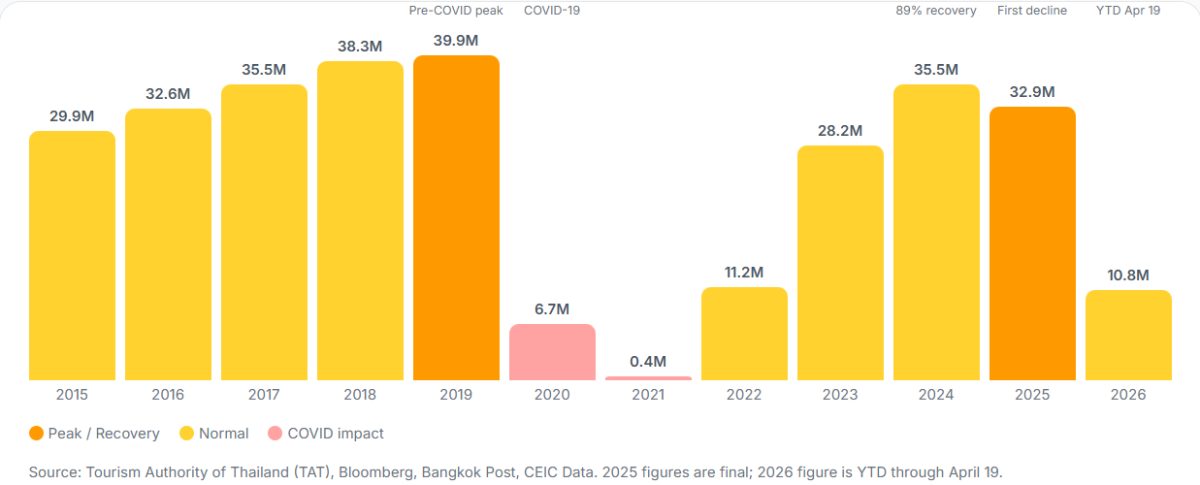
Thailand has set its sights on welcoming 33 million foreign visitors by 2027, but here's the twist: officials aren't just rolling out a welcome mat for anyone. They're being deliberate about who they're courting.
The Tourism Authority of Thailand is pursuing what they call a "Value over Volume" approach. Translation: forget about padding visitor statistics. The focus now is pulling in travelers with deeper pockets, improving the overall experience, and making sure the money actually sticks around in local communities. The strategy leans heavily on better destination management, upgraded services, and digital innovation to reshape Thailand's tourism reputation.
Part of this shift means expanding beyond traditional markets. While China continues sending the most visitors (2.86 million through July 2026), Thailand is actively pursuing travelers from Belarus, Brazil, and South Africa. At the same time, officials are negotiating with Chinese airlines to boost flight capacity, recognizing that accessibility remains a major draw.
Natthriya Thaweevong, Permanent Secretary for Tourism and Sports, summed up the thinking plainly: "Thailand's goal does not measure success merely by visitor numbers, but prioritises the quality of tourists, the revenue generated, and the benefits distributed to the public and entrepreneurs in all areas."
The data backs the pivot. Recent figures show 17.36 million foreign tourists between January and mid-July 2026, generating an estimated 838.73 billion baht in tourism revenue. That's steady performance in a global tourism landscape that's become increasingly unpredictable. Malaysia (2.25 million arrivals), India (1.31 million), Russia (1.06 million), and South Korea (631,777) round out the top five source markets.
But international visitors are only half the equation. Thailand also wants to hit 203 million domestic trips, achieved partly through travel incentive programs designed with private-sector partners. Getting locals to explore their own country more frequently spreads tourism benefits across regions beyond the typical Bangkok-Phuket corridor.
To stay competitive in Southeast Asia's crowded tourism space, Thailand has rolled out some unconventional moves. The country legalized afternoon alcohol sales for the first time since 1972, a shift that honored hospitality industry requests while modernizing regulations. More spectacularly, Thailand will host Tomorrowland for the first time in December 2026, positioning itself as a hub for global creative experiences alongside beaches and temples.
The bigger picture reveals how tourism boards everywhere are grappling with the same challenge: sustainable growth that actually improves lives rather than overwhelming infrastructure. Thailand's approach suggests that chasing prestige travelers who spend freely might deliver more long-term value than scrambling for raw volume. Whether that strategy pays off depends on execution, but the country isn't waiting around to find out.