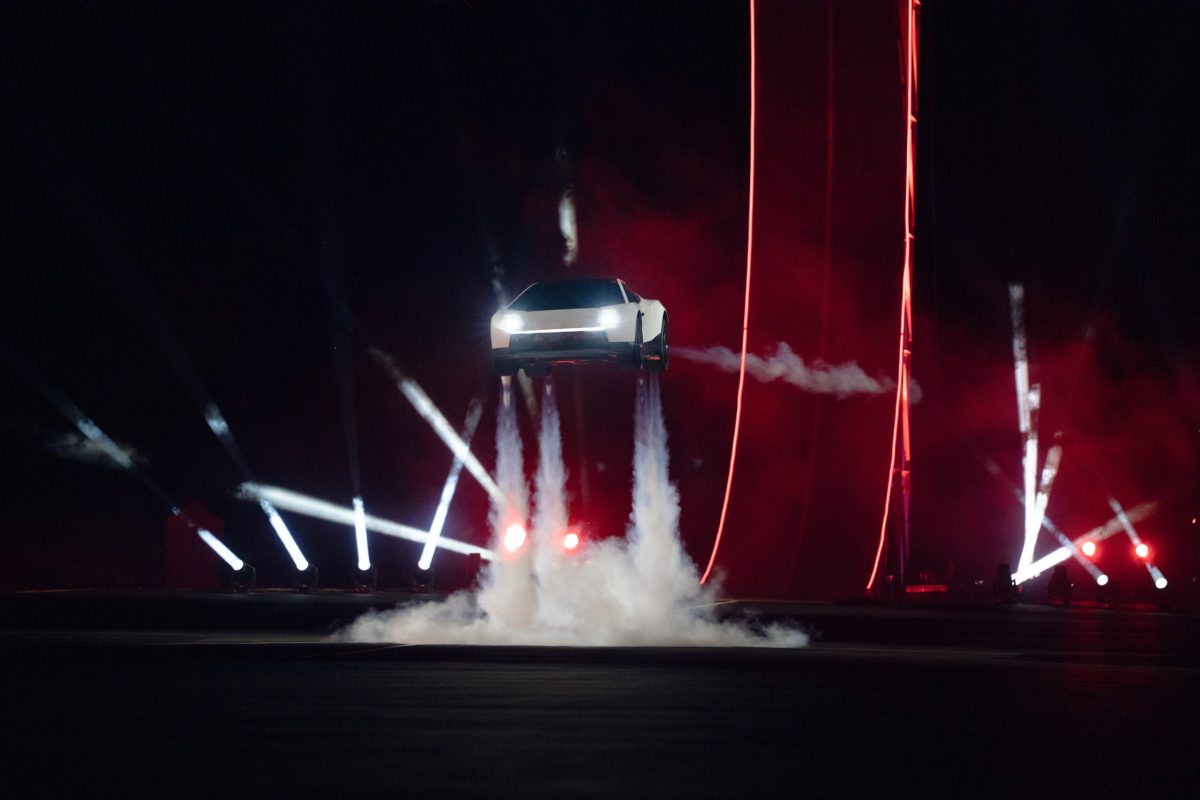
At a SpaceX test site in Texas, Tesla just showed off a Roadster that can launch off a ramp, flip upside down, and land like a stunt plane. The two-seater hit 0 to 60 mph in 0.81 seconds, a number that sounds more like a roller coaster than a car. But before you start planning a road trip through the clouds, here's the catch: this thing only flies for a few seconds at a time. It's not a flying car in the way you might hope.
Elon Musk unveiled the updated Roadster on October 15 at SpaceX's Rocket Test and Development Center in McGregor, Texas. The car performed airborne flips and hovered over a row of Teslas using compressed-air thrusters developed with SpaceX technology. The underside fan system creates suction for extra grip on the ground, while separate nozzles control orientation mid-air. It's an impressive piece of engineering, but the demo was all about short stunts, not sustained flight between destinations.
Production is now targeted for 2028, extending a wait that began when the Roadster was first shown in 2017. Deliveries were originally promised for 2020, so this is already years behind schedule. For travelers, the question is whether this counts as a glimpse of future transport or just a very expensive toy. The answer, for now, is the latter.
What It Means for Travel
The term "flying car" already covers wildly different ideas. Slovakia's AirCar, for example, received airworthiness certification in 2022 after completing over 70 hours of flight testing. It flew 35 minutes between Nitra and Bratislava, a real journey that could connect road travel with regional aviation. Tesla's Roadster, by contrast, offers no passenger service, no intercity flight schedule, and no evidence of sustained flight. Its relevance to tourism lies more in the thrill of an unusual driving experience than in replacing airport transfers or regional flights.
That's not to say it won't be fun. The idea of a car that can briefly take to the air is the kind of thing that makes you want to plan a road trip just to try it. But whether you'll actually get to use those airborne tricks on public roads is another matter. The demo was done with no driver aboard, using autonomous control to avoid risk. Musk said the car will eventually be the company's only manually driven model, but that's a long way off.
European Availability Remains Uncertain
Musk acknowledged that the Roadster might not be legal in every jurisdiction. Tesla's UK website specifies left-hand drive only, which is a consideration for British buyers. The launch leaves open questions about where owners could use the airborne capabilities and under what conditions. A controlled test site is not the same as permission to perform flips on the M25. So while the Roadster is a spectacle, its practical travel applications are still unproven.
For now, the Roadster is a concept that pushes the boundaries of what a car can do. It's not a flying taxi, and it won't be shuttling you between cities anytime soon. If you're curious about the future of aerial travel, you might look at LA's flying taxi stations, which are being built ahead of the 2028 Olympics. That's a more realistic glimpse of how air travel might evolve for everyday passengers.
The final price hasn't been announced, and with production targeted for 2028, the Roadster remains a prospective product. Its everyday travel applications have yet to be demonstrated. So while the idea of a flying car is thrilling, the reality is that you'll likely be booking a regular flight for your next trip. And if you're planning a trip to Europe, don't forget to check the latest on ETIAS travel permit requirements, which are still being delayed.
In the meantime, the Roadster is a reminder that the future of travel is being imagined in bold ways. Whether it's a car that flips through the air or a flying theatre in Macao, the boundaries of what's possible are expanding. But for now, the Roadster is more about spectacle than substance, and that's okay. It's a glimpse of what could be, not what is.