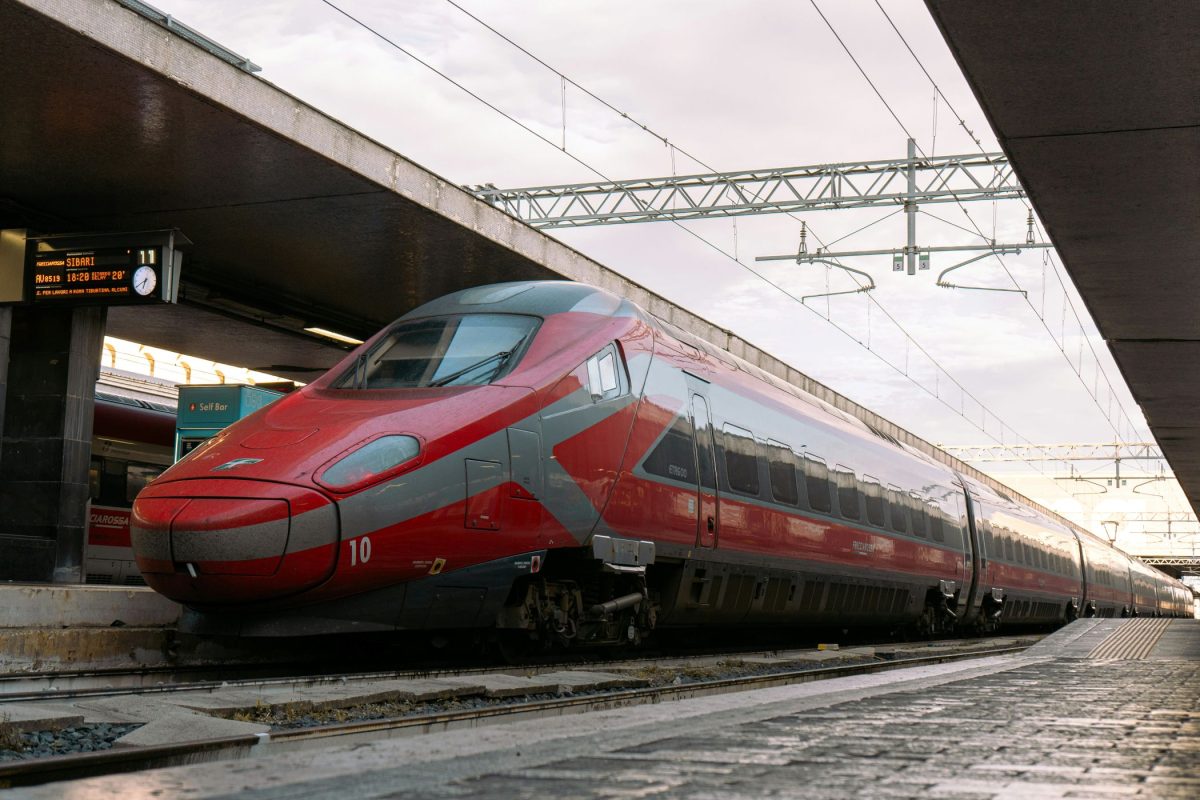
Here's something that might shift how you think about European travel: Italy is launching a direct train service to Germany that'll make flying look unnecessarily complicated. Trenitalia, the Italian state railway, is preparing to run its Frecciarossa high-speed trains straight across the Alps, connecting Milan and Rome to Munich beginning in summer 2027.
The trains are already being tested on German and Austrian tracks. When they launch commercially, you'll have four daily connections on each route, operated in partnership with Deutsche Bahn in Germany and Austrian Federal Railways (OBB). No plane changes. No fumbling through airport security at 5 a.m. Just board, settle in, and watch the landscape transform.
What the journey actually looks like
The Milan-to-Munich run takes about six and a half hours, stopping in Brescia, Verona, Rovereto, Trento, Bolzano, and Innsbruck before reaching Bavaria. If you're leaving from Rome, add roughly two hours to that. You'll pass through Florence and Bologna first, then merge onto the same Alpine corridor.
The real reward here isn't speed. It's the window seat. You're getting a ground-level tour of terrain that airlines make you miss entirely. The Dolomites. The Brenner Pass. Tyrol's valleys. This is the kind of journey where you understand why Europe's geography matters.
Travel times will compress even further once the Brenner Base Tunnel opens in 2032 (possibly 2034, depending on construction delays). That infrastructure project alone will cut roughly an hour off Italy-to-Germany travel. When it's finished, the new rail corridor becomes significantly more competitive against flying.
Why this matters beyond getting you to Munich
Innsbruck is emerging as the central hub for this entire network. Both routes funnel through the Austrian city after crossing the Brenner Pass, positioning it as a genuine crossroads for European rail. Europe's boldest night train yet targets Scandinavia by spring 2028, and this daytime expansion suggests the continent is serious about rethinking mobility away from aviation.
The Frecciarossa 1000 trains were designed with cross-border operation in mind. They run on Italian, French, German, Spanish, Swiss, Dutch, and Belgian rail networks without modification. This isn't just convenient. It's genuinely rare in European rail. Passengers board in Italy and arrive in Germany without ever switching trains, which sounds mundane but represents years of technical coordination between national operators who don't always play nicely together.
Ambitions extend far beyond Munich
Trenitalia isn't stopping here. By December 2028, the company plans to run ten daily connections between Italy and Germany, with routes extended to Naples and Berlin. The parent company, FS Group, has bigger appetites still. Frankfurt and Krakow are on the target list. There's even a plan to launch London-Paris service through the Channel Tunnel by 2029, directly challenging Eurostar's current monopoly.
Gianpiero Strisciuglio, FS Group's CEO, frames this as building a "European Metro" that stitches regions, people, and economies together via rail. Italy's infrastructure minister, Matteo Salvini, echoed the sentiment, emphasizing job creation and market expansion across the continent.
The calculus is straightforward: high-speed rail is cheaper than aviation for operators, produces fewer emissions, and offers a genuinely pleasant travel experience when it's done right. The trains are already operational in France and Spain. Germany and Austria are next. If this expansion continues, casual European travel by plane might start feeling quaintly inefficient within a decade.
For travelers, the pitch is simple. Summer 2027 onwards, you can sip coffee over the Brenner Pass instead of recycled air at 35,000 feet. You can work, read, or just stare out the window at mountains. You'll arrive in Munich without the security theater, baggage drama, or the general exhaustion that comes with flying short-haul. Assuming Trenitalia executes, this is the kind of infrastructure shift that actually changes behavior.