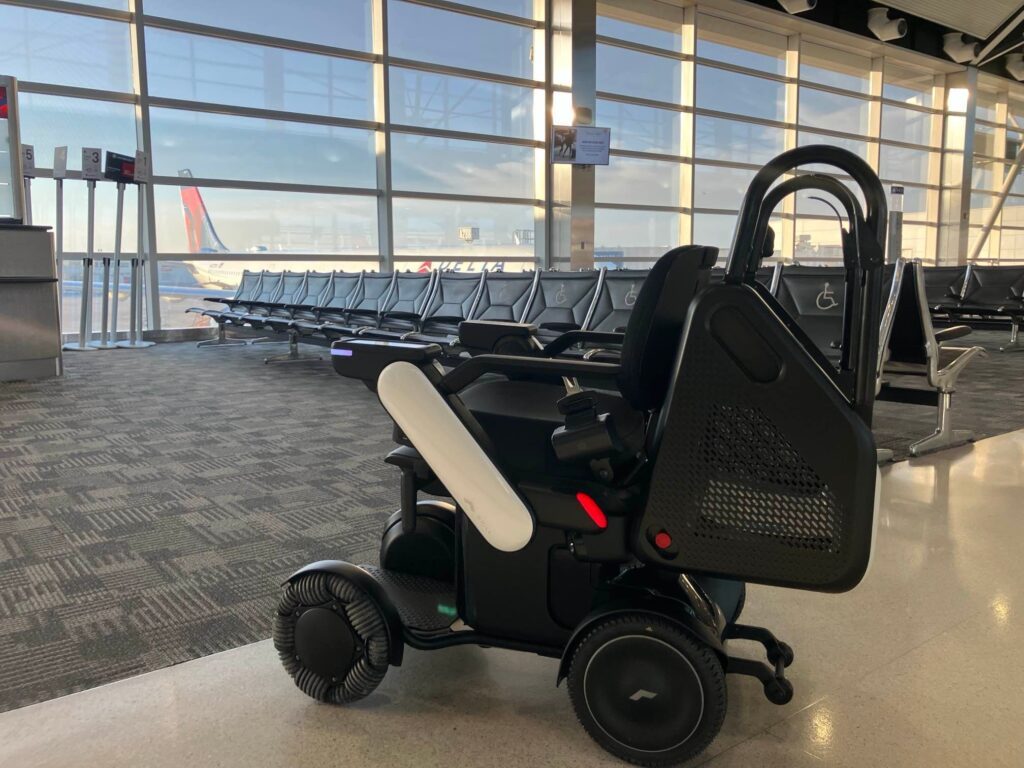
The moment you land at a major US airport, you might spot something that looks like science fiction rolling through the terminal: a sleek autonomous wheelchair navigating crowds and obstacles on its own. What sounds like a futuristic concept is already happening at airports coast to coast, and it's reshaping how people with mobility needs experience air travel.
The rollout is spreading fast. Los Angeles, Miami, Seattle, and Detroit have all embraced autonomous mobility assistance. Anchorage just joined the club at Ted Stevens International Airport. More are coming. The technology works because these aren't just fancy wheelchairs - they're intelligent devices equipped with artificial intelligence, obstacle detection, and built-in navigation that guides passengers through sprawling terminals without requiring an attendant to push them.
How the tech actually works in practice
At Detroit Metropolitan Wayne County Airport, the team partnered with Unifi and deployed vehicles powered by Blueberry Technology. The system gives each passenger a virtual map of the terminal on their personal device, letting them plot their own route to their gate without relying on airport staff. The wheelchair's AI-powered sensors detect obstacles and automatically avoid collisions. "This partnership enables us to provide an innovative and efficient service for our customers, facilitating a more seamless experience," said WCAA CEO Chad Newton when the service launched.
Alaska's approach mirrors this philosophy but with a different partner. At Anchorage's Ted Stevens, Alaska Airlines and NANA Management Services brought in WHILL Autonomous Service wheelchairs. The key difference: staff provide hands-on instruction and support, turning the technology into a hybrid model where trained agents help passengers through security and the transition onto the autonomous device. Passengers can book the service when making their flight reservation or request it upon arrival at the terminal.
Who can use them and how to get one
These aren't designed for every traveler. The wheelchairs work best for passengers who can stand and transfer independently. If you need complete assistance, traditional wheelchair services remain available. The eligibility screening happens on-site after you request the service.
The booking process in Anchorage tells you what to expect at other airports rolling out the service. First, request wheelchair assistance through your airline at booking or when you arrive at the terminal. Head to the assistance kiosk where staff will verify you're a good fit for the autonomous device. Then you'll be guided through TSA screening before being transferred to your WHILL wheelchair. Staff provide training so you can operate it safely and confidently. The entire setup removes the bottleneck of waiting for a gate agent to become available, which matters especially during peak travel times when airport staff are stretched thin.
The bigger picture for airport accessibility
What's happening in these terminals reflects a broader shift in how airports approach hospitality. Modern terminals are rethinking their design from the ground up, and accessibility sits at the center of that conversation. Autonomous wheelchairs solve multiple problems at once: they give passengers independence and control over their movement, they reduce the burden on airport staff during chaotic hours, and they actually scale accessibility infrastructure without proportionally increasing labor costs.
Ted Stevens marks the sixth US airport where WHILL devices are operating. Seattle-Tacoma, Los Angeles, Winnipeg Richardson, Detroit Metro, and Miami already have them deployed. Each deployment teaches engineers and airport operators something new about real-world usage patterns.
For travelers, the technology represents something simpler than the logistics: the chance to navigate an airport the way you want to, at your own pace, without depending on someone else's schedule. That autonomy matters, especially when you're already managing the stress of air travel. Accessibility done right turns out to be good business, and airports are finally figuring that out.
If you're traveling through these airports in the coming months, these wheelchairs will likely be available to you. Request them early, arrive with enough time to get oriented with the technology, and you might just have the smoothest airport experience of your travel life.