
Imagine settling into your seat for a two-hour train ride, ready to catch up on emails or stream a show, only to find yourself completely cut off from the digital world. For millions of UK rail passengers, this isn't imaginary. It's the daily reality.
A fresh investigation by Ofcom, the UK's communications watchdog, paints a bleak picture of connectivity on British trains. Testing mobile performance across 24 railway sections in England, Scotland, and Wales, researchers discovered that networks performed poorly between 58% and 83% of the time. The regulator tried to perform basic tasks like video calls, social media browsing, and video streaming. Most of the time, the connections simply weren't up to it. As Ofcom bluntly put it: for millions of travellers, stepping on board means going off grid.
Which networks are actually the worst?
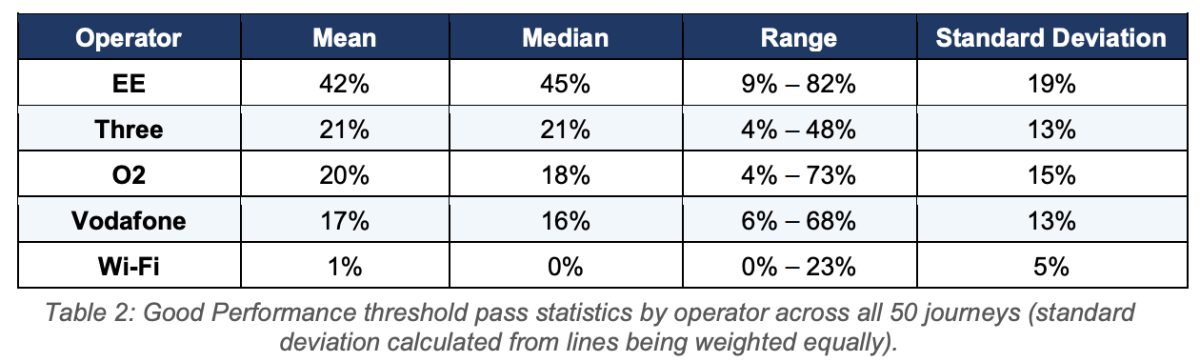
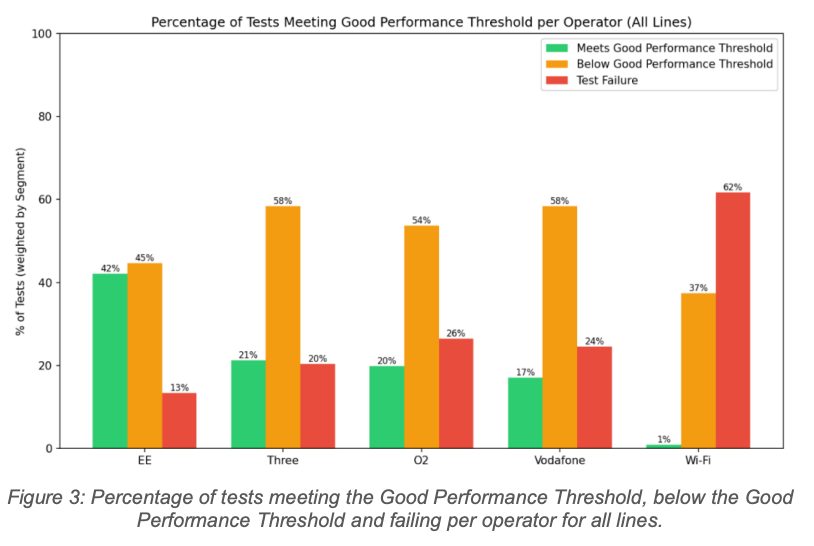
EE came out ahead, meeting the regulator's standards on 42% of routes tested. Everyone else lagged significantly behind. Three managed 21%, while O2 and Vodafone hit 20% and 17% respectively. Even the strongest performer failed to deliver on most journeys. To put this in perspective, Ofcom's benchmark was genuinely modest: 5 megabits per second download, 1.5 megabits per second upload, and 50 milliseconds response time. These are the bare minimum speeds needed for modern browsing and video calls. Networks couldn't even clear that bar.
Some routes tell a sharper story. The London Victoria to East Croydon line performed relatively well, especially for EE customers. The Basingstoke to Coventry route, cutting through Reading and Oxford, was among the worst. Rural and intercity routes got hammered compared to urban corridors. And forget about connectivity during rush hour, when everyone's trying to squeeze onto the network at once.
Train Wi-Fi is basically broken
If you thought switching to onboard Wi-Fi might save you, think again. Ofcom found that train Wi-Fi actually worked well just 1% of the time. Many train operators are still running equipment from another era, struggling to handle what passengers expect today. Some deliberately throttle speeds to manage bandwidth, which only makes the experience worse. Travellers bounce between patchy mobile data and unreliable Wi-Fi, never quite winning.
Why are trains such signal deserts?
The problem runs deeper than lazy network operators. Mobile signals from roadside masts get weaker along railway corridors, especially in sparsely populated areas. Trains themselves work against connectivity. Metal carriages and special window coatings block signals from reaching passengers inside. Older trains make it worse, and double-decker trains create extra signal challenges. It's a perfect storm of physics, ageing infrastructure, and geography.
This struggle isn't unique to Britain. Keeping passengers connected on moving trains has long been a headache across Europe, particularly on routes threading through countryside. But what passengers expect has shifted dramatically. Work culture now treats train time as office time. People attend video meetings, access real-time travel info, and stay in touch with colleagues and family. Connectivity isn't a perk anymore; it's expected.
What's actually being done about this?
The telecom industry points to structural and capacity challenges that make reliable train service genuinely difficult. BT Group argues investments are ramping up. A spokesperson noted the company plans to pump more than 40 billion pounds into network improvements this decade. But the gap between investment promises and passenger experience remains enormous.
The UK government is trying a different angle. The Department for Transport is backing a 57-million-pound satellite connectivity project. Instead of relying solely on 4G and 5G towers, trains could beam data through low-Earth-orbit satellites. Meanwhile, Ofcom is pushing for something equally important: cooperation. The regulator wants telecom operators, local authorities, developers, and government bodies working together instead of in silos. Natalie Black, Ofcom's group director for infrastructure and connectivity, said the agency is "determined to play its part" but stressed that breaking down barriers requires everyone at the table.
For now, thousands of UK passengers will board trains this week expecting to stay online and instead experience a pocket of disconnection. Until the networks, regulators, and government actually synchronise their efforts, the journey time means offline time.