The 2026 FIFA Men's World Cup has wrapped, and fans everywhere are nursing that familiar letdown that comes after the final whistle. But soccer lovers shouldn't despair. In 2030, the World Cup returns to Europe, with Spain, Portugal, and Morocco splitting hosting duties (plus special centenary matches kicking off in Argentina, Paraguay, and Uruguay). Europe's collective attention will turn to the Iberian Peninsula, and Portugal is preparing to make a bold statement.
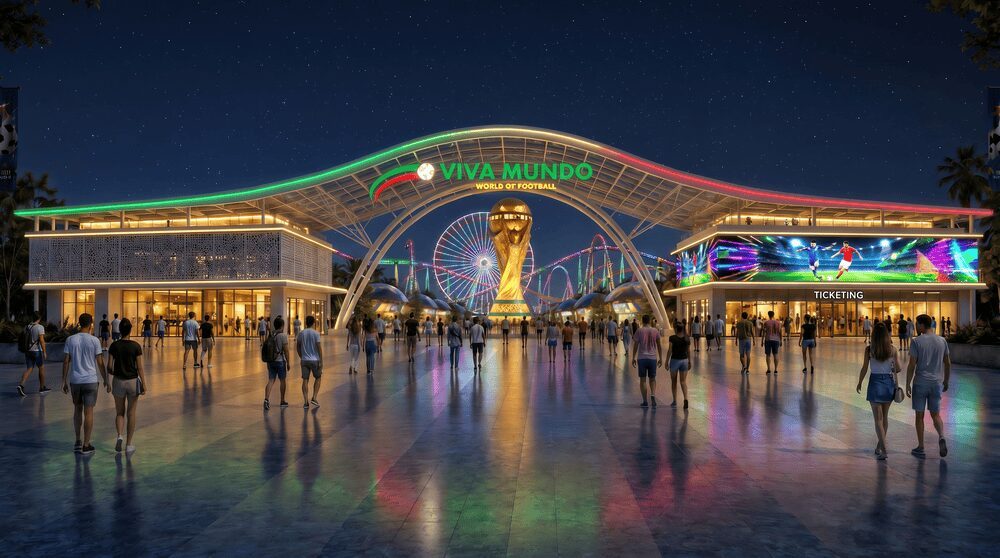
Developers Zul Virani and JFA Group have unveiled plans for Viva Mundo, an 80-hectare destination rising near Santarém, a charming historic city just 40 minutes from Lisbon. The project carries a staggering price tag of 450 million euros and a mission: to become the world's first theme park dedicated entirely to football. The park's tagline spells it out: "Made for every football fan. No flags. No clubs. A space where the only identity that matters is a love of the game."
The park will sprawl across six themed zones featuring 28 football-based experiences. Visitors will navigate a 4D cinema, a log flume, dual racing rollercoasters, and a Las Vegas-style sphere. The centerpiece? A colossal golden World Cup monument framing the main entrance, flanked by a neon-lit retail concourse. A 300-room hotel sits within the grounds, allowing fans to experience the venue Disney-style without leaving the property.
The six sections each have their own flavor. "Memory" houses a museum and shop celebrating football history and memorabilia. "Flavours" dedicates itself to food and drink, a nod to Portugal's exceptional culinary tradition. A "Fans" zone captures match-day electricity. Developers expect 1.5 million visitors annually and project between 800 and 1,000 direct jobs once operational.
Santarém itself is no ordinary backdrop. Sometimes called the capital of Portuguese Gothic, the town sprawls across limestone and sandstone cliffs along the Tagus River. Its architecture spans nearly every Gothic era imaginable. The surrounding region also holds significant geological importance, with rock formations dating back to the Miocene and Pliocene epochs. Portugal's next big adventure park is taking shape in central Portugal, and this one promises to reshape tourism in the region.
Not everyone is celebrating. Citizen groups have raised concerns about transparency in land transfers, privatization of public space, and environmental strain. Critics worry about traffic congestion, stress on existing infrastructure, and housing pressures in the Ribatejo region. These tensions highlight the friction between economic opportunity and local preservation that large-scale development often triggers.
Despite these objections, the project has advanced to the design stage. A master plan earned approval from local authorities. The complete design is scheduled for January 2027, with developers seeking a construction license by February of that year. The park is targeted to open by the end of April 2029, giving it five months before World Cup matches begin in June.
For travelers planning a Portugal trip around 2030, Viva Mundo represents something novel: a high-octane alternative to traditional sightseeing. Whether you're a football obsessive or just someone who enjoys massive, well-designed attractions, the park sits conveniently close to Lisbon's culture, food, and riverside charm. By the time World Cup fever hits Europe, Portugal will have created a destination entirely built for the moment.