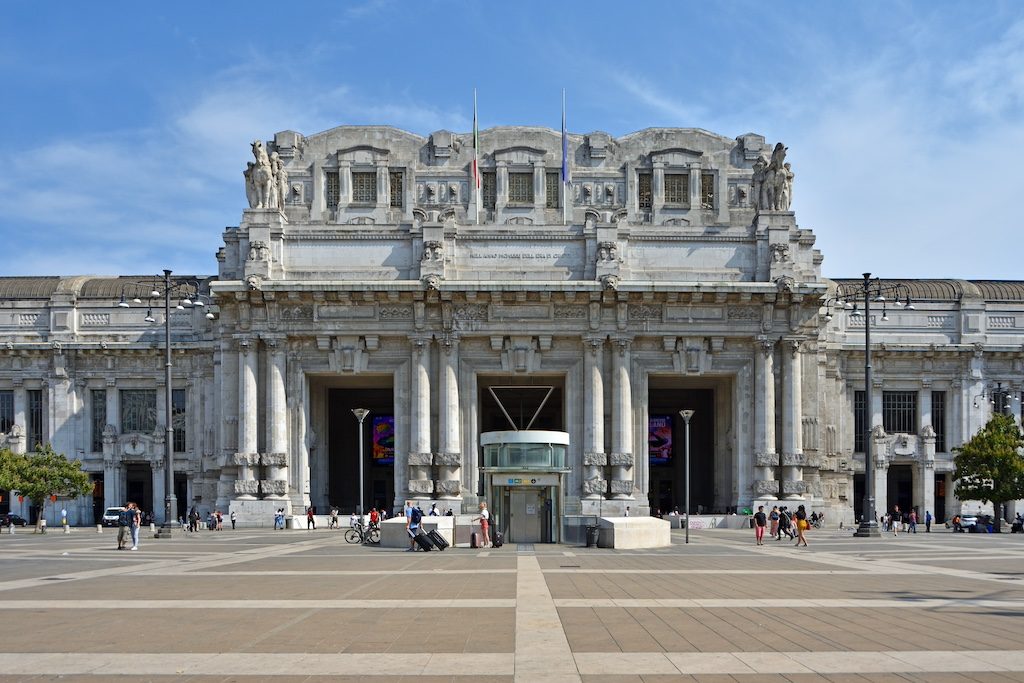
Most visitors arrive in Milan expecting haute couture, gallery openings, and the gleam of modern Italian design. When they step off their train at Milano Centrale, that luxury wraps around them immediately. The 1931 masterpiece building by architect Ulisse Stacchini towers overhead, a theatrical mix of Roman columns, Egyptian motifs, Art Deco curves, and Liberty flourishes. It's the kind of architecture that announces: you have arrived somewhere important.
But there's a conversation this building refuses to have with most visitors. Beneath the polished floors and echoing announcement halls runs a second story, one hidden from public view. In the 1930s, when fascism was tightening its grip on Italy, architects built an ingenious mail operation deep below the passenger platforms. Two cargo platforms sat at ground level where postal workers loaded mail into special carriages. Hydraulic lifts then hoisted these carriages up to the main departure levels, keeping the dirty work of logistics completely invisible to traveling gentlemen and women heading to their trains.
When Nazi Germany occupied Italy in 1943, that hidden infrastructure became something far more sinister. Binario 21 (Platform 21) stopped being a mail room. It became a processing center for human beings destined for death.
The dark function that stayed invisible
Researchers from CDEC (Fondazione Centro Di Documentazione Ebraica Contemporanea), a modern Jewish history foundation, didn't discover what happened at Binario 21 until 1994. Working through historical documents and survivor testimony, they pieced together a brutal picture. At night, trucks arrived with Jewish deportees, political prisoners, and opponents of fascism. Men, women, and children were crammed into the shuttered mail carriages, so packed there was no room to sit. There were no bathrooms. Journeys stretched over 1,000 kilometers to Auschwitz in Poland or Mauthausen in Austria. At least 20 convoys departed from that basement platform.
Of the roughly 44,500 Jews living in Italy at the time, at least 7,680 were murdered in the Holocaust, according to Yad Vashem. Many passed through Binario 21 on their last day in their own country.
The most devastating part? The postal workers, the rail staff, the commuters passing through Milano Centrale every single day, none of them spoke up. They continued their routines. They loaded mail. They caught trains. They went home. The machinery of mass deportation hummed quietly beneath their feet, and Europe's economic capital chose not to look down.
A memorial emerging from darkness
Today, Binario 21 is open to the public as the Fondazione Memoriale della Shoah di Milano (Milan Holocaust Memorial). When you descend into that basement space, you're walking into a museum of conscience. Projections display the names of hundreds of deportees whose identities survived the war's erasure. Two original cargo carriages sit in the space, their doors open, inviting visitors to understand the literal dimensions of that suffocation. Artwork lines the walls, installations that force the viewer to confront how ordinary people did nothing while the extraordinary horror unfolded.
Saverio Colacicco, an outreach coordinator at the memorial, describes its importance beyond its historical role: "This is the chance to think of our own past, that of the Italian people, which we have partly forgotten and partly erased after 80 years. Italians haven't fully taken responsibility. But the fact that this happened in the economic capital of our country is significant. This was done by Italians, and the responsibility is ours. It's important to know that in the belly of the station you use every day, this space exists."
Martin Westlake, an Italian history expert, sees the platform as a perfect metaphor for fascism itself: the bombastic exterior promising grandeur and order, hiding something increasingly dark and sinister within. Much like how entire stories hide beneath cities we think we know, Milan's gleaming surface concealed depths of tragedy.
When you visit Milano Centrale today, you're standing in a building that witnessed both human cruelty and human indifference on an industrial scale. The memorial is small, sometimes easy to miss, which might be intentional. It's in the basement, after all. But that's precisely why it matters. Visitors have to choose to descend, to enter that darkness. In doing so, they're doing something the thousands of people who passed through that station in 1943 and 1944 did not: they're looking directly at what happened, refusing to turn away.