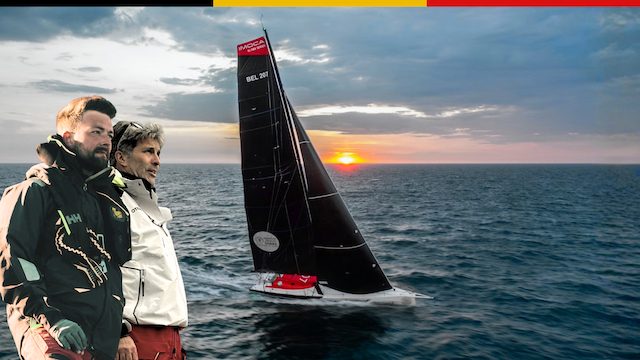
Quentin Debois has a specific dream. The 38-year-old sailor from Marchin holds the record for the fastest solo Atlantic crossing by a Belgian, but that's just his opening act. Come November 2028, he wants to pilot a boat 40 feet long around the entire planet, alone, without stopping, and without assistance. He wants to do it in front of the whole world. He wants to fly the Belgian flag.
This isn't hyperbole. The Vendée Globe is the Everest of sailing. Crews battle through the Southern Ocean's killer waves, face wind that could shred metal, and spend months isolated from civilization. Of the thousands who dream about it, only 130 have actually finished. Most don't even try.
Debois isn't going this alone. His partner is Denis Van Weynbergh, a sailor who already owns a place in sailing history as the first Belgian to complete the Vendée Globe. Now Van Weynbergh is stepping into a different role: team manager and co-skipper during the qualifying races that will happen in 2027. The two men are using their combined firepower to make Belgium a permanent fixture in this monumental race.
From Ambition to Action
Both sailors come from unconventional backgrounds. They're entrepreneurs who abandoned corporate life to chase open water. That shared restlessness is what binds them. Debois started ocean racing just two years ago, in 2022, yet he's already posted records that would take most sailors a lifetime to achieve. His Atlantic time trials (east-west last January, west-east this summer) are stepping stones toward something bigger.
"Flying the flag for Belgium" isn't just nationalist pride for Debois. It's a mission statement. His record attempts explicitly carried that weight. The Vendée Globe is the logical summit of that push. As he puts it, the race is part of an ongoing journey, not a standalone goal.
The qualification process is brutally competitive. Debois needs to finish in the top 37 of the championship to earn his spot. Only 40 monohulls (IMOCA boats, each about 60 feet long) get to start the race itself. The field is packed with seasoned pros, wealthy sponsors, and crews that have trained for years. Belgium's second-ever entry will face an ocean of rivals.
Building the Team and Finding the Money
Here's the catch: by the end of 2026, Debois and Van Weynbergh must secure partners. Money talks in ocean racing. An IMOCA is three times bigger and faster than the Mini 6.50 boats Debois currently races, which means technical expertise, sponsorship, and logistics become exponentially more complex. Van Weynbergh's role includes coordinating that machinery. The team will expand to include three technical preparers who'll work alongside the crew Debois has already assembled for his Atlantic attempts.
Van Weynbergh sees this partnership as the next chapter in Belgium's sailing story. "I've shown that it's possible," he told supporters. "Now I want to encourage other Belgian skippers." His vision extends beyond one race. He wants to establish a tradition where Belgium competes in every Vendée Globe edition, creating a pipeline of talent and ambition rather than one-off heroics.
That's the real gamble here. Hosting one competitor is impressive. Building a culture of world-class offshore racing is something else entirely. It requires sustained investment, mentorship, and a nation willing to back its sailors when the odds are long and the prizes are measured in glory rather than cash.
The Route and the Reality
The race kicks off from Les Sables d'Olonne in late 2028, and Debois has set a concrete target: finish in under 100 days. That's ambitious but not impossible. The best skippers circle the world in 80 days. Debois has youth, hunger, and Van Weynbergh's experience in his corner. The route takes sailors down the Atlantic, around Cape Horn, across the Indian and Pacific Oceans, and back up through the Atlantic. It's the longest solo race in sports, period.
Between now and November 2028, Debois will need to rack up serious boat time in an IMOCA, master the quirks of that machine, and sharpen his skills alongside Van Weynbergh in the double-handed qualifying races. The learning curve is steep, but the window is real.
Belgium's sailing community isn't huge compared to countries like France or the UK. That makes this push more remarkable. One person breaking an Atlantic record catches attention. Two people building a sustainable challenge for the Vendée Globe builds something resembling a movement. Whether they can secure the funding, find the right boat, and execute flawlessly under pressure remains to be seen. But the ambition is already real, and that counts for something when you're chasing history on the open ocean.