That feeling you get when you settle into your theater seat and realize you're in for the long haul? Totally justified. Movie enthusiasts have suspected for years that films are stretching longer, and now the data backs them up.
Film analyst Stephen Follows decided to put the theory to the test. He spent time analyzing the running times of 36,431 movies to figure out whether Hollywood really has been padding runtimes. The answer turned out to be more nuanced than a simple yes or no.
The Numbers Tell a Surprise Story
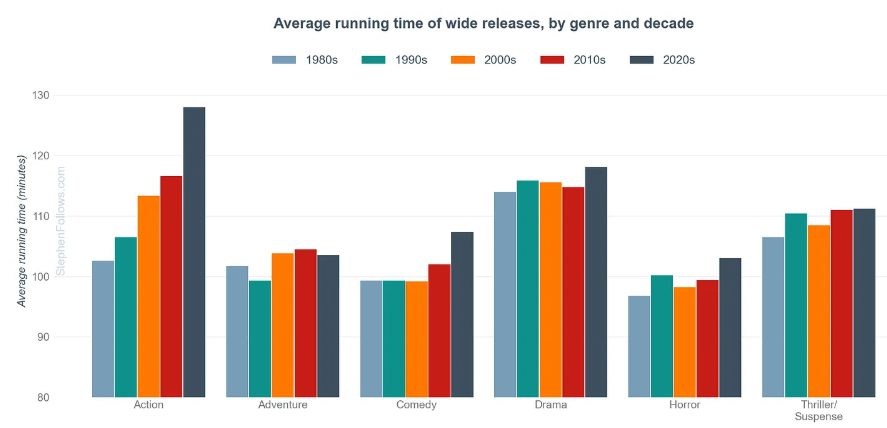
When Follows looked at all movies produced worldwide since 1980, the picture stayed remarkably stable. Average film length bounced around between 100 and 103 minutes year after year. Nothing to see here, right? But zoom in on theatrical releases (the big-budget films that open in hundreds or thousands of cinemas across North America), and the story changes dramatically.
In the early 2000s, wide releases averaged 106 minutes. Fast forward to the 2020s, and that number has climbed to 114 minutes. That's a meaningful jump. More telling still: around 14 percent of wide releases exceeded two hours back in the 1980s. Today, nearly a third do. Meanwhile, films running under 90 minutes have become endangered species, shrinking from 13 percent in the 1980s to just 7 percent now.
As Follows explained in his analysis, the shift isn't just outliers skewing the average. The entire distribution has moved upward. The 105-to-119-minute window is now the sweet spot for wide releases, and crossing the two-hour threshold no longer feels like a bold creative choice.
Action Movies Are the Culprit
If you want to blame someone for those sore theater seats, look to the action genre. Back in the 1980s, action films ran about 103 minutes on average. Today they stretch to 128 minutes. That's a 25-minute cushion added to what was already a solid chunk of entertainment.
Recent blockbusters show how extreme things have become. The Batman clocked in at 175 minutes. Oppenheimer sat audiences down for 180 minutes. Avatar: The Way of Water demanded 190. Killers of the Flower Moon stretched to 206, and The Brutalist pushed beyond 215 minutes. These aren't experimental art films screening at midnight in arthouse cinemas. These are tentpole releases that studios poured $200 million into and pushed toward mainstream audiences.
Why Studios Are Betting on Length
The logic from the studio perspective is straightforward. When you've invested that much money into a film, you want audiences to feel they received something substantial for their premium-priced ticket. Cutting 20 minutes might tighten the narrative, but it doesn't signal "event movie" the same way a three-hour runtime does. Longer feels bigger, and bigger feels worth the ticket price.
But other forces are at play too. Digital projection eliminated the need to swap out physical film reels, which means runtime limitations disappeared. Streaming services have likely gobbled up the market for shorter films, leaving theatrical chains focused on spectacles. The theater becomes less about grabbing a quick escape and more about committing to an experience.
Whether that's good news for audiences depends on your tolerance for marathon storytelling. If you're planning a movie night during your next trip somewhere, maybe budget an extra hour. And if you're someone who prefers the occasional quick cinematic break during travels (much like a shorter travel day), you might need to be selective about what you choose.