For nearly 50 years, France has sat unchallenged at the peak of global tourism. It welcomed 102 million visitors in 2025 alone. But the throne is wobbling.
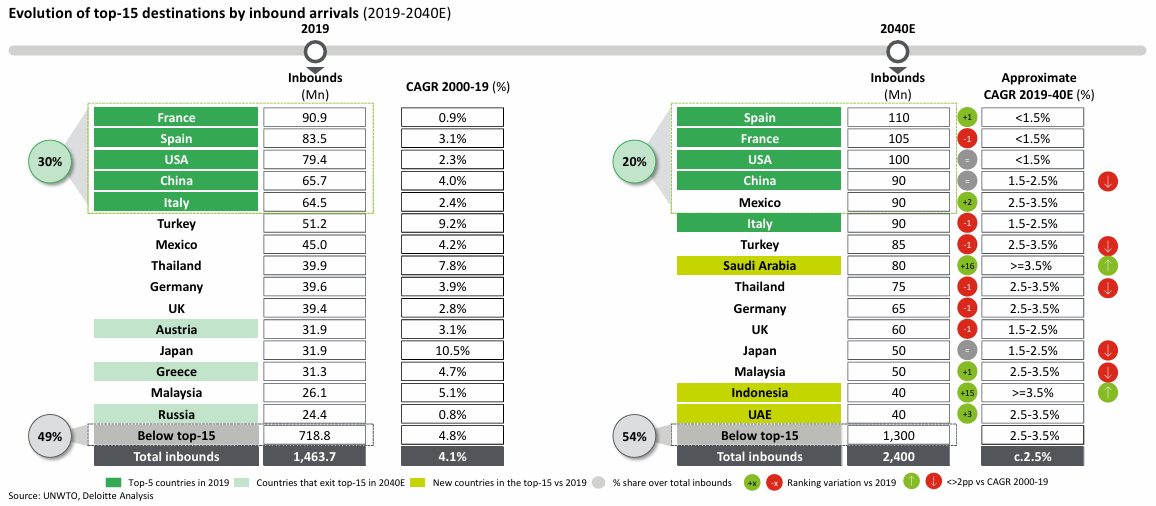
A major research collaboration between Deloitte and Google forecasts that Spain will overtake France by 2040, capturing roughly 110 million annual visitors compared to France's projected 105 million. On the surface, that 5-million-visitor gap sounds modest. But the real story is larger: the age of a handful of tourism superpowers is ending. The tourism map of the future will be radically different.
Spain's rise matters because it reveals something critical about how travel is changing. The country already welcomed 96.8 million international visitors in 2025, up 3.2% from the previous year. If current momentum holds, Spain could breach the symbolic 100-million-visitor threshold in 2026. That would put the country within just 10 million visitors of what analysts expect it to achieve by 2040.
What makes Spain's trajectory even more remarkable is how it's earning money. While Spain received fewer visitors than France in 2025, it generated €134.7 billion in tourism revenue versus France's €77.5 billion. International travelers stay longer in Spain, boosting spending across hotels, restaurants, and attractions. This raises a provocative question: What matters more, the headcount at the border or the economic value each visitor creates?
The global tourism boom reshaping the world
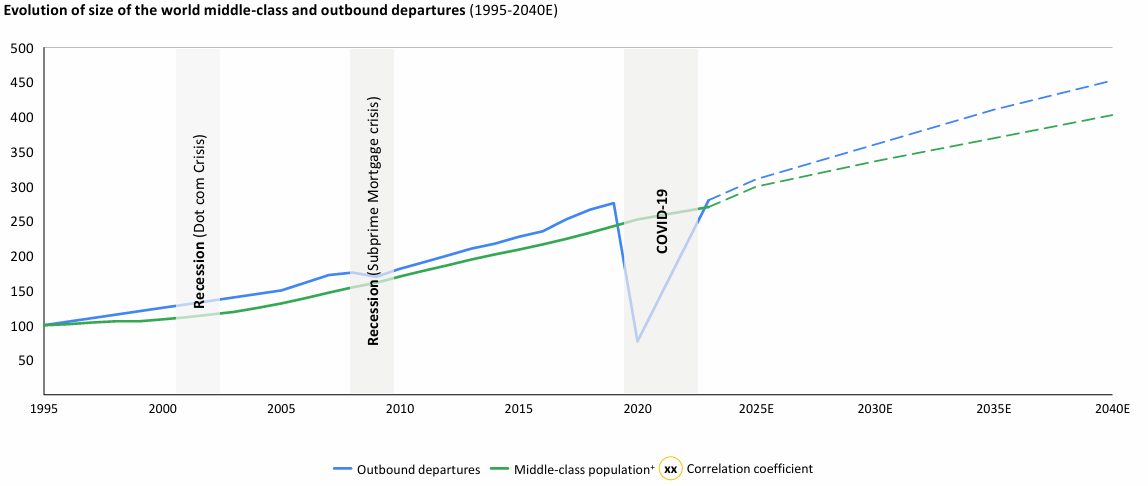
Between 1975 and 2019, international travel roughly doubled every 15 years, reaching nearly 1.5 billion trips before the pandemic hit pause. The long-term trajectory is clear: by 2040, the world will see roughly 2.4 billion international trips annually. That's not a small shift. That's transformational.
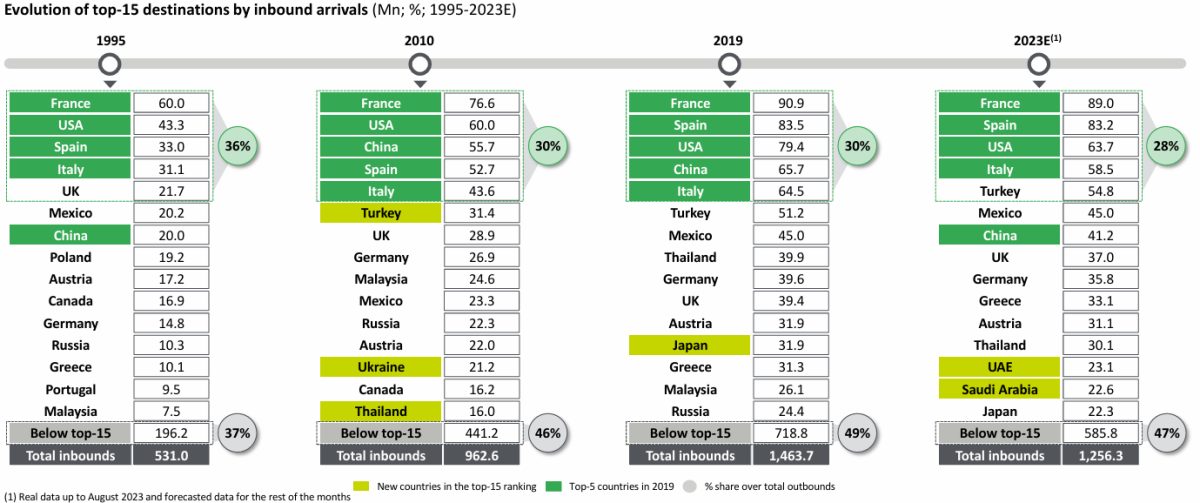
The competition for those travelers is intensifying. Europe will capture 38% of the growth, adding more than 362 million new arrivals. Asia-Pacific follows with 278 million additional visitors. But here's the twist: the top five destinations currently account for about 30% of all global arrivals. By 2040, that share is expected to drop to just 20%. Spain, France, the United States, and China will likely hold their top positions, but Mexico is projected to jump into fifth place, bumping Italy to sixth. Emerging powerhouses like Saudi Arabia, Indonesia, and the UAE could crack the top 15.
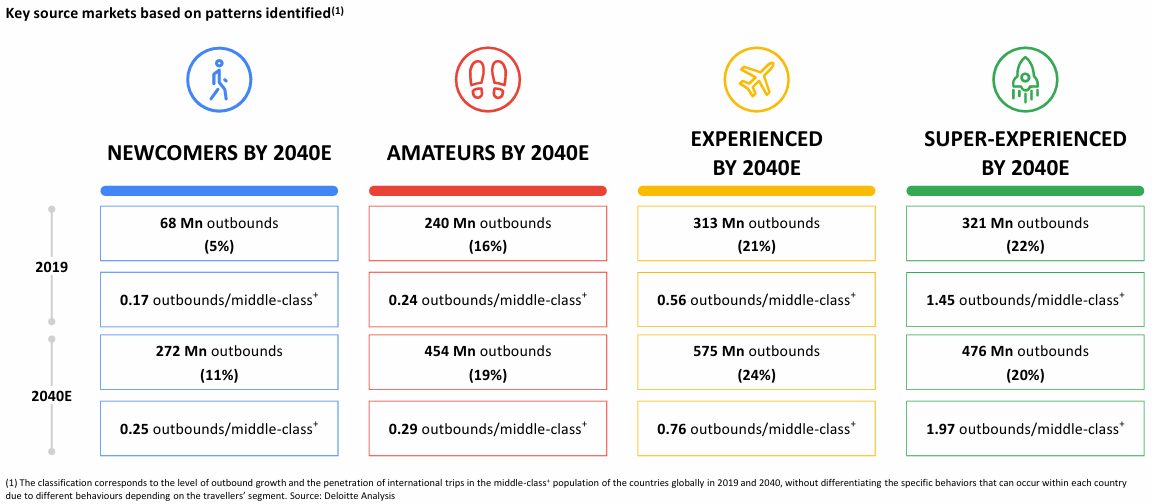
The future of travel belongs to regions that haven't yet saturated the global consciousness: the Mediterranean, Southeast Asia, the Caribbean, and the Arabian Peninsula. These areas are expected to welcome nearly 45% of all international travelers by 2040.
Why Spain is winning where France is stabilizing
Spain possesses assets that competitors simply cannot replicate. The country has built one of the world's most sophisticated tourism infrastructures, with excellent aviation connectivity linking it to markets worldwide. Barcelona and Madrid pull serious cultural crowds. The Canary and Balearic Islands offer year-round beach getaways. The Mediterranean coastline, historic inland cities, and increasingly popular rural and nature destinations give travelers genuine variety.
Climate also favors Spain. While seasonal tourism was once concentrated in summer, Spain now attracts visitors shoulder-season travelers in spring, autumn, and increasingly winter. Changing traveler preferences and slightly warmer temperatures are extending the season for beach destinations and outdoor activities.
Meanwhile, France has begun reframing what success looks like. Rather than chasing raw visitor numbers, French tourism authorities are targeting €100 billion in revenue by 2030 while positioning France as a sustainable, premium destination. Spain is following a similar playbook. Both countries recognize that mass tourism and environmental sustainability are increasingly at odds. Spain's recent policy shifts reflect this pivot toward more conscious tourism management.
What this shift means for travelers
The broader tourism landscape is becoming less predictable. Travelers who assumed Paris or the French Riviera were the only European destinations worth visiting will need to recalibrate their expectations. Spain's rise isn't just about numbers. It signals that the old hierarchy of tourism prestige is dissolving.
This restructuring extends beyond Spain and France. Recent cultural and sporting moments have triggered genuine shifts in travel patterns, proving that tourism flows respond to far more than just infrastructure and climate. Investment in rail networks, development of new attractions, and changing global wealth distribution are all reshaping where people choose to go.
France's achievement in maintaining its position shouldn't be underestimated. Sustaining 100+ million visitors annually is an extraordinary feat. But the fact that another European nation is poised to eclipse it within 15 years reveals something important: tourism is democratizing. No single destination can rest on its reputation anymore. The travelers of 2040 will have more options than ever before, and they'll distribute themselves across a much wider range of places than their predecessors did.