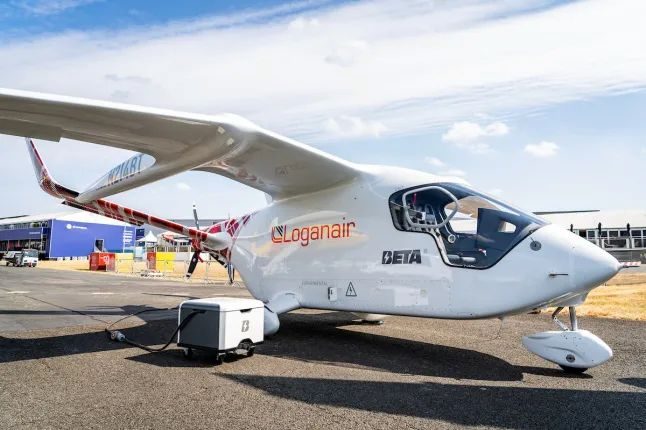
Here's something that felt impossible five years ago: a European airline is about to start flying all-electric passenger planes on regular routes. Loganair, the UK's largest regional carrier, has just ordered at least five BETA Alia CX300 aircraft, making it the first commercial airline on the continent to do so. The first jets should enter service by 2029.
This isn't some distant dream or prototype announcement. Loganair already tested the CX300 this year, flying demonstration routes across Scotland in March with partner BETA Technologies. They covered the Glasgow-to-Dundee corridor and looped through Aberdeen, Inverness, Orkney, and Wick. The airline saw exactly what it needed to see: a plane that works.
Why this matters for regional travel
Most of Loganair's flights cover distances around 100 miles (160 kilometers). The CX300 can handle roughly 390 miles (622 kilometers) on a single charge, which means these routes are a textbook fit. But range alone doesn't tell the story. The plane recharges in just 20 to 40 minutes, keeping the airline's schedule tight and its promises to remote communities intact. "Reliable regional connectivity" sounds dry on paper, but for people on Scottish islands and highlands who rely on these flights, it's everything.
The economics are hard to ignore too. With fuel prices volatile and airlines ordering new fleets worldwide, the CX300 could slash Loganair's operating costs by up to 80 percent. Electric planes simply cost less to run. No jet fuel, minimal maintenance, and a radically simpler engine than anything with turbines.
The bigger picture for aviation
Loganair's bet reflects a larger shift underway. The BETA CX300 competes with workhorses like the Cessna Caravan. It has slightly less interior volume but operates at a fraction of the cost. Other manufacturers are racing to catch up. Sweden's Heart Aerospace is developing a hybrid-electric model called the ES-30. Eviation's Alice is chasing funding. The Pipistrel Velis Electro, which launched in 2020, proved that electric propulsion could be certified and built at scale. Aviation is changing faster than most people realize.
For travelers, this transition will start small and quiet. Regional routes connecting smaller cities and remote areas will go electric first. These aren't the transcontinental flights that dominate headlines, but they're the backbone of how millions of Europeans move between towns and islands. Short-haul routes and freight runs are where electric aviation will prove itself before expanding further.
What you need to know
If you regularly fly from Scotland's major hubs, don't expect your next trip to suddenly go silent. Loganair's existing fleet will stay operational, and the new CX300s will integrate gradually into the schedule. But starting in 2029, booking a flight on certain Scottish routes could come with a benefit most passengers rarely consider: zero direct emissions. The plane uses existing runways, fits into current airports, and works within the infrastructure that already exists.
BETA Technologies claims the aircraft met "high standards" by flying over 1,000 nautical miles across Loganair's real routes and real conditions. That's the kind of proof that matters in aviation. Simulators and test flights only go so far. You have to fly the actual routes, in actual weather, with actual passengers counting on you.
The deal was sealed in July at the Farnborough Airshow, where aviation's biggest players gather to announce orders and partnerships. Loganair's commitment to five aircraft (with options for more) sends a signal that the technology has moved past the hype phase. Other airlines will be watching. If Loganair proves the model works in one of Europe's most demanding aviation markets, someone else will follow.
For now, Scotland's highlands and islands will become the testing ground for commercial electric aviation in Europe. It's fitting, in a way. These remote regions pushed Loganair to innovate in the first place. They're doing it again.