Artificial intelligence is everywhere these days, and travel is no exception. But a fresh survey suggests that when it comes to handing over the reins, travelers have clear boundaries. They are happy to let AI watch the numbers, but they want to keep the joy of planning for themselves.
The survey, conducted in July by hospitality tech company Mews, polled 3,250 travelers across France, Germany, Italy, the Netherlands, Spain, Sweden, the UK, and the US. The results paint a picture of a tech-savvy traveler who values convenience without sacrificing control. 63% would use AI to monitor hotel room rates for price drops, and 56% would rely on it for real-time translations. But when it comes to the creative side of travel, enthusiasm drops. Only 44% would use AI to plan their itineraries, and just 41% would let it personalize their hotel rooms.
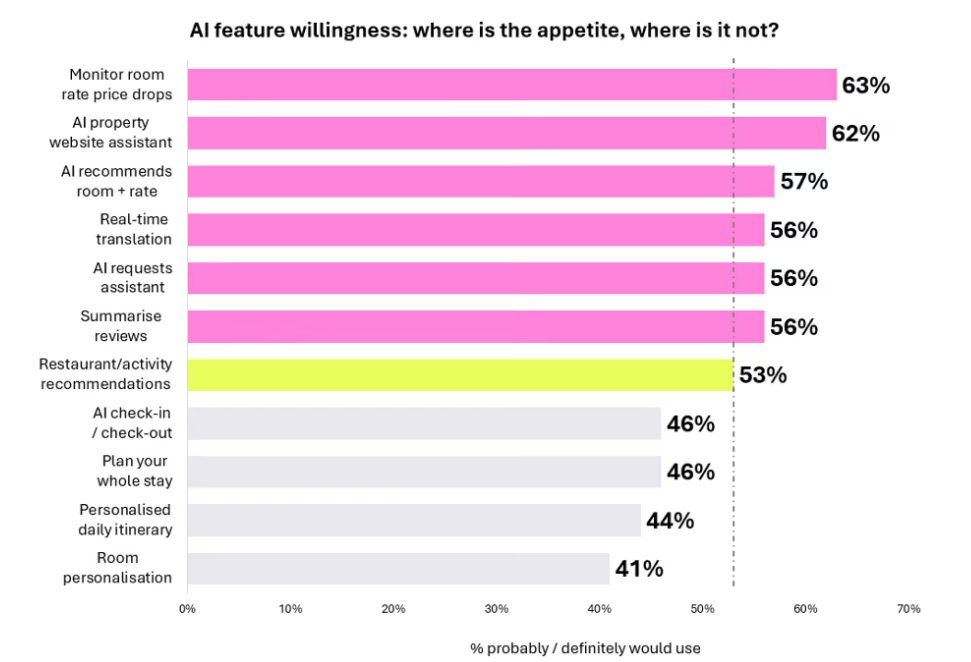
The pattern is clear. Travelers are comfortable delegating tasks that are repetitive or require little human touch. Recommending room rates (57%) and summarizing reviews (56%) get a thumbs up. Even AI-suggested restaurants and activities earn 53% approval. But the numbers fall when AI moves into more personal territory. Only 46% want it for check-in or check-out, and the same percentage for planning their entire stay. It seems the magic of discovery is something travelers want to keep for themselves.
There is also a comfort level with data. Travelers are more at ease with AI recommendations based on what they have willingly shared, like stated preferences (61%) or previous hotel stays (56%). They are less comfortable with AI using their online behavior (43%) or external sources like social media (34%). Americans are the most relaxed about AI using their past stays, with 63% on board.
This research adds a new layer to earlier findings. A report from August showed that 54% of US travelers had already used AI to plan a trip, and 75% intended to do so in the future. But this latest survey suggests that using AI for planning does not mean letting it make the decisions. It is a tool, not a replacement for the traveler's own instincts.
Regional differences add more texture. Spaniards care deeply about transparency, with 72% saying they would be more willing to use AI if they had greater control over their personal data. Italians and Spaniards are the most enthusiastic overall, with 58% of Italians expecting hotels to offer digital check-ins. The British are the most hesitant about personalization during their stays, with only 30% considering it important, compared to a 40% average across all countries.
For hoteliers, the message is reassuring. AI can handle the mundane, freeing up staff for the human touches that matter. As Josef Starýchfojtů, Mews CPTO, put it, "Having clever technology is great, but firstly, we should know whether guests want a task done for them or want to be part of it. Get that wrong and even good AI feels intrusive." The goal is to use technology to handle the routine admin, so hotel teams have more time for their guests.
So what does this mean for your next trip? Maybe let AI track the price of that dream hotel room, but keep the itinerary planning for yourself. After all, half the fun is in the dreaming. And if you are looking for inspiration, check out how Zagreb's tourism conference asks who really decides where you travel or what 192 safari guides really think about your country's travelers. For more on how travel is changing, see what nearly 30 million travelers picking Portugal really means.