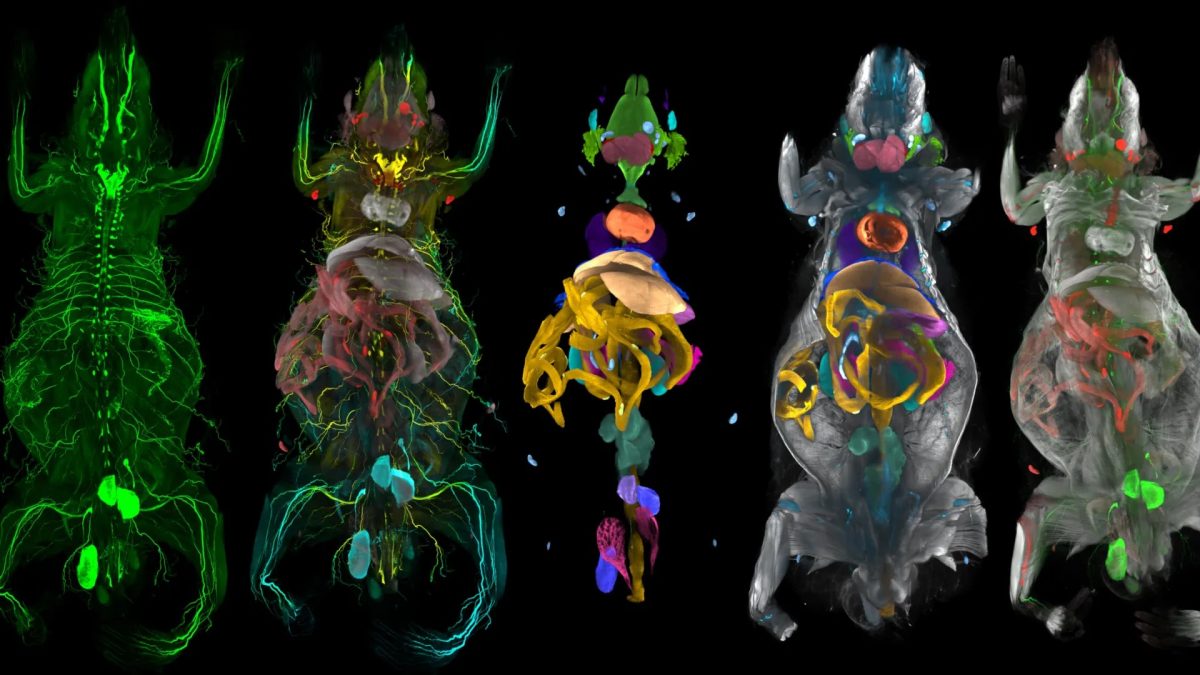
Imagine if you could see inside your own body with perfect clarity, down to individual cells, and watch how a single condition ripples across every system at once. That's what researchers at Helmholtz Munich and Ludwig Maximilian University just accomplished, and the results are forcing a rethink of what we thought we knew about obesity.
A team of scientists has created MouseMapper, an AI platform that generates detailed three-dimensional maps of an entire organism at cellular resolution. The team trained it by taking mice, labeling their nerves and immune cells with fluorescent markers, then rendering their tissues optically transparent while keeping cellular structures intact. Using advanced microscopy, they generated 3D scans containing tens of millions of cellular data points. MouseMapper then did what brains struggle with: it analyzed the whole picture at once, identifying 31 different organs and tissue types while simultaneously mapping immune cells and nerves across the entire body.
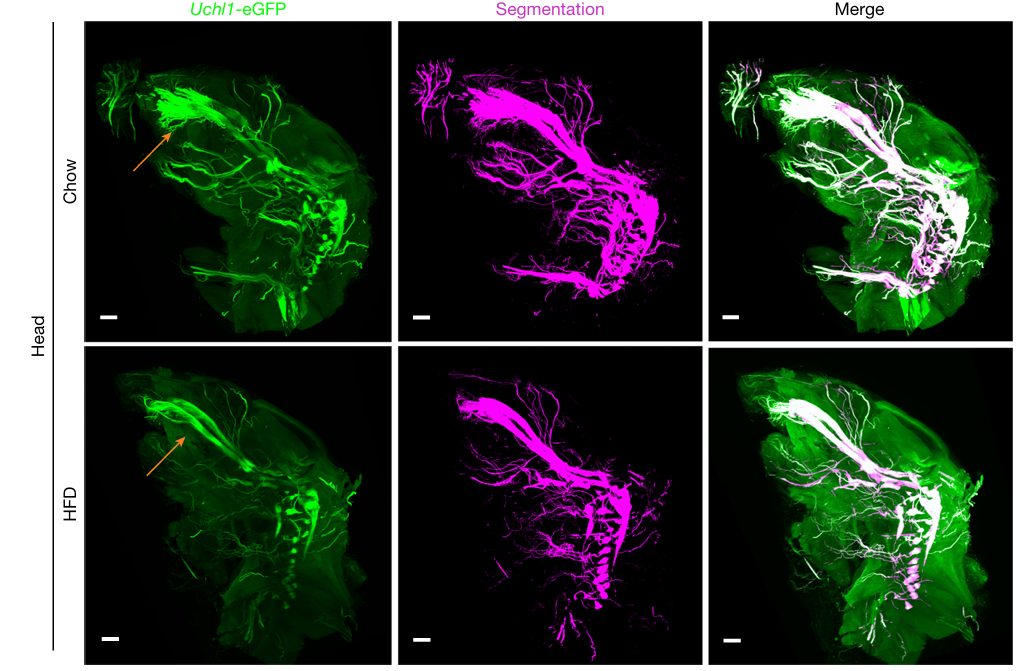
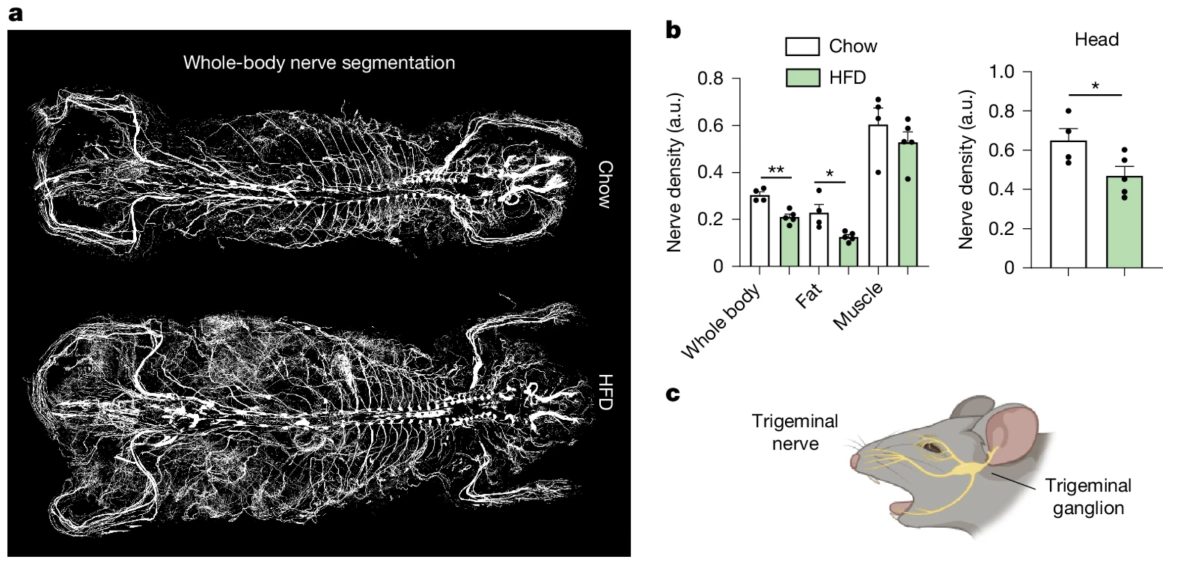
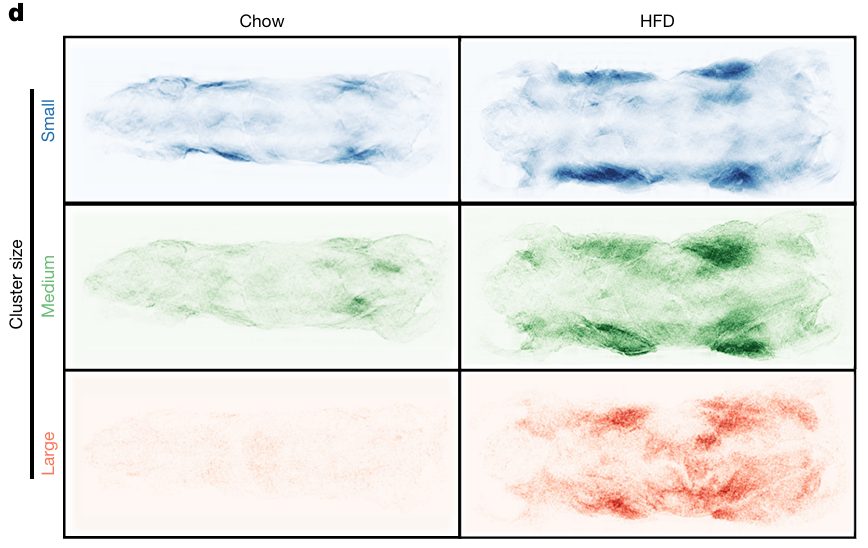
What they discovered challenges the organ-by-organ approach that's dominated medical research for decades. When they applied this technology to obese mice, the AI revealed widespread inflammation across fat, muscle, and liver tissue. But one finding stood out: obese mice had significantly fewer nerve endings and branches in their trigeminal nerve, a major facial nerve responsible for sensation. Behavioral tests confirmed it. The obese mice simply didn't respond as strongly to touch and sensory stimulation as their lean counterparts.
The trigeminal nerve discovery matters because researchers found the same molecular changes in human tissue samples from people with obesity. This wasn't a mouse-specific quirk. It was a genuine biological signature that appears to translate across species. The research, published in Nature, presents what lead researcher Doris Kaltenecker calls a finding that "simply cannot emerge from studying one organ at a time."
What makes this breakthrough genuinely transformative is the shift in perspective. For years, scientists studied obesity's impact on the heart, then the liver, then the pancreas, treating each organ as an isolated problem. MouseMapper forces a different question: what if obesity isn't a collection of separate diseases hitting different parts of your body, but a cascading system-wide disruption? That reframing opens entirely new research pathways for diabetes, cancer, neurodegenerative diseases, and autoimmune conditions.
The team's long-term ambition reaches into science fiction territory. They want to build digital twins of organisms, detailed enough to simulate disease progression and test treatments computationally before touching a single lab animal. Imagine running thousands of drug experiments in a simulation before running a single physical trial. It could accelerate discovery while reducing reliance on animal testing altogether.
The researchers have made all their whole-body datasets publicly available online, which means scientists across the globe can now pick through this cellular atlas and ask their own questions about how weight reshapes tissue systems. It's the kind of collaborative science that moves fast.
For anyone thinking about health, diet, and travel, this research lands differently than typical "obesity causes health problems" warnings. It reveals that the impact is far stranger and more complex than we assumed, affecting nerves we didn't know cared about our weight, in ways we couldn't measure before. The body is messier and more interconnected than we give it credit for. That's both humbling and, somehow, fascinating.