When Tadeusz Gołębiewski laid the foundation stone for his Baltic vision in 2018, few people imagined what would emerge from the pine forests of northwestern Poland. The man who once sold wafer rolls had bigger dreams. In June 2022, he died, never seeing his most ambitious project reach completion. But on June 10, the Gołębiewski Pobierowo opened its doors anyway, and it arrived with the kind of fanfare that shakes entire regions.
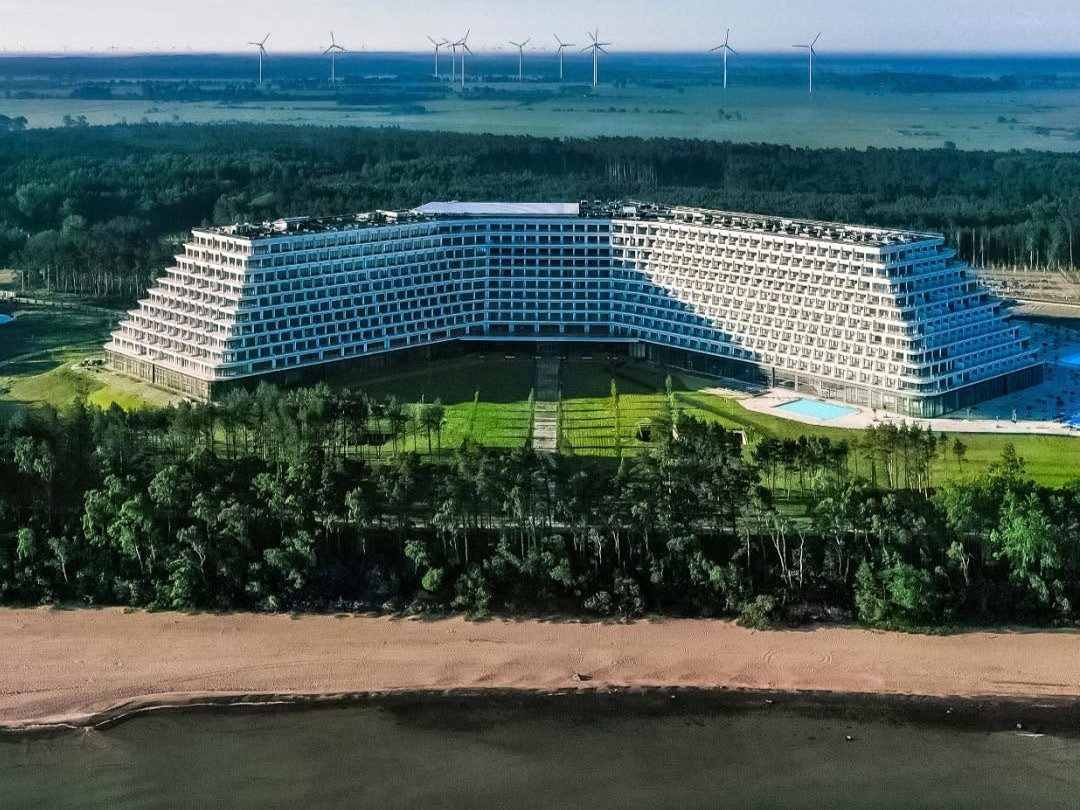
The resort sprawls across 180,000 square metres on a former military site in Pobierowo, a sleepy seaside town of roughly 1,000 people. Just 150 metres from the Baltic shoreline, this 13-floor complex offers 1,240 rooms, making it the largest hotel on the entire Baltic coast. Within the first 24 hours of opening reservations, the hotel logged over 2,000 bookings. The demand was so fierce that the opening was pushed up by two weeks.
What exactly did those early bookers get? Rooms starting around 350 euros per night, with suites climbing to 900 euros. Each unit spans about 50 square metres, and many include balconies facing the sea. But the real draw extends far beyond the bedrooms. There's a 104-by-60-metre outdoor pool, the Tropikana water park with indoor pools and whirlpools, an 11-room spa complete with salt and ice caves, a cinema, bowling alley, nightclub, and a pianist performing live in the lobby.
The Controversy Nobody's Ignoring
Here's where things get interesting. German newspapers didn't hold back. Sueddeutsche Zeitung called it "the largest and perhaps the ugliest hotel on the Baltic coast," comparing the structure to a cruise ship that ran aground. The publication even drew a historical parallel to Prora, the massive Nazi-era complex built on the German coast, never opened to the public. Others dubbed it "Little Dubai," meant as criticism rather than compliment.
The resort cost nearly 1,500 trees and rose from what was once forest. For many Poles, its concrete towers recall the brutalist apartment blocks of the communist era. The municipality of Rewal sold the land in 2017 for approximately 11.8 million euros, and construction battles dragged on for eight years, delayed by permits, the pandemic, and construction disputes.
But hotel director Barbara Garczyńska chose to embrace rather than dodge the comparisons. "I understand the scale evokes associations," she told local media. "But if we are to be like Dubai, a place full of amenities and luxury, then so be it. If guests choose to relax on the Polish Baltic instead of travelling to the other end of the world, that will be our greatest satisfaction."
A New Kind of Tourist Competition
Tourism operators across the German border in Mecklenburg-Vorpommern are watching nervously. Their largest Baltic hotels hold fewer than 500 rooms each. Just 60 kilometres away from German territory, the Gołębiewski could fundamentally reshape where European beach vacationers spend their money and time. This hotel is positioned to pull visitors (and spending power) away from established destinations.
The timing matters. Pobierowo sits conveniently between Berlin (a three-hour drive) and the German island of Usedom (30 minutes away). Garczyńska isn't hiding her strategy: she expects steady demand from Germany, Czech Republic, and Poland itself.
Planning Your Visit
Summer on Poland's Baltic coast offers mild temperatures around 22 degrees Celsius and water that reaches 18-20 degrees by peak season. The region is known for iodine-rich sea air, thick pine forests, and endless sandy beaches. Currently, only about 500 of the 1,240 rooms are operational, though more will come online as construction finishes.
The project remains polarizing. Some see a forward-thinking resort bringing world-class amenities to a quiet corner of Europe. Others view it as a cautionary tale of ambition without restraint. What's undeniable is this: a small Polish fishing village has become impossible to ignore, and the map of Baltic tourism just shifted.