The 2026 FIFA World Cup has turned commercial aircraft into something more than transportation. For airlines across Latin America, Europe, Africa, and beyond, this tournament became a canvas for showcasing national identity. From Canada to Mexico to the United States, fleets of planes now carry flags, team crests, player numbers, and slogans that celebrate the world's biggest football competition. Each design tells a story about the country or team it represents.
This creative explosion makes sense given what's at stake. The World Cup is about to flood Canada with travelers (and money), and airlines want to capture that energy. Some of these liveries are temporary stickers slapped onto fuselages weeks before the tournament. Others are permanent paint jobs that will stay on aircraft long after the final whistle blows. Every design choice reflects how deeply football runs through a nation's veins.
Argentina Puts Messi on the Tail
Aerolíneas Argentinas created one of the most instantly recognizable designs of the tournament. An Airbus A330-202 features Lionel Messi's iconic number 10 emblazoned on the tail fin, a direct tribute to the national team captain and Argentina's most celebrated player. The fuselage displays three gold stars, each one representing one of Argentina's World Cup victories. Both engines wear captain's armbands as a football reference. It's a livery that doesn't whisper about national pride; it announces it from 30,000 feet.
North Africa Brings the Foxes
Air Algérie took a different approach with their Airbus A330-941 (7T-VLB). The aircraft features the slogan "One Two Three Viva l'Algérie," a chant synonymous with the national team. The real star of the design is the fennec fox on the tail fin. This isn't just decoration. The fennec is Algeria's national animal and also the nickname of the football team, the Desert Foxes. The livery arrived pre-painted when the aircraft entered service, making every journey to Algiers a statement of identity.
Latin America's Colorful Lineup
Colombia's Avianca airline transported the national team on an Airbus A320-251N featuring the team emblem on the tail. For another match, the squad flew on a Boeing 787-8 Dreamliner operated by the same carrier. Copa Airlines chose a different route to celebrate. They introduced a Boeing 737 MAX 8 with a livery selected through an internal employee competition. The winning design wraps the aircraft in an all-red color scheme with the national team crest on the tail, giving Panamanian workers a tangible connection to their national squad.
Royal Air Maroc sent their Boeing 787-9 Dreamliner across the Atlantic carrying Morocco's national team. The fuselage bears the slogan "Go Lions 2026," a nod to the Atlas Lions nickname that striker Hakim Ziyech and his teammates carry with pride. In the Caribbean, Divi Divi Air designed a special livery for their Twin Otter aircraft supporting Curaçao's national team, highlighting the island's ambitions on the global football stage.
Europe's Tribute to its Teams
Iberia presented a striking Airbus A350-941 featuring the Spanish national team. The aircraft carries stickers of the squad alongside the slogan "Despega un equipo, vuela un país" (A team takes off, a country flies). It's the kind of messaging that transforms a flight from point A to point B into something symbolic. TAP Air Portugal supported their national team with sticker decorations on an Airbus A330-941. Before departure, players gathered for photos in front of the aircraft, and Cristiano Ronaldo shared the images with his millions of followers, turning a simple airline partnership into social media gold.
Global Sponsors Join In
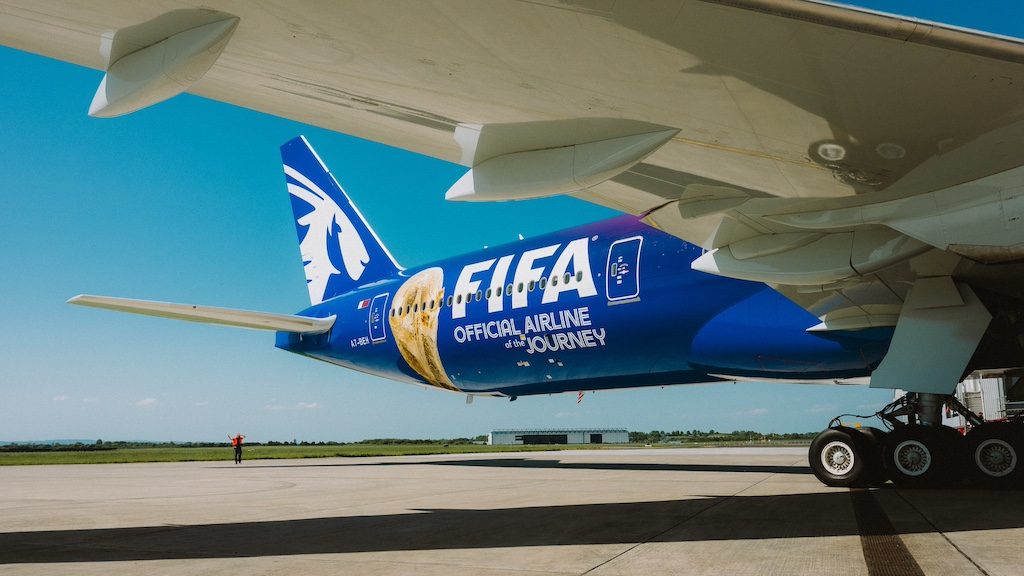
Qatar Airways, already deeply invested in global football sponsorship, unveiled a dedicated World Cup livery applied to a Boeing 777-3DZ(ER). The airline decorated both exterior and cabin elements to reflect the tournament. Unlike some temporary designs, this aircraft is expected to continue flying well after the competition concludes. North America saw a partnership livery as well. American Airlines and Qatar Airways collaborated on a special World Cup-themed Boeing 737-800 unveiled in Miami, blending the resources of two major carriers to create something neither could achieve alone.
These aircraft have become more than metal tubes carrying people from one airport to another. They're flying billboards for national pride, moving galleries celebrating football culture, and tangible proof of how deeply sports shape identity. Whether it's a fennec fox on an Algerian tail fin or Messi's number 10 on an Argentine fuselage, each design whispers (or shouts) a country's love for the beautiful game. When the 2026 World Cup kicks off, these planes will be ready to carry their nations' hopes across continents.