When Spain's captain Rodri Hernandez hoisted the FIFA World Cup Trophy before a roaring stadium in 2024, he became the latest in a long line of champions to claim football's most coveted prize. The 36-centimetre golden monument gleams under stadium lights like few other objects on earth. What most viewers don't know is that this trophy has a hidden creator, an Italian artist whose name deserves far more recognition than it gets.
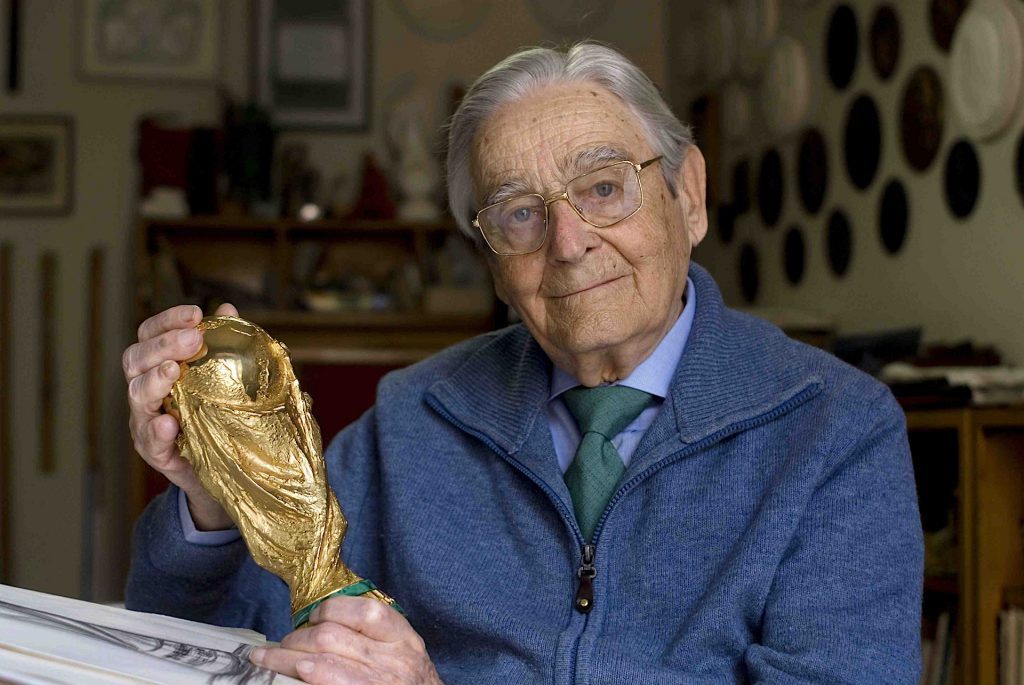
Silvio Gazzaniga, a Milanese sculptor already celebrated for crafting the UEFA Cup and European Super Cup, won an international design competition in 1970 by thinking bigger than his rivals. While 53 other competitors submitted sketches, Gazzaniga arrived with a full-size plaster model. It was a gamble that paid off. The FIFA leadership saw exactly what they needed in three dimensions, and Gazzaniga's vision became immortal.
The Inspiration Behind the Golden Icon
Gazzaniga drew from two powerful sources when conceiving the design. He wanted to merge the image of triumphant athletes with a representation of our world itself. The sculpture shows two stylized footballers lifting the globe together, their bodies flowing upward in a movement that captures victory frozen in metal. The rough texture between the two figures represents the vigour and toughness of football, the sculptor explained, channeling the intensity of competition into form.
His son Giorgio recalls watching his father sketch endlessly in those early days. "He was drawing a huge number of designs and finally developed the idea of having the world with this symbol that looks like two DNA spirals moving upwards," Giorgio remembers. The final trophy weighs just under 6.2 kilograms and is fashioned from 18-carat gold mounted on a base of malachite bands. Every curve serves purpose. Every line speaks.
What Came Before
The World Cup hadn't always looked this way. The original trophy, called the Jules Rimet Trophy after the FIFA president who launched the competition in 1930, was designed by French sculptor Abel Lafleur. It depicted the Greek goddess Nike holding an octagonal cup aloft, crafted from gold-plated sterling silver on a lapis lazuli base. That trophy went to Brazil after their third World Cup victory, but in 1983 it vanished from the Brazilian Football Confederation headquarters. It was never found.
This wasn't the first time the trophy had gone missing. In 1966, while on public display in England, it disappeared again. This time a dog named Pickles found it under a hedge in south London, returning it to the world intact. The Pickles rescue became famous, but the later theft in Brazil shattered the trophy's mystique permanently. FIFA learned a hard lesson about permanence.
A Trophy That Stays
The Brazil theft forced FIFA to completely rethink its approach. Today, when a team wins the World Cup, they celebrate with the original Gazzaniga trophy during the presentation ceremony, but it remains FIFA property. Winners receive a gold-plated replica to take home instead. This arrangement has worked since the early 1980s, protecting the original while allowing champions their moment of glory.
Gazzaniga's studio in Milan still houses his original drawings and the plaster prototype that won the competition. Earlier this year, a commemorative plaque was unveiled there in tribute. The sculptor himself passed away in 2016 at age 95, but his work endures on the world's biggest stage. Every four years, as another captain lifts his creation into the air, Gazzaniga's legacy returns to the center of global football.
"Were I to ever redo it, I wouldn't change a thing," the sculptor once said. FIFA appears to agree completely. The organization has committed to keeping this trophy in use until at least 2038, meaning Gazzaniga's vision will dominate World Cup moments for at least another decade and a half. Not many artists get to see their work become truly timeless.