Every summer brings fresh headlines about tourists behaving badly at the world's most precious landmarks. This season's offender? A woman at Florence's Fountain of Neptune, who allegedly climbed barriers and made her way onto one of the sculpture's marble horses to complete a bachelorette dare. The target of her shenanigans was, well, let's just say the Roman sea-god's anatomy wasn't off-limits in her mind.
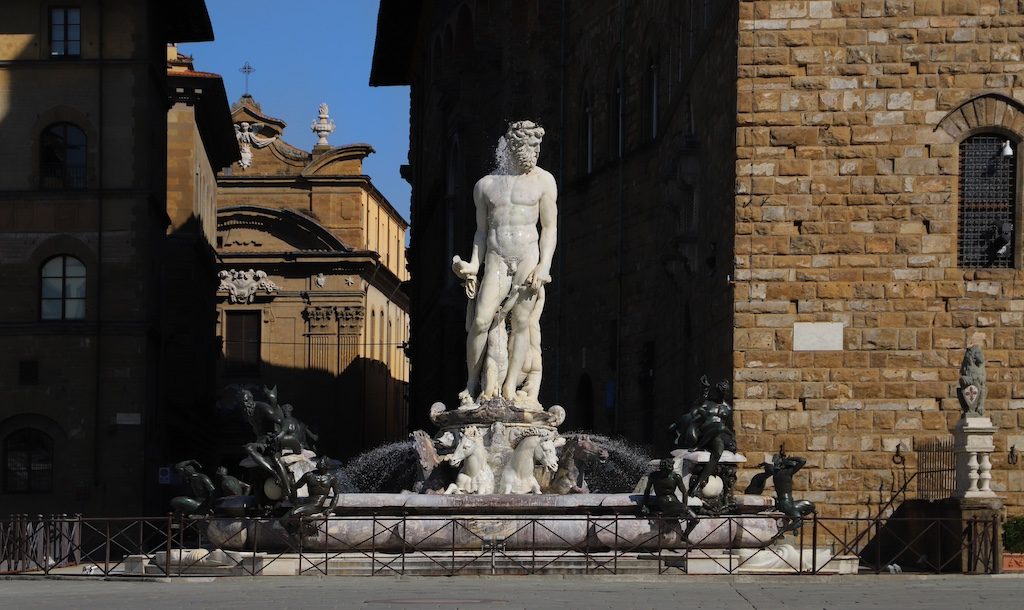
The fountain itself deserves far better. Designed by sculptor Baccio Bandinelli in 1559, it sits proudly in Piazza della Signoria, portraying mythological figures in gleaming white marble. It was commissioned by Cosimo I de Medici, the last Duke of Florence, to celebrate his gift of fresh water to the city. The monument has witnessed centuries of Florentine life and has even been featured in royal celebrations. What it didn't need to witness was someone standing on its edge for an Instagram moment (or a pre-wedding challenge).
The timing makes this incident particularly painful. In 2019, restoration experts spent 1.5 million euros bringing the fountain back to its former glory. That careful work lasted less than seven years. On April 18, 2026, the woman in question scaled the protective railings, climbed onto the horse, and damaged both the sculpture's hooves and a decorative frieze she grabbed while trying not to fall into the water. The good news: experts classified the damage as "minor but significant." The bad news: repairs will still run about 5,000 euros, and the woman now faces charges for defacing Italy's cultural heritage.
A Fountain With a Target on Its Back
This isn't the first time Neptune's statue has suffered at tourist hands. In 2005, another visitor broke off one of the sculpture's hands while scaling it for photos. In 2023, a German tourist damaged it again during a selfie session. During the 16th century, local residents even washed themselves in the water and damaged the railings in the process. In 1848, the fountain took literal fire when cannonballs struck it during political turmoil over Italian unification.
The broader pattern across Europe should worry anyone who cares about cultural preservation. The selfie problem killing wildlife tourism has become a cliche at this point, but it's not confined to nature reserves. Rome's Trevi Fountain was breached in 2023 by a visitor simply wanting to refill a water bottle. That incident prompted authorities to impose a 2-euro entrance fee just to approach the monument. In Venice that same year, passengers refusing to stop taking selfies caused a gondola to capsize. Even mountain rocks aren't safe: in 2024, an ancient stone in the Dolomites was graffitied with an anti-tourism message by someone ironically making the overtourism problem worse.
When the Dream Becomes the Nightmare
Italy's reputation for "la dolce vita" and effortless romance seems to come packaged with a certain expectation from visitors: that the rules don't apply once you're sipping Aperol Spritzers in a piazza. The country regularly dominates headlines not for its art and architecture, but for the ways tourists trash it. Europe's travel comeback is real, but it looks nothing like before, and these incidents reveal what that comeback looks like at ground level.
What's most maddening is that these aren't accidents or misunderstandings. They're dares. They're Instagram opportunities. They're moments prioritized over preservation. The woman at Neptune's fountain knew what she was doing was wrong, which is presumably why she needed a dare to do it. The judicial system will now decide what consequences fit the crime of damaging one of Florence's greatest treasures.
For travelers planning visits to Florence, Rome, Venice, or anywhere else in Italy's crowded cultural centers, the message should be simple: the guardrails exist for a reason. The "no entry" signs protect something irreplaceable. And some moments are better experienced with respect than recorded for social media. The fountains, frescoes, and facades that drew you there in the first place deserve more than a punchline in someone's story.