The world's largest private airport operator felt the squeeze this summer, but a closer look reveals a network that's surprisingly resilient. VINCI Airports, which runs more than 70 airports across 14 countries, welcomed 93.5 million passengers in the third quarter of 2026, a dip of 0.6% compared to the same period last year. The numbers, released this week, show that while geopolitical tensions in Asia and stubbornly high fuel prices took their toll, a surge of travelers in Europe and Latin America nearly balanced the books.
Europe's Summer Surge
Budapest's airport was the star performer, with passenger numbers jumping 12% year-on-year thanks to expanded Wizz Air and Ryanair routes to Southern Europe. Belgrade also flexed its muscles as a regional hub, with strong demand on flights to Western Europe. Edinburgh saw a boost from increased capacity on easyJet, Ryanair, and Jet2, particularly to Mediterranean hotspots. In Portugal, Porto and Faro both posted healthy gains, up 7.1% and 3.7% respectively.
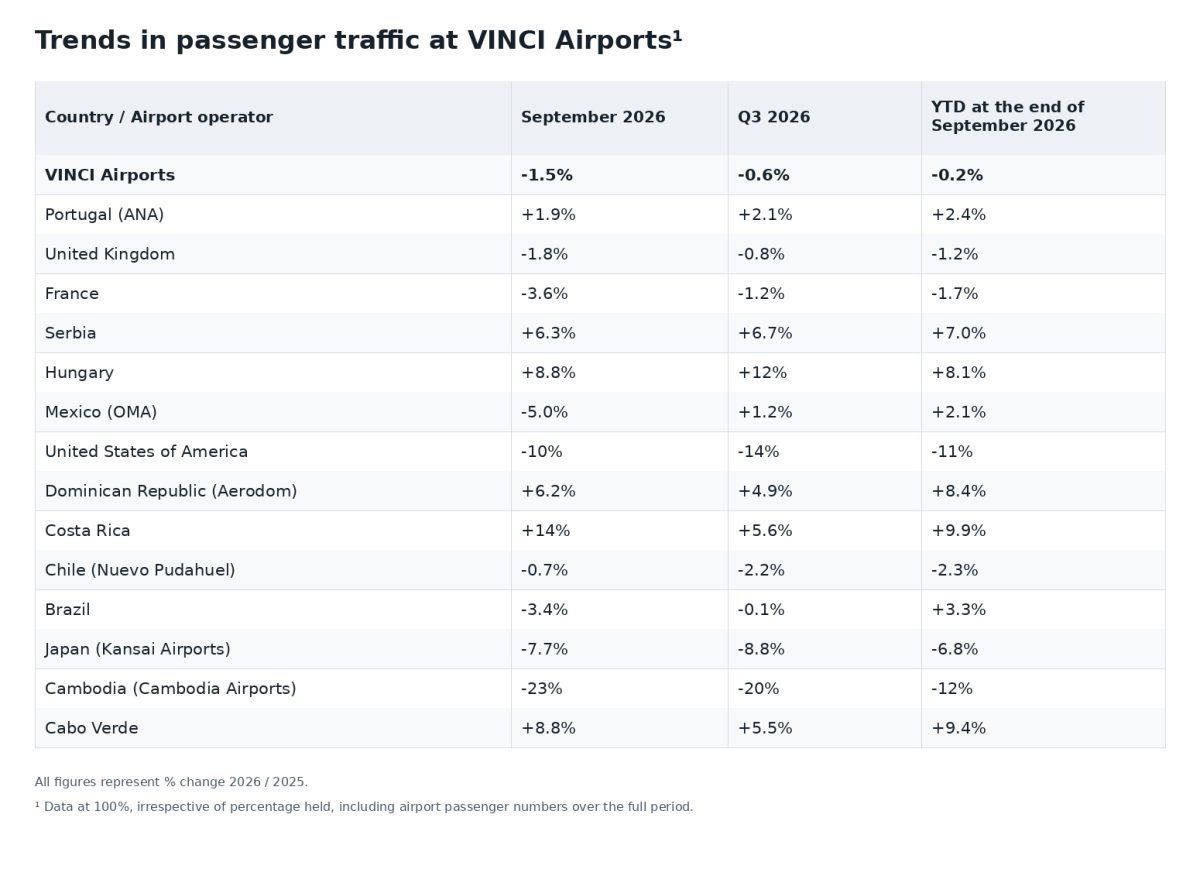
The good news wasn't confined to the mainland. In the Cabo Verde archipelago, new easyJet and TAP connections to Europe drove a notable uptick in arrivals. Across the Atlantic, Mexico's domestic routes kept busy, while Salvador Bahia in Brazil cemented its status as a rising regional hub after GOL invested in more flights. The Dominican Republic also enjoyed a solid summer, fueled by links to Spain, the Caribbean, and Latin America.
Asia's Headwinds
Not every region shared the optimism. In Asia, tensions between China and Japan continued to weigh on Japanese airports in the network, which saw traffic fall 8.8%. Cambodia also struggled, with weaker demand from China and Thailand. The story was similar in Chile, where Santiago Airport faced a contraction due to unfavorable fuel prices and seasonal flight adjustments for the Southern Hemisphere's winter.
London Gatwick, one of VINCI's busiest hubs, saw its decline ease to 2.9%. The airport is still feeling the effects of low-cost carriers restructuring their medium-haul offerings, but strong summer demand, especially to Spain, and five new based aircraft from Jet2 helped soften the blow.
A Network Built to Bounce Back
What stands out in this report is how the company's geographic spread cushioned the shocks. While Asia struggled, Europe and Latin America picked up the slack. That's no accident. VINCI's portfolio spans mature markets and emerging ones, giving it a natural hedge against regional downturns. The company itself points to "the network's sound geographic diversification and its resilience to cyclical shocks."
For travelers, the takeaway is practical. If you're planning a trip to Japan or Cambodia, expect fewer flight options and potentially higher fares as airlines adjust capacity. On the flip side, routes to Budapest, Porto, and the Dominican Republic are booming, which often means more choices and better prices. And with fuel costs still high, it's worth checking if your airline has adjusted schedules for the winter season, as jet fuel prices just forced airlines to rethink their winter schedules.
The broader trend in aviation is toward smarter, more efficient operations. Airports are investing in technology and sustainability, as airports are finally treating sustainability as more than a carbon game. And with record-breaking summers in some regions, the industry is learning to adapt to a world of unpredictable disruptions, from summer travel chaos gripping US airports to geopolitical standoffs.
For now, VINCI's numbers tell a story of resilience. The dip is small, and the underlying momentum in many markets is strong. As the company looks ahead, the question is whether Asia's troubles will ease and whether fuel prices will finally stabilize. Until then, the network's diversity remains its greatest asset.