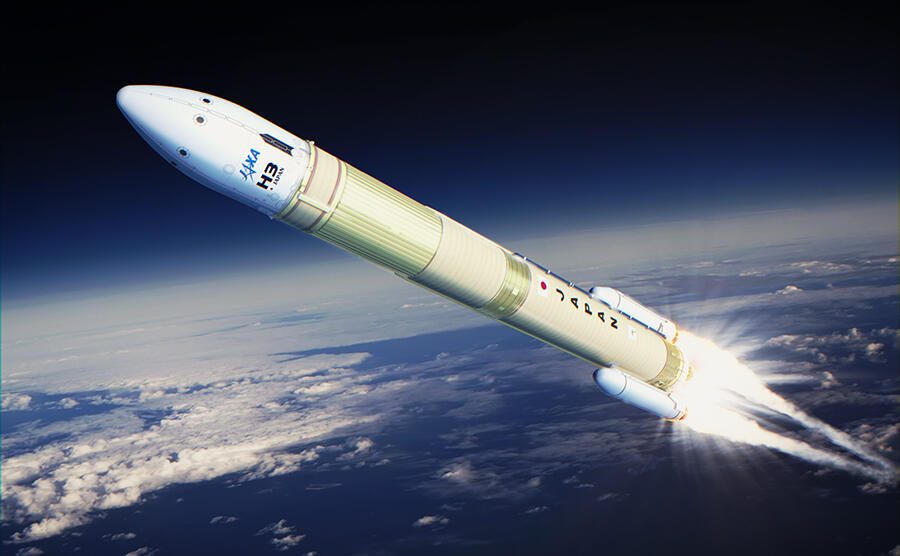
Early on October 20, 2026, Japan's H3 rocket roared off the pad at Tanegashima Space Centre, carrying a spacecraft that could make history. The Martian Moons eXploration (MMX) mission is now on its way to Phobos, the larger of Mars's two moons, with a plan to land, collect samples, and return them to Earth. No one has ever done that before.
The launch, which happened at 4:41 am local time, went off without a hitch. That's a big deal for JAXA, Japan's space agency, which had to recover from an engine failure on the H3's first flight back in 2023. This time, the rocket performed flawlessly, and the MMX spacecraft separated from the upper stage as planned. You can follow the mission's progress on the official MMX page.
Now comes the long part. MMX will spend about nine months cruising toward Mars, arriving in August 2027. Then it'll spend three years studying Phobos and its smaller sibling Deimos from orbit, before touching down on Phobos to grab a sample. The goal is to bring back just 10 grams of moon material, which might not sound like much, but it could be enough to answer some big questions.
Scientists are split on how Phobos and Deimos formed. One theory says they're chunks of Mars itself, blasted off by an ancient impact. Another says they're captured asteroids, drifting in from the outer solar system. The sample could settle the debate, and it might also reveal clues about how life-sustaining environments develop on rocky planets like our own. That's the kind of payoff that makes a $578 million mission worth it.
If everything goes according to plan, the samples will land back on Earth in 2031. That's a long wait, but space exploration is a patient game. Meanwhile, NASA's Perseverance rover is still rolling around on Mars, though its own sample-return plans hit a snag when President Trump blocked them in January 2026. China, on the other hand, is aiming to launch its Tianwen-3 mission in 2028, with a return to Earth also targeted for 2031. So if all goes well, we could see two sample-return missions touch down in the same year.
For travelers and space fans, this mission adds another reason to look up. Japan has been making waves in space exploration, and it's also a top destination for Earth-bound adventures. If you're planning a trip, you might want to check out Lufthansa's expanded Japan routes or consider a quieter side of the country with this new 350 km cycling loop. And if you're curious about Japan's quirky side, there's always the Poké Ball hotel.
The MMX mission is a reminder that Japan isn't just about cherry blossoms and bullet trains. It's a nation that pushes boundaries, whether that's in robotics, design, or deep space. The next few years will be tense as the spacecraft makes its long journey, but if it succeeds, it'll be a triumph not just for Japan, but for anyone who's ever wondered what's out there.
So mark your calendars for 2031. That's when the samples come home, and we might finally learn what Mars's moons are really made of. Until then, the MMX spacecraft is out there, doing the slow, steady work of exploration. And that's something worth following.