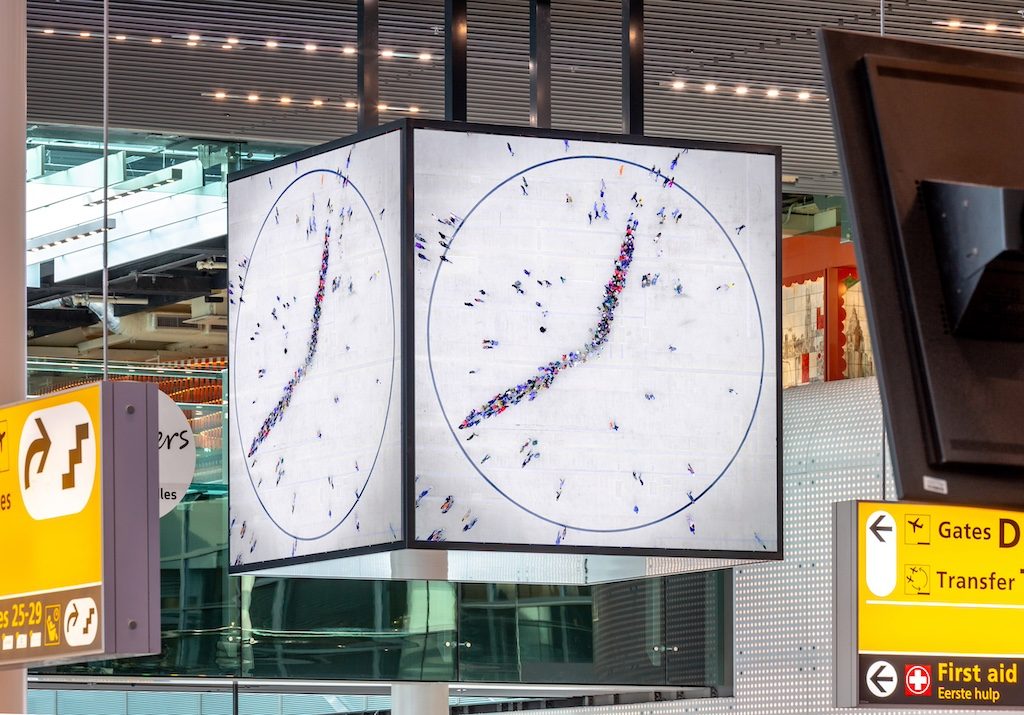
Walk through Lounge 1 at Amsterdam's Schiphol Airport and you'll encounter something that stops you cold: a massive clock called The People's Clock, a work of art that literally required a thousand human beings to create. Dutch designer Maarten Baas dreamed this up, and the result is far more than just another wall installation to glance at while killing time before your flight.
This isn't Baas' first rodeo at Schiphol. Back in 2016, he installed Real Time, a clock in Lounge 2 where the designer himself, dressed in blue overalls, hand-painted the clock hands in real time using a roller and paint. It was hypnotic and strange, deliberately playing with our sense of what time actually is. That project grew from a series dating back to 2009 that challenges how we perceive measured moments.
But The People's Clock takes everything he learned and amplifies it dramatically. Ten years later, Baas returned to Amsterdam with an audacious upgrade: he'd involve not hundreds, but a thousand people. These weren't art students or volunteers plucked from the street. They were airport workers themselves. Security staff. Baggage handlers. Airline personnel. Cleaners. The invisible infrastructure that keeps an airport breathing.
The mechanics are beautifully simple. Roughly a thousand people moved in synchronized patterns to form the hour and minute hands, while a lone runner completed a lap around the clock's perimeter every sixty seconds, becoming the second hand. To film this in a single continuous take required over 12 hours of shooting in a Schiphol hangar. That's not a quick afternoon project. That's commitment.
Creating art on that scale meant keeping people engaged for half a day. The airport and its partners organized yoga sessions, silk-printing workshops, games, meals, and other activities to maintain momentum. It's the kind of logistics typically reserved for, well, running an airport. Which makes sense: The People's Clock isn't really about the clock itself. It's about what a community can accomplish when they show up for something together.
As Baas explains in the documentary about the project, "Thousands of people are involved in the clock. I don't know any other example in which so many people for such a long time were concentrated on one place to make one artwork. So many people who are becoming, literally, time." There's something profound in that statement. These workers don't just operate the airport. They embody it.
Schiphol has been collecting art since the 1960s, and the strategy was deliberate from the start. Terminal design began with the traveler's experience at the core. Art was meant to complement that peaceful environment and give passengers something to anchor on during the stress of travel. But as airports grew more complex and congested, art took on a larger role. Today it creates meaning. It makes people think about the human element beneath all the steel and glass and efficiency.
The physical installation itself is substantial: 250 x 250 x 250 centimeters of video display now permanently installed in Lounge 1, where millions of intra-European travelers will pass through each year. But the real impact isn't the size. It's the message embedded in every frame. Your airport isn't just a building. It's built on the labor and coordination of ordinary people. And sometimes, their work becomes art.