Imagine pedaling through a crowded European city while someone nearby scrolls Instagram with their noise-cancelling headphones cranked to full blast. They don't hear you coming. You ring the bell. Nothing. This everyday danger finally has a solution, and it came from an unlikely place: Czech car manufacturer Škoda.
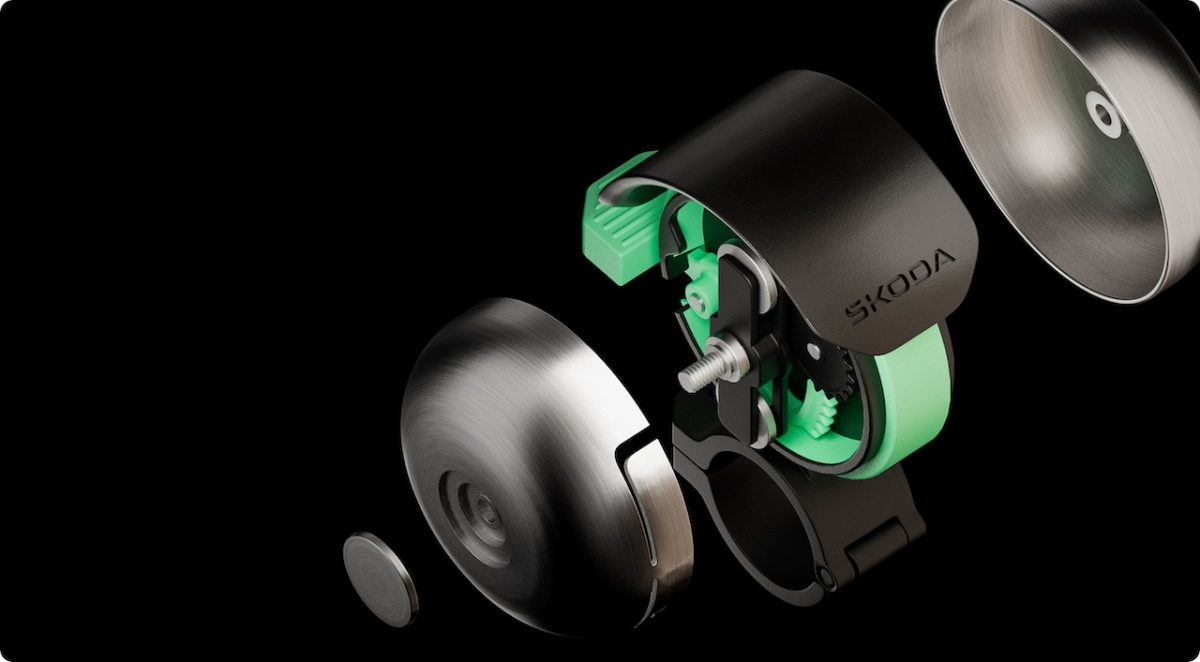
The company has unveiled the DuoBell, a bicycle bell engineered specifically to cut through active noise cancellation (ANC) technology. This isn't a gimmick. Škoda partnered with acoustics experts from the University of Salford to identify a critical vulnerability in how ANC headphones work, then exploited it with surgical precision.
How ANC Headphones Got Outsmarted
Most noise-cancelling headphones operate the same way: they generate an opposite sound wave to cancel out incoming noise before it reaches your ears. Smart, right? Except there's a gap in their defenses. Through rigorous acoustic testing, researchers discovered that sounds between 750 and 780 Hertz can slip right through ANC algorithms without being suppressed. This frequency band acts like a safety door that even the best artificial intelligence can't slam shut fast enough.
The DuoBell exploits this weakness with dual-resonator technology. The primary tone hits that critical 750 to 780 Hertz sweet spot, while a secondary resonator fires rapid, irregular strikes at a higher frequency. This second component generates sound waves that ANC systems can't process quickly enough to suppress. Together, these frequencies create audio chaos that no noise-cancelling algorithm can handle. Ben Edwards, the creative lead on the project, called it "a smart analogue trick that outsmarts the artificial intelligence algorithms in these headphones."
Real-World Safety Gains
The numbers matter. During testing, pedestrians wearing ANC headphones gained an extra 22 metres of warning distance when the DuoBell rang. That translates to five additional seconds of reaction time, enough to step out of harm's way or alert a cyclist before impact. In February 2026, Deliveroo couriers in London trialed the bell and liked it so much they asked to keep it on their bikes permanently.
This is where the real story gets interesting for travelers. Cities worldwide are struggling with the exact same problem: more people wearing noise-cancelling headphones, more bicycles on streets that weren't designed for them, and rising accident rates that nobody seems able to solve. Škoda has published detailed research behind the bell's design, making the engineering open-source rather than proprietary. That's unusual corporate generosity, and it hints at how serious this safety issue has become.
What This Means for City Travel
If you're planning a cycling trip through Prague, Amsterdam, or Copenhagen, you're entering spaces where hundreds of thousands of people move through streets on bikes. Walkers, delivery couriers, leisure riders, commuters all share the same narrow paths and intersections. When the University of Salford's acoustics team examined how many pedestrians were actually hearing standard bicycle bells while wearing ANC headphones, the answer was sobering: very few.
Bicycle infrastructure in European cities is brilliant, but it's only as safe as its sound system. The DuoBell addresses a gap that city planners largely ignored because they assumed bells would always work. They didn't account for our collective addiction to wireless audio or the exponential growth of noise-cancelling technology. What started as a luxury feature on premium headphones is now standard on budget models too.
As more cities roll out bike-sharing schemes and encourage cycling as primary transport, innovations like this become less of a novelty and more of a necessity. Škoda framed this as exploration requiring safety for everyone, and that philosophy extends beyond bikes and bells. Travel itself has become more complex: managing borders, booking through phones, navigating new mobility options. Our relationship with technology while traveling keeps shifting in ways we rarely anticipate.
The DuoBell won't revolutionize safety overnight. But it represents something worth watching: a major corporation recognizing a genuine problem in urban mobility and solving it with actual engineering rather than marketing speak. The bell itself is simple, analog, and built on acoustic science that's been around for decades. Its genius lies in understanding what changed (our headphones) and adapting an ancient tool to meet a modern world.