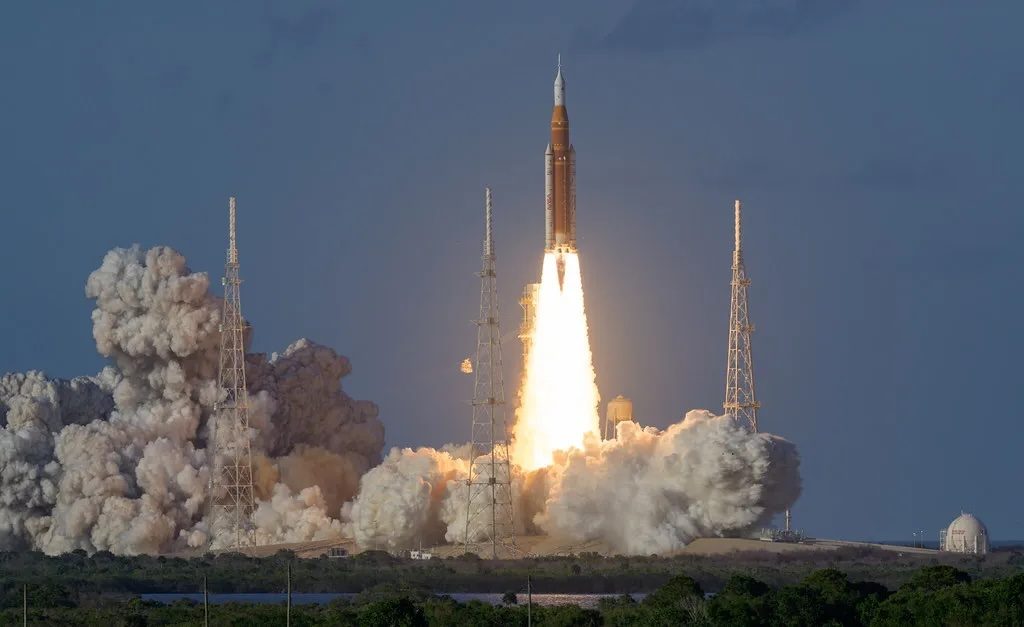
Imagine settling into your seat on a commercial flight, expecting an ordinary departure from Florida, when suddenly you catch something extraordinary outside your window: a massive rocket piercing the sky in a brilliant burst of light and fire. That's exactly what travelers experienced on April 1, 2026, when NASA launched Artemis II from Kennedy Space Center, and the views from the air have since captivated millions online.
Southwest Airlines passengers got front-row access to one of the defining moments in modern space exploration. Videos from the cabin show the spacecraft as a glowing sphere rising rapidly through the atmosphere, trailed by a luminous column of water vapor and boiling cryogenics that creates an otherworldly appearance against the darkening sky. Other clips capture the rocket's continuing trajectory against a brilliant blue backdrop, with passengers audibly gasping and cheering as the historic liftoff unfolds outside their windows.
The mission itself is staggering in scope. Four astronauts crossed the threshold into space at 6:35 pm ET that Wednesday: Commander Reid Wiseman, pilot Victor Glover, mission specialist Christina Koch, and Canadian Space Agency representative Jeremy Hansen. They're not just passengers on a routine orbital hop. These explorers are heading farther from Earth than any human has traveled in over 50 years, approaching the Moon itself on a trip that will rewrite the record books.
Each crew member carries profound significance for the future of space travel. Glover made history as the first person of color to venture beyond low Earth orbit. Hansen became the first non-US citizen to approach the Moon. Koch is the first woman to reach this distance from home. And Wiseman, at his age, is the oldest person ever to travel this far. NASA Administrator Jared Isaacman called them "remarkable explorers" taking on "a true test mission that will carry them farther and faster than any humans in a generation."
The launch drew massive crowds to Florida's Space Coast. Roughly 400,000 spectators filled hotels, RV parks, and viewing areas to witness the most powerful Space Launch System ever deployed blasting off. The economic windfall wasn't small either: the influx of launch tourists pumped approximately 10 million euros into the local economy, a reminder of how space exploration still captivates travel-minded crowds and drives tourism to launch sites.
What makes this moment even more resonant is the message that came from the crew once they reached the void. Pilot Victor Glover sent a reflection back to Earth during Easter weekend, one that transcends the technical achievements of the mission. "You guys are talking to us because we're in a spaceship really far from Earth, but you're on a spaceship called Earth that was created to give us a place to live in the universe," he shared. "Maybe the distance we are from you makes you think what we're doing is special, but we're the same distance from you. And I'm trying to tell you, just trust me, you are special."
He continued with a call for unity that echoed across the world: "In all of this emptiness, this whole bunch of nothing, this thing we call the universe, you have this oasis, this beautiful place that we get to exist together." His words about Easter carried weight beyond any single tradition. "I think, as we go into Easter Sunday, thinking about all the cultures all around the world, whether you celebrate it or not, whether you believe in God or not, this is an opportunity for us to remember where we are, who we are, and that we are the same thing, and that we've gotta get through this together."
For travelers and space enthusiasts alike, witnessing this launch from the air represents something rare: being in the right place at exactly the right moment when human achievement literally rises before your eyes. The viral videos prove that some of life's greatest moments come as complete surprises, reminding us why travel itself remains an adventure. Whether you're chasing celestial events or simply open to wonder, Florida's Space Coast has earned its place in the travel experience. Future journeys to witness space exploration milestones may well become a new category of experiential tourism, drawing visitors who want to be present when humanity pushes its boundaries outward.