Hong Kong's tourism sector is creeping back to life, but not as quickly as you might expect. The World Travel & Tourism Council released fresh data showing the city has recovered to 98.5 percent of its 2018 visitor spending levels by 2025. That sounds respectable until you look at the scorecard next to regional competitors. Singapore and Macao have already surpassed 2018 benchmarks, leaving Hong Kong in third place among Asia's premium travel hubs.
The city endured a brutal one-two punch. When political unrest erupted in 2019, international visitor spending dropped 21 percent in a single year, from US$49.2 billion to US$38.8 billion. The travel sector shed 93,000 jobs and sank $1.2 billion in potential investment. Then COVID-19 hit. International visitor arrivals collapsed by 90 percent in 2020 and dropped another 36 percent in 2021. By 2020, the sector's total contribution to Hong Kong's GDP had contracted by 73.6 percent, with another 128,000 jobs lost.
The numbers paint a grim picture of recovery momentum. While Hong Kong welcomed 50.3 million visitors in 2025, that figure still trails the 2018 peak of 65.3 million by nearly 23 percent. Compare that to Macao and Singapore, which are only 12.6 and 12.4 percent below their previous peaks respectively. The gap reveals something deeper: Hong Kong has lost market share to rivals in ways that won't easily come back.
Why Visitors Aren't Staying as Long
The culprit isn't hard to identify. Hong Kong depended heavily on Mainland Chinese tourists who would stay multiple nights and shop until their suitcases burst. That pattern has fractured. Overnight stays from Mainland visitors have dropped 23.4 percent since 2018. Many travelers now prefer to base themselves in Shenzhen, use the newly completed Bay Bridge for day trips, and skip the hotel bills altogether. The luxury shopping scene, once Hong Kong's golden ticket, has lost its monopoly as high-end retail flourishes in Shanghai, Chengdu, and other Chinese cities. E-commerce has drained more retail traffic, and when Hainan Island launched its Free Trade Port in December 2025, it began stealing duty-free spending that once belonged exclusively to Hong Kong.
International visitors paint an equally sobering picture. Americans are visiting Hong Kong 28.1 percent less than they did in 2018. Japanese travelers are down 35.7 percent. Visitors from the United Kingdom have fallen by 40.5 percent. South Korea, another key source market, shows a 29.2 percent decline. These aren't minor wobbles. They signal that Hong Kong lost relevance in the eyes of long-haul travelers.
The Business Travel Collapse
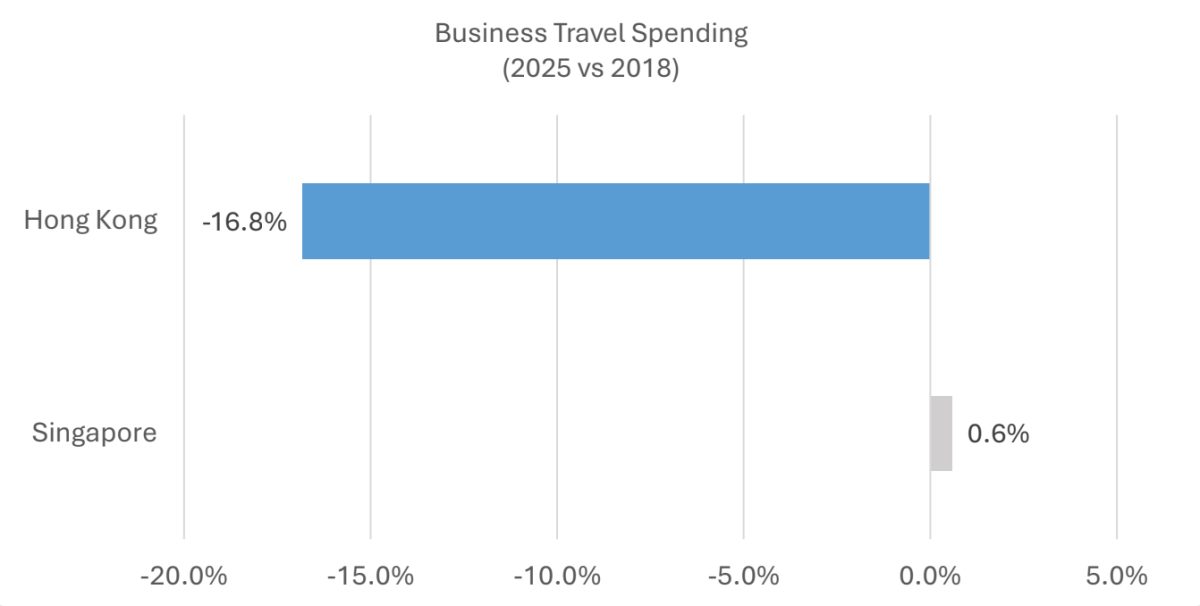
One segment deserves special attention. Business travelers, who typically spend far more per visit than leisure tourists, have largely fled to Singapore. Spending by business visitors sits 16.8 percent below 2018 levels, a painful loss because these travelers fill hotel rooms, eat at premium restaurants, and attend conferences that generate ongoing revenue for the tourism ecosystem. That shift matters because major tourism conferences and business events now happen elsewhere, weakening Hong Kong's position as a regional power player.
Air connectivity has worsened the problem. Flight capacity in and out of Hong Kong remains 15 percent below 2018 levels. While Cathay Pacific has launched new routes like the Seattle service, rising fuel surcharges triggered by Middle East oil tensions are making expansion harder. The broader Middle East crisis is already straining tourism economics across multiple regions, and Hong Kong isn't immune to these geopolitical headwinds.
What Comes Next
The fix, according to tourism analysts, requires Hong Kong to stop betting everything on shopping and reinvent itself as a destination for deeper experiences. That means promoting food culture, neighborhood walks, curated itineraries, and bundled experiences that keep visitors around longer. Rather than chasing quick daytrips and shopping sprees, Hong Kong needs to make travelers want to stay four, five, or six days instead of two.
The opportunities exist. Markets like India represent untapped potential. The Indian middle class is growing rapidly, and outbound tourism from India is surging. Yet Hong Kong barely features in Indian travelers' plans. Strategic marketing, easier visa processes, and business travel incentives could rebuild convention traffic. Airlines need new partnerships to restore long-haul demand.
Travel and tourism accounts for 14 percent of Hong Kong's GDP, making recovery essential for the entire city. The World Travel & Tourism Council notes that while the sector "has made meaningful progress," the Hong Kong Tourism Board faces critical pressure to accelerate the comeback. The city has the assets. It has the infrastructure. What it needs now is a reimagined reason for travelers to choose it over Singapore, Bangkok, or any other contender on the Asian circuit.