Cuba is facing a tourism catastrophe unlike anything it has experienced in nearly a generation. Prime Minister Manuel Marrero delivered the grim news in late July: 73 percent of the island's hotels have closed their doors. Seven major international hotel chains that collectively operated roughly half of Cuba's accommodations have pulled out entirely. The situation, he said plainly, amounts to "almost total paralysis."
This collapse didn't happen overnight. Cuba's tourism sector enjoyed a golden run in 2017 when it welcomed 4.2 million international visitors. Tourism became the island's lifeblood, employing 300,000 people and ranking as the second largest generator of foreign currency earnings. But the combination of US travel restrictions, the COVID-19 pandemic, and more recently, severe economic pressure and infrastructure failures has unraveled that prosperity. Rolling blackouts, electricity shortages, and fuel scarcity began eating away at visitor numbers starting in 2025.
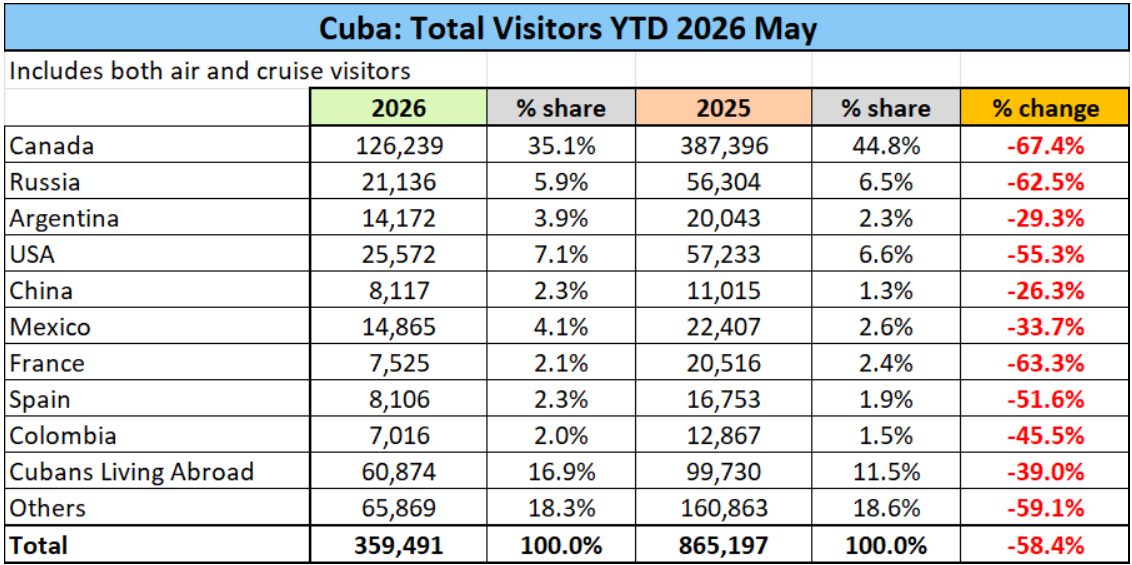
Last year proved devastating. Cuba attracted just 1.8 million international visitors in 2025, marking its worst performance since 2002. This year has been even worse. Between January and June 2026, the island welcomed only 360,000 tourists. That's a gut-punch of a 58 percent drop compared to the same months the year before.
When fuel runs dry, planes stop flying
The immediate culprit is geopolitics and supply chains. Since January 2026, the United States has ratcheted up economic pressure on Cuba through new sanctions, including tariffs on fuel suppliers and penalties against anyone doing business with military-run sectors of the economy, including tourism. Cuban aviation fuel supplies began depleting by February. Global fuel markets, already stressed by Middle East blockades, made the situation worse. Canadian, European, and Russian carriers all began suspending or reducing routes to the island.
When flights disappear, tourists can't arrive. The connectivity crisis became self-reinforcing. Occupation rates at remaining hotels plummeted to as low as 34.1 percent. Melia, the Spanish hospitality giant, slashed operations at 15 of its 34 Cuban properties in June before announcing a complete withdrawal a month later, citing economic, legal, and operational struggles. Iberostar and Barceló followed suit. Even Canada's Blue Diamond Resorts walked away. The pattern is clear: international operators see no path to profitability.
The human cost keeps growing
Tourism's collapse threatens roughly 25,000 job losses, according to Marrero. For a nation where the sector had become central to household income and foreign currency reserves, that represents a potential economic shock. The irony cuts deep. Back in 1994, Fidel Castro famously said tourism was "the only thing that could save the nation." For more than two decades, that bet seemed to pay off.
What's happening in Cuba offers a cautionary tale about over-reliance on a single economic sector, especially one vulnerable to geopolitical shifts and global supply disruptions. While other destinations have experimented with managing tourism pressure, as Edinburgh did when it introduced visitor taxes, or embracing rapid growth like Saudi Arabia's unexpected surge to become a global tourism leader, Cuba faces the inverse problem: a sector in freefall with limited immediate solutions.
For travelers considering Cuba, the practical reality is stark. Hotel availability has evaporated. Flight connectivity has shrunk dramatically. The infrastructure that once made Cuba an accessible Caribbean destination is fragmenting. Fuel shortages mean rolling blackouts remain common. The economic pressure that fueled the crisis shows no signs of easing.
Cuba's tourism story went from triumph to tragedy in just a few years. Whether the island can rebuild connectivity, restore visitor confidence, and reimagine its tourism model remains an open question. For now, one of the Caribbean's most culturally rich and historically significant destinations has become one of its most difficult to visit.