Spring arrives differently in Brussels. While other cities celebrate with street fairs and outdoor cafes, the Belgian capital marks the season with something far more exclusive: the opening of the Royal Greenhouses of Laeken. For over 100 years, travelers have planned trips around this three-week window, when one of the continent's architectural treasures finally opens its glass doors to the public.
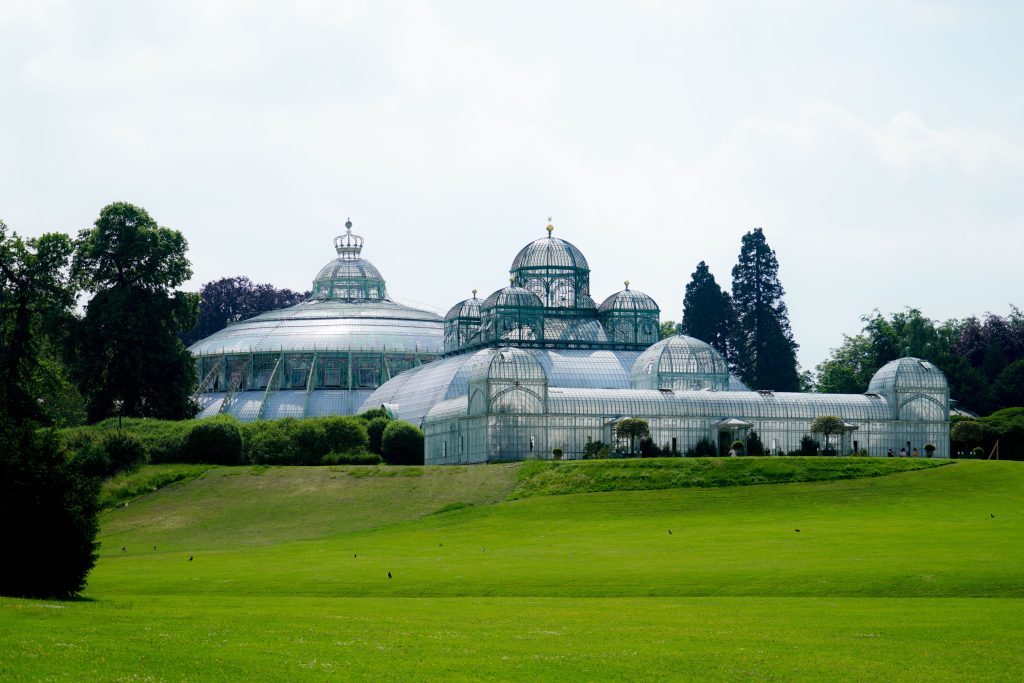
The complex itself reads like a love letter to both nature and engineering. Designed by Alphonse Balat (mentor to the legendary Victor Horta) and built between 1874 and 1905 for King Leopold II, the greenhouses occupy a sprawling corner of the Royal Domain. What you'll encounter is less a traditional greenhouse and more a glass city: interconnected domes, galleries, and arcades that shimmer beneath iron frames, creating the sense that you've stepped into a luminous parallel world.
Inside, centuries-old plants thrive under carefully controlled conditions. Palm trees that shadowed Leopold II still stand tall. Royal azaleas, some of the planet's rarest and largest, burst with color. Ancient orange and laurel trees fill the air with a fragrance that hits you the moment you enter each chamber. The Victoria amazonica water lilies float in their own lagoon-like greenhouse. A permanent team of 15 to 20 gardeners tends to this living archive, some specimens of which have occupied the same patch of soil for generations.
What to Expect This Year
Here's the trade-off: the Winter Garden, the complex's most iconic space and the first structure completed in 1874, will remain closed throughout the season for renovation work. This 25-meter-high cupola housed the tallest palms in the collection, so its absence stings for returning visitors. But the organizers sweetened the deal. For the first time ever, the route opens with the Grand Gallery of Honour at Laeken Castle, adding an unexpected layer of royal grandeur to your visit.
The rest of the collection remains on display: the Palm Plateau, the Débarcadère (a pier-like greenhouse from the 1880s originally designed to welcome guests), the Azalea and Geranium galleries, the Diana Greenhouse, the Congo Greenhouse with its subtropical plants, and the Orangery. Two route options let you choose your experience. The shorter 2-kilometer circuit focuses purely on the greenhouses. The longer 3-kilometer path winds through landscaped gardens, past temple ruins near the water, a rose arch, and eventually back to the glass structures. Photographers often choose the longer route for its sweeping sightlines and architectural vistas, so pack a wide-angle lens if you're serious about capturing the place.
Planning Your Visit
The greenhouses operate from April 17 to May 10, 2026. This is where you need to move fast: ticket sales begin March 20 at 1 p.m., and last year 140,000 tickets sold within 36 hours. Online booking only, no exceptions. Evening visits run Friday through Sunday plus May 30, though only the shorter route is available after dark. May 5 is reserved for visitors with reduced mobility.
Getting there by car is possible but parking is tight. Public transport works better: Bus 53 (Serres royales stop), De Lijn buses R30 and R31 (Koninklijke Serres stop), or tram lines 7, 19, and 35 to De Wand. Metro line 6 to Stuyvenbergh gets you close, followed by a walk. Brussels' public transit continues to evolve, making the greenhouses increasingly accessible to travelers without a car.
Wear comfortable shoes. The domain sprawls across considerable ground, and you'll be walking between structures regularly. Time your visit for late April if you want to catch cherry blossoms near the lake, where the Japanese Tower stands as another hidden gem within the royal grounds. The walking between chambers, the sudden temperature shifts from one greenhouse to another, the way light filters through the glass panels, the weight of that orange blossom scent in the air: it all combines into something sensory and slightly disorienting in the best way. This is what keeps Brussel residents coming back, even when the crowds swell to uncomfortable levels.
The Royal Greenhouses aren't meant to be rushed. They're meant to be savored like a botanical museum that happens to be alive, breathing, and utterly unlike anywhere else in Europe.