If you flew anywhere in 2025, you were part of history. Airports around the globe handled a staggering 9.8 billion passengers last year, according to the latest data from Airports Council International (ACI) World. That's a record, and it shows just how hungry the world remains for travel.
But here's the twist. The first half of 2026 tells a far more cautious tale. Global passenger traffic grew by a mere 0.6% compared to the same period in 2025, a sharp slowdown that reflects everything from geopolitical tensions to airspace closures and rising costs. The Middle East, in particular, saw a 21% drop in passenger numbers as conflict disrupted major hubs and international routes.
The full picture comes from ACI World's 2026 Annual World Airport Traffic Report, which crunches data from 2,817 commercial airports across more than 185 countries. It's the organization's largest dataset yet, covering an estimated 97% of scheduled global passenger traffic. The report also highlights that international travel drove most of the growth in 2025, up 6.1%, while domestic traffic limped along at just 1.7%.
A Year of Extremes
Last year wasn't just about passenger numbers. Air cargo volumes hit an all-time high of 131.2 million tonnes, up 3.3%, and aircraft movements rose 2.0% to 103.1 million. Africa led regional growth with a 9.0% surge, followed by the Middle East at 6.5%, Asia-Pacific at 5.1%, Latin America and the Caribbean at 4.5%, and Europe at 4.2%. North America was the odd one out, with traffic dipping 0.7% as domestic demand softened.
Hartsfield-Jackson Atlanta International Airport retained its crown as the world's busiest, handling 106.3 million passengers. Dubai International followed with 95.2 million, and Tokyo Haneda came in third with 91.7 million. These hubs are the beating heart of global travel, but even they aren't immune to the headwinds of 2026.
Justin Erbacci, ACI World's Director General, struck a note of cautious optimism. "The 2025 results confirm what this industry has shown year after year: long-term demand for air travel remains strong, and more capacity will be needed," he said. He also stressed the importance of smarter use of existing infrastructure and regulation that encourages investment rather than stifling it.
What This Means for Travelers
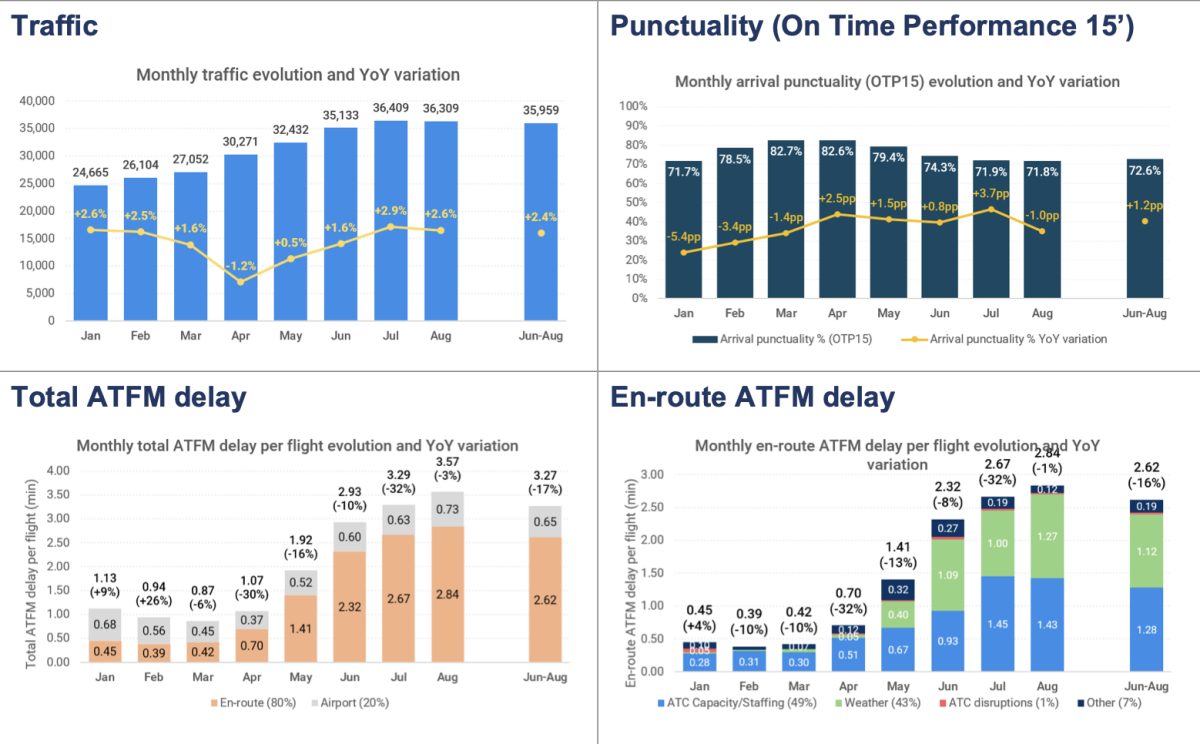
For now, the slowdown hasn't translated into empty terminals. Europe, for instance, just recorded its busiest-ever summer for air traffic in 2026, with an average of 35,959 flights per day between June and August, up 2.4% from the previous summer. That resilience is good news if you're planning a European getaway, but it also means airports are stretched thin.
If you're heading to the Middle East, expect disruptions. The 21% drop in passenger traffic reflects real-world challenges, from rerouted flights to longer layovers. Meanwhile, North America's flat numbers suggest a market that's cooling off, though airports like Atlanta and Dubai remain as busy as ever.
Looking ahead, ACI World argues that the fundamental drivers of demand, population growth, rising incomes, and a global appetite for mobility, remain strong. But the industry faces a long-term puzzle: how to expand capacity without blowing carbon budgets or breaking the bank. For travelers, that could mean more crowded airports in the short term and, eventually, higher fares as airlines and airports pass on rising costs.
So, what's the takeaway? The golden age of air travel isn't over, but it's getting more complicated. Whether you're jetting off to a new destination or just trying to get home, expect a mix of record-breaking enthusiasm and real-world friction. Pack patience, and maybe a good book for those longer waits.