
Forget the usual rankings that crown the most powerful passports based on visa-free access alone. A fresh index from Global Citizen Solutions flips the script, asking a different question: which passports actually lead to a happier life? The answer, it turns out, is about more than just how many borders you can cross.
The Happy Passports Index ranks 50 countries by blending six factors: prosperity, mobility, well-being, freedom, health, and safety. It borrows from the concept of powerful passport listings but adds a human layer. The authors argue that a passport's true value lies not only in the doors it opens abroad, but in the quality of life it represents at home.
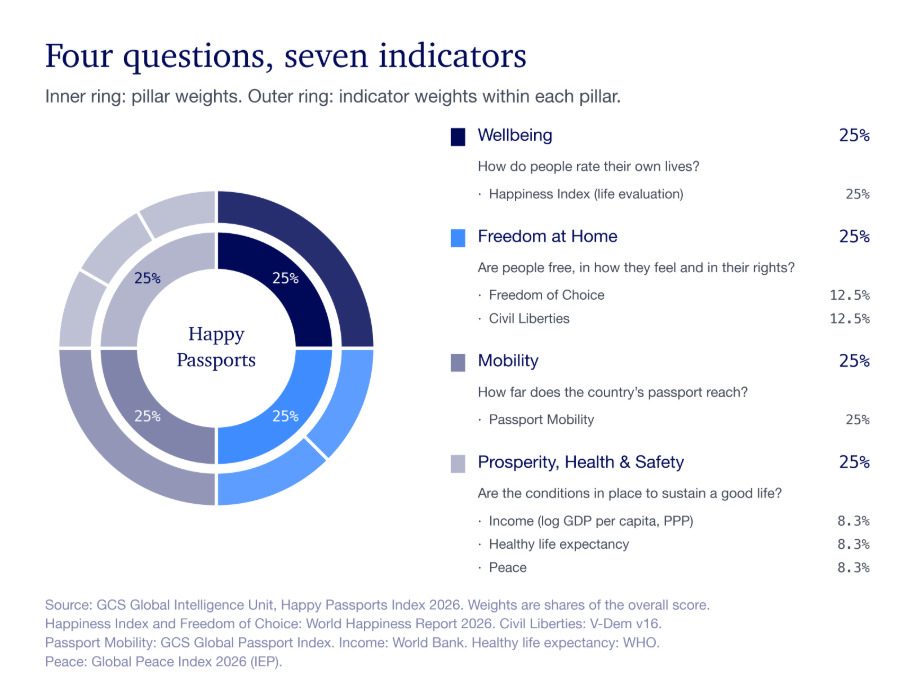
What sets this ranking apart is its dual approach to freedom. It measures both the personal sense of choice and the civil liberties that protect citizens. The United Arab Emirates, ranked 23rd, shows why this matters. Residents there report a strong sense of freedom to make life choices, ninth in the sample, yet its civil liberties score is the second lowest. The United States, at 28th, flips the pattern. Its civil liberties score sits mid-pack, but Americans rank 47th on freedom of choice and 45th on peace.
At the top, the list feels familiar to anyone who follows annual happiness reports. Finland takes the crown with a score of 93.2 out of 100, recording the highest life evaluation in the world and ranking second on both freedom at home and mobility. Its only modest showing is in prosperity, health, and safety, where it lands 11th. The top 10 is heavily European, with Iceland at 92.4, Denmark at 92.1, and Norway and Switzerland close behind.
It takes until number eight to leave Europe, and that honor goes to New Zealand, a consistent high scorer for peace. Austria follows at nine, and then Singapore rounds out the top 10. Singapore is a fascinating case. It tops the list for income, life expectancy, and powerful passport, yet ranks 23rd on well-being and 30th on freedom at home, with a civil liberties score of 39th. The analysts note that strong material foundations and a powerful passport do not, on their own, guarantee happiness.
For travelers, this ranking offers a fresh lens on where to go and why. It suggests that a destination's appeal goes beyond its sights and cuisine. The places that score well, like Finland and Denmark, are also known for their outdoor culture, safety, and social trust. If you are planning a trip and want to experience what happiness feels like on the ground, these are the countries to consider. And if you are curious about how tourism is evolving beyond simple metrics, check out tourism's new scorecard that goes beyond money and numbers.
The index also raises a question for those who hold less powerful passports. Does a weaker passport mean a less happy life? Not necessarily. The ranking shows that freedom and well-being can exist even without top-tier travel access. It is a reminder that happiness is a complex equation, one that no single metric can capture.
So, the next time you see a list of the world's most powerful passports, remember this one. It might not tell you where you can go, but it tells you where you might feel most at home. And for those dreaming of a Nordic escape, Lisbon's recent top spot on a city happiness index shows that joy can be found in urban corners too.