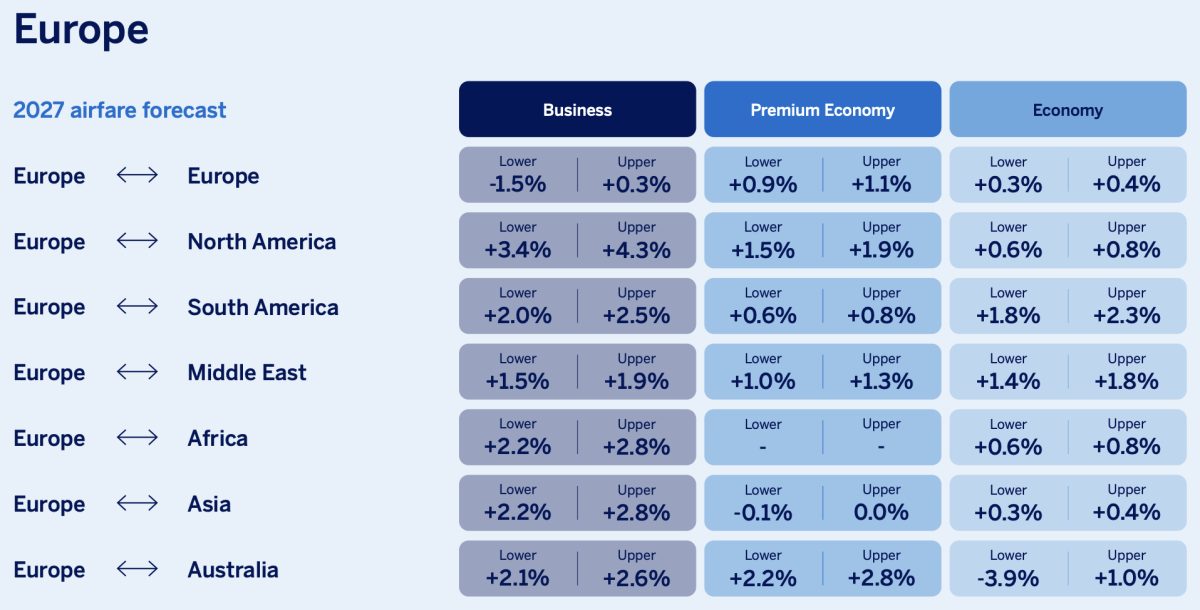
Good news for anyone planning a European getaway in 2027: the price of your plane ticket is likely to stay almost exactly where it is now. A new forecast from American Express Global Business Travel (Amex GBT) predicts economy fares on flights within Europe will rise by just 0.3% to 0.4% next year. On a €200 ticket, that works out to an extra 60 to 80 cents. Barely a coffee.
The reason for this stability? Amex GBT points to weak economic growth across Europe, which tends to keep demand in check. The company's annual Air Monitor report also sees a possible drop for business class travelers on intra-European routes, with fares falling by as much as 1.5%. That is a rare piece of good news for road warriors who have watched prices climb for years.
What the Forecast Means for Your Wallet
The report gives two estimates for each cabin class, depending on how inflation behaves. The International Monetary Fund expects global inflation to hit 4.1% in 2027. If that holds, use the lower estimate. If prices rise faster, the higher one applies. Under the higher scenario, business class within Europe would actually go up 0.3%, while premium economy shows a modest increase of 0.9% to 1.1% in both cases.
For travelers, the practical takeaway is simple: book your European flights without fear of a price shock. The days of double-digit fare hikes appear to be easing, at least for now.
Long-Haul Routes Show Bigger Swings
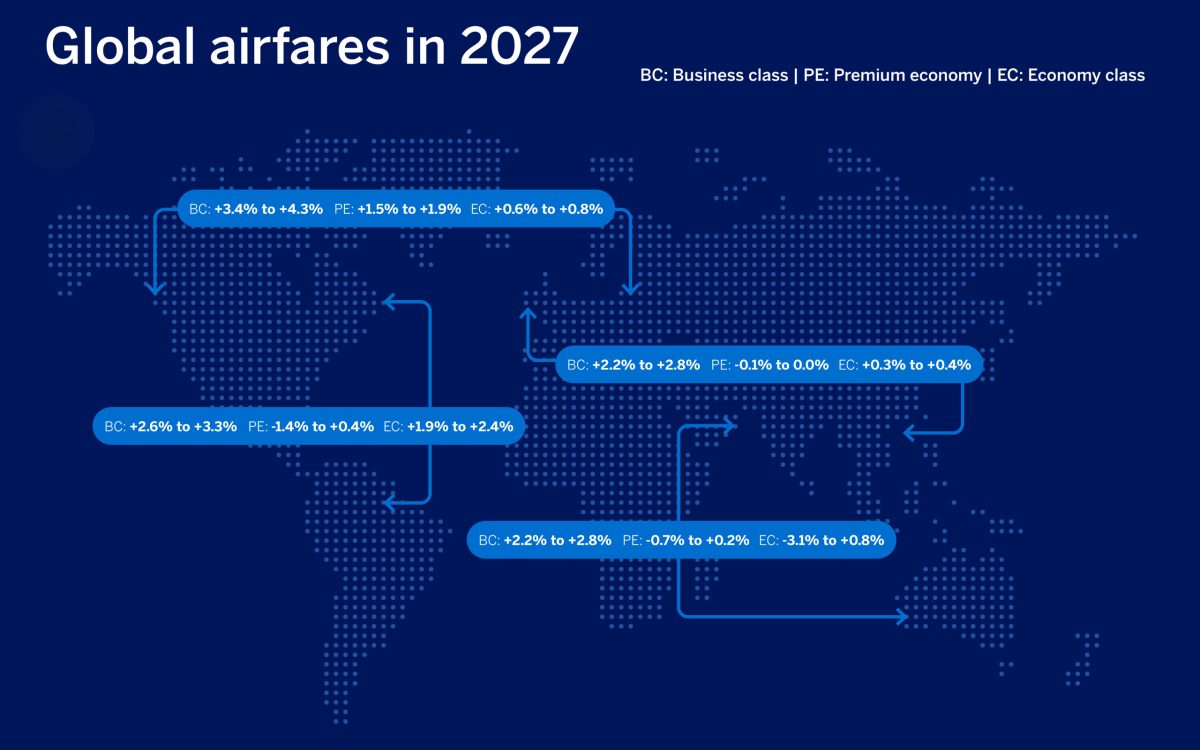
If you are flying further afield, the picture changes. South America stands out with the largest projected economy fare increase from Europe, at 1.8% to 2.3%. The Middle East follows at 1.4% to 1.8%. At the other end, economy fares between Europe and Asia are expected to rise just 0.3% to 0.4%, matching the intra-European trend.
Australia offers the widest gap between the two estimates. Economy fares between Europe and Australia could fall by 3.9% under the lower inflation scenario, or rise by 1% under the higher one. That is a big difference for anyone planning a trip Down Under.
On transatlantic routes, where you sit matters a lot. Economy fares are forecast to rise 0.6% to 0.8%, adding €6 to €8 to a €1,000 return ticket. Premium economy goes up 1.5% to 1.9%. But business class takes the biggest hit, with a projected increase of 3.4% to 4.3%. On a €3,000 business class return ticket, that means an extra €102 to €129.
Why the Slowdown?
Amex GBT recorded double-digit fare increases on many routes in 2026, driven by the conflict in the Middle East and its effect on jet fuel prices. Analysts expect those fuel spikes to ease in 2027, even as business travel demand holds up. That combination helps explain the smaller increases.
Fuel costs have been a worry for airlines. In October, Ryanair chief executive Michael O'Leary warned that many European carriers had yet to lock in prices for fuel they would need from April 2027. That uncertainty could still push fares up if oil prices jump again.
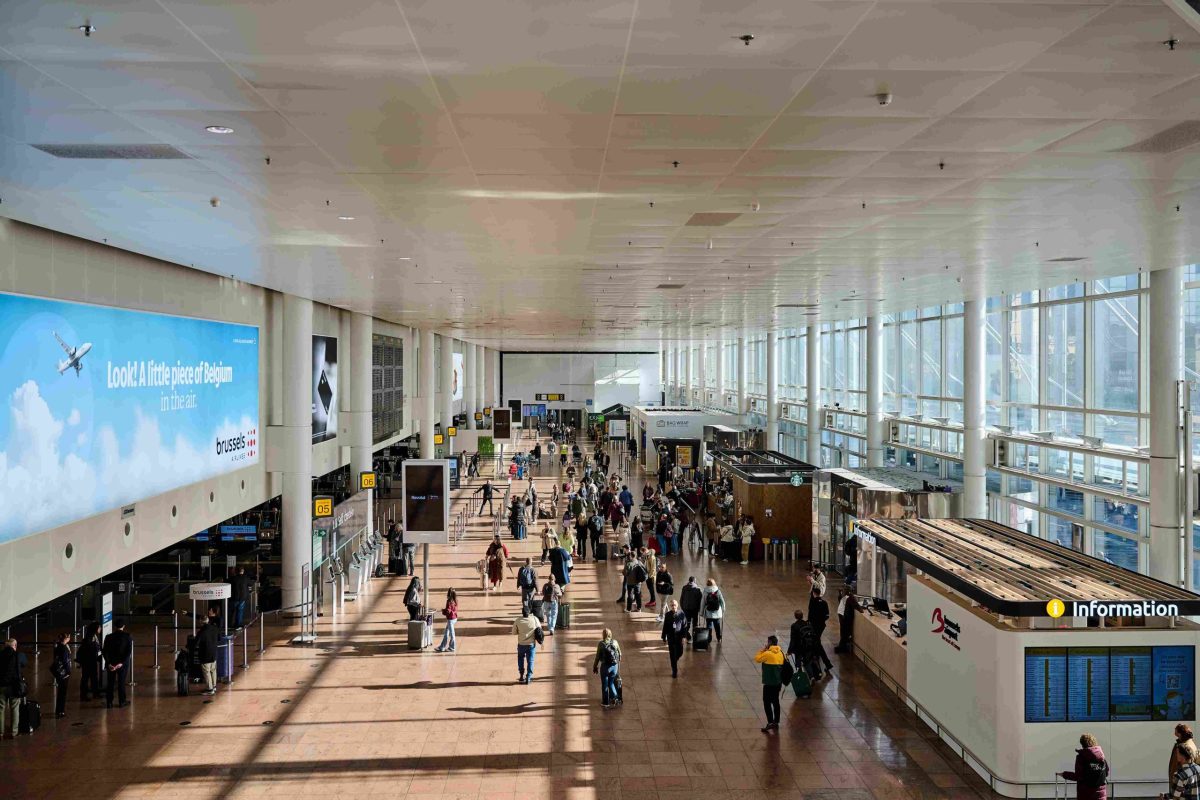
Even with stable fares, the total cost of flying keeps creeping higher. Sara Andell, director of consulting strategy at Amex GBT, notes that airlines are adding more separate fees. One example is Brussels Airlines' Economy Basic fare, introduced in 2026 on routes like Prague and Budapest. That fare includes only a small personal item, such as a laptop bag or a backpack up to 40 by 30 by 15 centimetres. If you want a cabin suitcase for a weekend in Prague, you pay extra.
For travelers, that means the headline fare is just the starting point. Before you book, check what is included. And if you are planning a winter trip, keep an eye on potential disruptions. Europe's airports are busier than ever, but winter looks brutal, so a little flexibility can go a long way.
If you are dreaming of a European escape, the fare forecast is a green light. Two European destinations just won a big tourism prize for 2027, and with prices staying flat, there is no better time to start planning. Just remember to pack light, or be ready to pay for that extra bag.