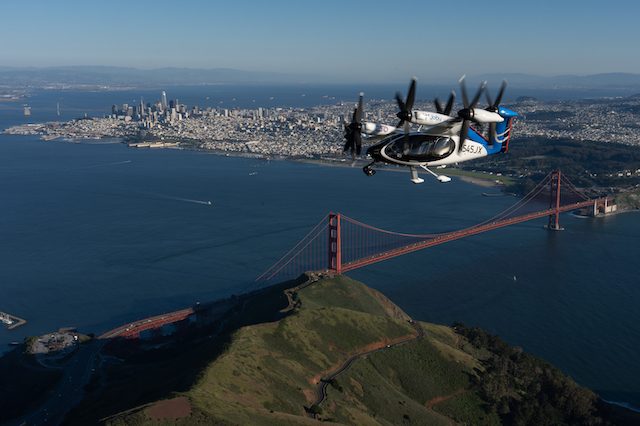
Picture this: you're stuck in San Francisco traffic, watching gridlock stretch for miles. Then you glance up and spot something that looks like a cross between a helicopter and a plane, barely making a sound, zipping silently overhead at 200 mph. That's not science fiction anymore. That's Joby Aviation's electric air taxi, and it just completed a real flight over the San Francisco Bay Area.
The demonstration covered iconic landmarks like the Golden Gate Bridge and Marin Headlands, proving that what once seemed purely theoretical is edging toward reality. The aircraft itself is sleek and purposeful: six tilting propellers paired with fixed wings give it the ability to launch vertically like a helicopter, then cruise forward like a plane. Four passengers at a time. Zero direct emissions. Almost silent operation. It's the anti-traffic solution the world's congested cities have been waiting for.
This is just the warm-up act
What happened over San Francisco marks the official kickoff of Joby's 2026 "Electric Skies Tour," a multi-city roadshow designed to introduce Americans to the technology. The company isn't rushing this either. They've already logged more than 50,000 test miles, meaning the engineering is genuinely mature. "By providing clean, quiet service with minimal infrastructure investment we are making flight an everyday reality for the community," said JoeBen Bevirt, Joby's founder and CEO.
The timing matters. Right now, as the skies are about to get wildly crowded, alternatives to traditional air travel are gaining serious momentum. Electric air taxis could fill a gap between ground transportation and full commercial aviation, especially for travelers moving between city centers and airports.
The government is officially on board
Joby is part of the White House-backed eVTOL Integration Pilot Program (eIPP), which sounds bureaucratic but means something concrete: government permission to begin limited real-world operations in specific regions. Arizona, Florida, New York, and Texas are on the roster. This isn't a test in a controlled lab anymore. This is actual pilots flying actual routes with actual regulatory oversight.
Why does this matter? Because current air traffic rules were written for planes and helicopters, not electric air taxis. Regulators need real-world data to update safety protocols, insurance models, and infrastructure requirements. Joby isn't alone either. Competitors like Archer Aviation and Beta Technologies are running similar pilot programs, which means the entire industry is moving from "someday" to "let's figure out the details now."
What this means for travelers
The realistic timeline: these services won't replace Ubers tomorrow. But within the next few years, travelers arriving at major airports in Phoenix, Miami, New York, or Houston might skip the rental car line and book an air taxi instead. The benefits are obvious. No traffic. Faster commute. Quieter than traditional helicopters. Lower environmental impact.
The pilot programs will teach regulators and operators how to handle passenger comfort, safety protocols, pricing models, and public acceptance. Right now, seeing an electric air taxi overhead might startle people. In three to five years, it could feel routine.
For travelers planning trips to major U.S. cities in the next few years, watch this space. Ground transportation might be about to fundamentally change. And unlike the chaos affecting traditional aviation, this could actually make getting around smoother, cleaner, and faster.