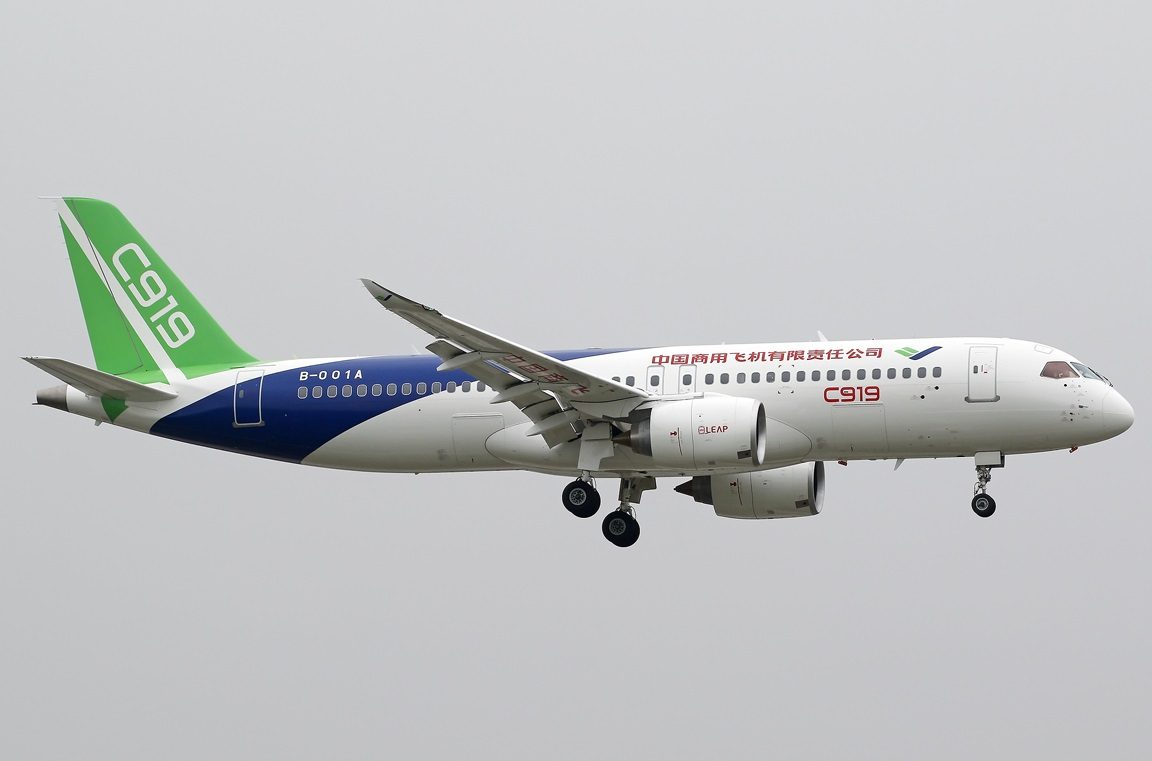
When the C919 took to the skies for its first commercial flight in May 2023, it represented a massive gamble for China's aviation ambitions. Now, less than two years later, the country is making a bolder move: weaning itself off the Western supply chain that built the aircraft in the first place.
Engineers at China's Aero Engine Corporation have begun developing homegrown alternatives for five key materials: sealants, rubber compounds, protective coatings, fasteners, and cleaning agents. The strategy stems from a simple reality: geopolitical tensions and supply chain disruptions have exposed the fragility of relying on foreign producers. When tensions flare or shipping routes collapse, companies that depend entirely on Western suppliers find themselves grounded.
From Shanghai to the World
The C919 has already achieved what many thought would take years longer. China's homegrown jetliner just crossed into true international waters when Air China launched its first international scheduled service in August, connecting Beijing and Ulaanbaatar. Before that, the aircraft had only ventured outside mainland China for flights to Hong Kong, making this an unmistakable step toward broader global operations.
By July, COMAC (the Commercial Aircraft Corporation of China) had delivered 42 aircraft to domestic carriers. These numbers matter because they signal momentum, but also because every new delivery offers another opportunity to test Chinese-made components in real flight conditions.
The Substitution Game
The challenge facing Chinese engineers is not trivial. Some locally made materials have already been tested on the C919, while others remain under evaluation. Take HM1176, a polythioether sealant developed domestically. It provides structural sealing and corrosion protection, and it has already been integrated into both the C919 programme and China's experimental CJ-1000 jet engine series since 2025. That's progress, but it's also just one material among dozens required to build a modern jetliner.
Zhang Xiaoyan, chief engineer at the Beijing Institute of Aeronautical Materials, was candid at an aviation forum in Guangzhou: replacing foreign components will take years, not months. Currently, the C919 still relies heavily on advanced materials and systems sourced from American and European manufacturers known for decades of technical dominance. Composite materials alone appear throughout the aircraft, originating from a handful of established producers in the US and Europe.
The real eye-opener is that even with a localisation push underway, Western companies continue supplying many of the C919's most critical parts. The engines themselves still come exclusively from CFM International, a joint venture between US-based GE Aerospace and France's Safran. The CJ-1000, which would offer a domestic alternative, is still under development.
Military Know-How Meets Commercial Flight
One intriguing angle: China plans to adapt technology developed for military aviation. Anticorrosive coatings, adhesives, and chemical treatments created for defence aircraft can be modified for civilian use, potentially accelerating the substitution timeline. This borrowing across sectors reflects how integrated China's aviation ecosystem has become.
But there's a catch. International certification matters enormously. The European Union Aviation Safety Agency (EASA) approval is considered essential if the C919 is to compete globally. Zhang argued that introducing Chinese alternatives would not harm the aircraft's certification prospects, positioning domestic products as backup options rather than replacements that undermine safety or performance. She even cited precedent: Airbus has already approved certain Chinese-made protective seals for A330 engines operated in China, showing that Western manufacturers will accept Chinese materials when quality matches their standards.
In July, European test pilots conducted in-flight evaluations of the C919 in Shanghai as part of the lengthy EASA certification process. Flight data and documentation are still being examined by regulators, but the fact that European aviation experts are testing the aircraft signals genuine movement toward international acceptance.
What This Means for Travelers
For passengers, the implications extend beyond geopolitics and supply chains. A successful self-sufficiency programme could stabilise production schedules, reduce costs, and ultimately expand the number of routes served by the C919. China's airlines just ordered nearly 100 new planes worth $16 billion, showing strong domestic appetite. If Chinese carriers can operate more C919s reliably, competition intensifies for Boeing and Airbus, potentially benefiting travelers through newer aircraft and more competitive pricing.
Zhang sees this localization effort as something with ramifications far beyond a single aircraft model. Success here would accelerate development of China's entire domestic aviation materials industry, building supply chains and manufacturing expertise that could support commercial aviation for decades to come. The C919 is no longer just a symbol of Chinese engineering pride. It is becoming a testing ground for an entirely different model of how aircraft get built in the modern world.