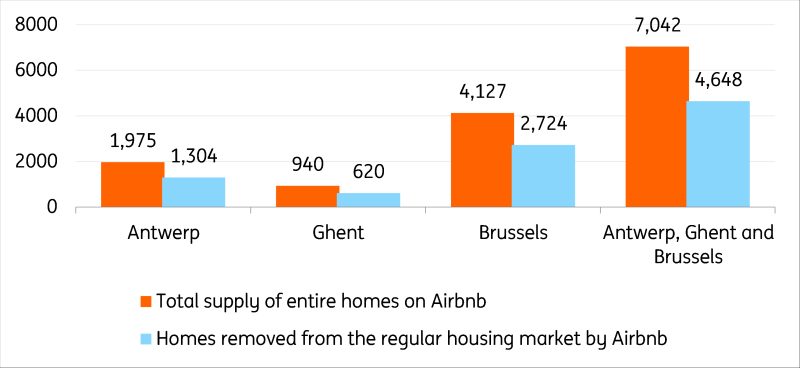
Picture this: five thousand homes across Belgium's three biggest cities are no longer available for families or young professionals seeking permanent housing. Instead, they're running as vacation rentals on platforms like Airbnb, creating a shortage that's starting to sting residents trying to find a place to live.
According to research by ING bank, these 5,000 properties represent 0.8% of the housing stock in Brussels, Antwerp, and Ghent. But here's the catch: that number likely climbs much higher when you factor in Booking.com, Expedia, and other platforms. "This share is likely even higher if we include other platforms," notes Alissa Lefebre, an economist at ING. The actual scope of the problem remains difficult to pin down, but the trend is unmistakable.
The numbers tell a wild story. In 2024 alone, Belgium saw 12.3 million overnight stays booked through these platforms across 1.23 million separate bookings. By the first three quarters of 2025, the country had already crossed the 10-million overnight stay threshold. Tourists aren't slowing down; they're accelerating. Meanwhile, the people who actually live in Brussels, Antwerp, and Ghent are finding fewer and fewer options in the regular rental market.
A Structural Problem That Goes Deeper
Lefebre and her colleagues at ING argue that regulating short-term rentals alone won't fix the underlying crisis. The real issue is that Belgium isn't building the right kind of housing. Planning approvals for single-family homes jumped 17% year-over-year, while permissions for apartment construction dropped 8%. That's the opposite of what the market actually needs in crowded urban centers.
"The housing supply must respond better to changing demand," Lefebre says. "Among other things, by encouraging and facilitating housing projects within smaller units." Cities need more compact housing, not sprawling suburban homes. Yet the construction pipeline is moving in the wrong direction.
The Flemish government in the north has announced stricter controls over short-term rentals, and that's a start. But without addressing construction bottlenecks, rising costs, supply chain issues, and bankruptcies within the building sector, regulatory measures alone won't ease the pressure on renters.
Cities Fighting Back Against Tourism Overload
Belgium's cities are taking their own steps to push back. Brussels has repeatedly clashed with Airbnb over missing fire safety certificates, inadequate criminal record checks, and property owners dodging taxes. The capital has also struggled with hosts breaking urban planning rules about residential versus commercial use.
Ghent updated its noise action plan in early 2026, capping sound at 60 decibels in sensitive areas like restaurant terraces and 70 decibels for temporary peaks. The city is even requiring its popular canal tours to switch to electric boats and swap loudspeakers for wireless headphones. In summer 2025, the coastal city of Ostend proposed new liveability bylaws to limit Airbnbs in certain neighborhoods and ban unattended key collection boxes, pushing hosts to be more accountable to their neighbors.
A European Solution on the Horizon
Here's where things might actually change. New European rules that came into force in May 2026 require vacation rental platforms to share data with authorities. That transparency could help cities finally see what's happening in their own housing markets. ING estimates that a national registration system could bring roughly 1,800 out of 4,650 unregistered homes back into the regular rental market.
Still, data alone won't solve everything. Belgium needs to fix what Lefebre calls the "structural bottlenecks" in housing construction and investment climate stability. It also needs to be careful with policies like rent caps, which have historically backfired by reducing rental supply and dampening new construction.
For travelers, this tension highlights something worth understanding: the destinations we love are also home to real people dealing with real housing crises. The vacation rental boom that makes short city breaks cheaper and easier for tourists has a flip side for locals. As Belgium grapples with this balance, other tourist destinations across Europe are watching closely, knowing similar pressures are building in their own cities. See how Airbnb's role in travel is evolving and what cities are doing to manage its impact.