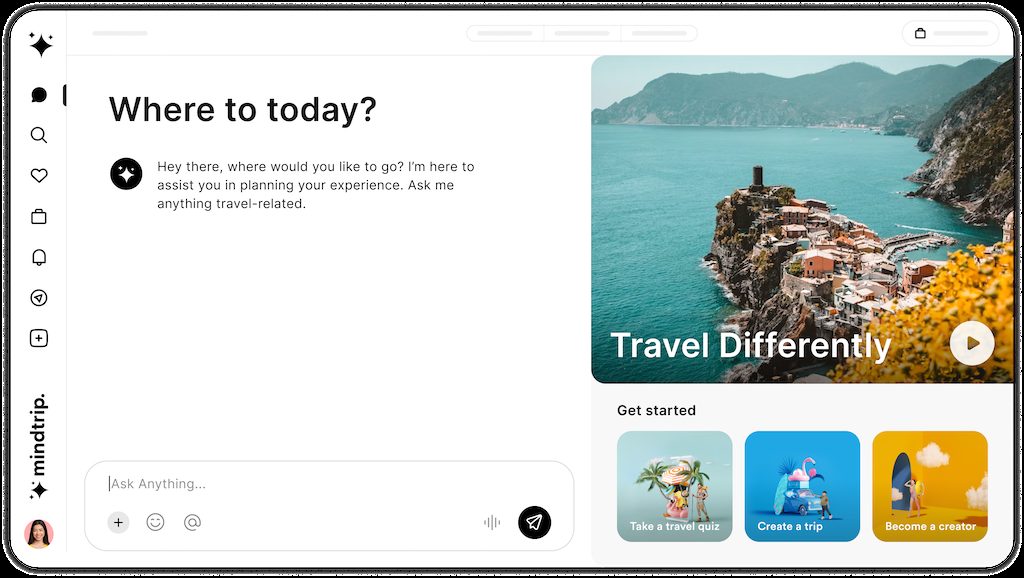
If you've used artificial intelligence to plan a recent trip, you're ahead of the curve. In fact, you're about 24 months ahead of the destination marketing organizations that are supposed to be helping you discover where to go next.
A comprehensive study by MMGY Intelligence, commissioned by Mindtrip, Sabre, and Sojern, surveyed over 1,000 leisure travelers across the US and more than 100 destination marketing leaders. What it found was striking: travelers and the tourism industry are moving at wildly different speeds when it comes to artificial intelligence.
The numbers paint a stark picture
More than half of all travelers (54%) have already used AI to plan a trip, and three-quarters plan to do so in the future. Yet only 22% of destination marketing organizations (DMOs) currently offer AI-assisted trip planning on their websites. Even fewer (26%) have documented AI strategies in place.
The stakes feel immediate. Seven in ten DMO leaders acknowledge that organizations failing to adopt AI within the next two years risk becoming irrelevant when it comes to destination discovery. That's not a distant threat. That's a ticking clock.
What travelers are actually using AI for
People aren't just dabbling. They're relying on AI for the nitty-gritty work of travel planning. Forty-two percent use it to research entire itineraries. Another 32% use it to compare flights, hotels, and tours. Sixty percent turn to AI to research attractions, restaurants, and transportation options. Fifty-six percent use it to hunt down the best prices.
This goes far beyond inspiration. When AI recommends a destination, travelers listen. About 40% have discovered new places thanks to AI suggestions, and 29% have actually changed their destination plans based on what algorithms suggested.
Younger travelers are leading this shift. Nearly seven in ten millennials (69%) and 63% of Gen Z travelers use AI assistants as frequently as social media when planning trips. For these generations, AI isn't a novel experiment. It's a standard tool in the planning toolkit.
The destination marketing disconnect
Here's where the gap becomes truly problematic: most DMOs still focus on inspiration rather than the practical, hands-on work of building trips. Only 20% of destination marketing leaders see itinerary building as a priority, even though that's exactly what travelers want.
Sylvia Weiler, President and GM of Sojern Destinations, frames it plainly. "We're witnessing the biggest shift in travel planning since online booking transformed the industry," she says. Travelers now expect AI to guide them at every stage, from spark of interest all the way through to booking confirmation. The opportunity for DMOs is to become the trusted source powering those AI-driven decisions, not to watch from the sidelines.
What travelers expect from AI-powered booking
Confidence in AI varies depending on context. More than a third of travelers are comfortable letting AI participate directly in the booking process, with younger travelers leading the way. That confidence jumps significantly when human support is available as a backup.
The real wake-up call for destination websites: 63% of travelers say they would use an AI trip planner directly on a destination's own site. Meanwhile, 25% are less likely to use a website that doesn't offer AI features at all. These aren't marginal percentages. These are the majority of travelers making decisions about where to spend their time and money.
The opportunity is still there
The good news for hesitant DMOs is that this gap is still closable. AI hasn't yet become so entrenched that latecomers can't catch up. Brad Johnson, Vice President of Product Management at Sabre, sees it as an opportunity rather than a threat. "For destination organizations, this creates an opportunity to extend their role beyond inspiration and become a more connected part of the traveler journey," he says.
The organizations that move decisively now can reshape how travelers discover and plan trips. Those that delay risk becoming irrelevant fast. In the travel world, being two years behind isn't just a gap in technology adoption. It's the difference between being essential and being invisible.