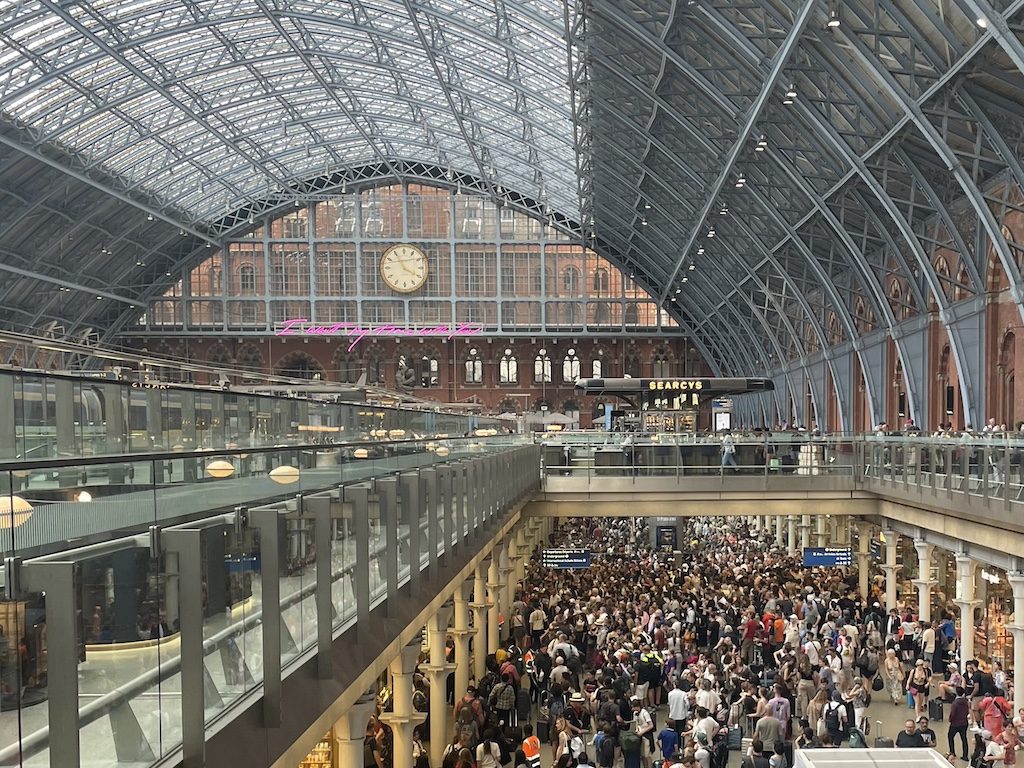
If you have booked a Eurostar ticket recently, you probably already know the score. St Pancras International has become uncomfortably tight, with security queues snaking across the concourse and passport control looking less like a bottleneck and more like a genuine jam. The crowds are only going to swell.
The problem is two-fold. First, the EU's new Entry/Exit System kicks in soon, adding another layer to border procedures. Second, and far more significant for the long-term future of rail travel between Britain and continental Europe, Eurostar's 30-year monopoly is finally ending in 2029. Real competitors are circling.
Eurostar's leadership is alarmed. Gwendoline Cazenave, the company's chief executive, has been making the rounds warning anyone who will listen. She told Le Monde that Britain's political establishment needs to get its act together, and fast. Right now, the concessionaire, regulator, and government are working in isolation from one another. That has to change.
The challengers are coming
Virgin is the closest threat. The UK airline-turned-rail-operator secured access to Temple Mills International depot in East London last October, and by mid-August this year received preliminary approval to run up to 20 daily return services starting in October 2030. That still leaves several hoops to jump through, but Paris, Brussels, and Amsterdam are already on Virgin's target list.
Trenitalia is also gearing up to enter the fray, having already ordered new high-speed trains specifically for the London-Paris corridor. Eurostar is not sitting idle. The company plans to invest up to 2 billion euros in 30 new trains, with another 20 on option, with deliveries beginning in 2031. The goal is ambitious: pushing annual passenger numbers from 20 million to 30 million within ten years.
Yet here is the catch. The Channel Tunnel itself is not the constraint. Getlink, which operates the tunnel, says traffic could easily double without any structural problems. The real choke points sit at either end of the journey. Paris Gare du Nord and London St Pancras are both operating beyond their designed capacity.
Numbers that tell the story
Paris-Nord can currently handle 2,000 passengers per hour at maximum. London manages 3,000. Eurostar wants to see those figures climb to 3,000 and 5,000 respectively. Without those upgrades, Cazenave warns, the company risks having to parcel out its existing slots to new competitors instead of expanding overall service.
In June 2025, Eurostar and London St Pancras Highspeed unveiled expansion plans that would more than double the London terminal's capacity. One proposal involves letting arriving passengers exit directly from the platform, which frees up valuable space below for departing passengers and the vital security and border checks. Paris has no such physical option available, though talks with French authorities are reportedly moving forward.
There is a wrinkle, though. The concession held by London St Pancras Highspeed expires in 2040, which is a decade before Eurostar's new trains are supposed to roll into service. Why would a company invest billions in infrastructure it will not control? One potential fix would extend the operator's ability to collect fees after the contract ends, giving them skin in the game.
The economic case
Eurostar is leaning hard on economic arguments to persuade policymakers. A commissioned report shows the Paris-London route has generated 2 billion pounds in economic activity and 23,000 jobs since 1994. The company claims that figure could jump by another 40 percent by 2035, provided the stations maintain their current service levels. That is a serious carrot to dangle in front of budget-conscious governments.
The evidence exists closer to home. Eurostar's London-Amsterdam service runs five times daily following station improvements in the Dutch capital, and the company has captured roughly a third of that market. With demand forecast to triple by 2040, expansion to Cologne, Geneva, and Frankfurt is already in the playbook. But fitting all those extra passengers into European rail infrastructure is becoming as urgent as finding the trains to carry them. The clock is ticking.