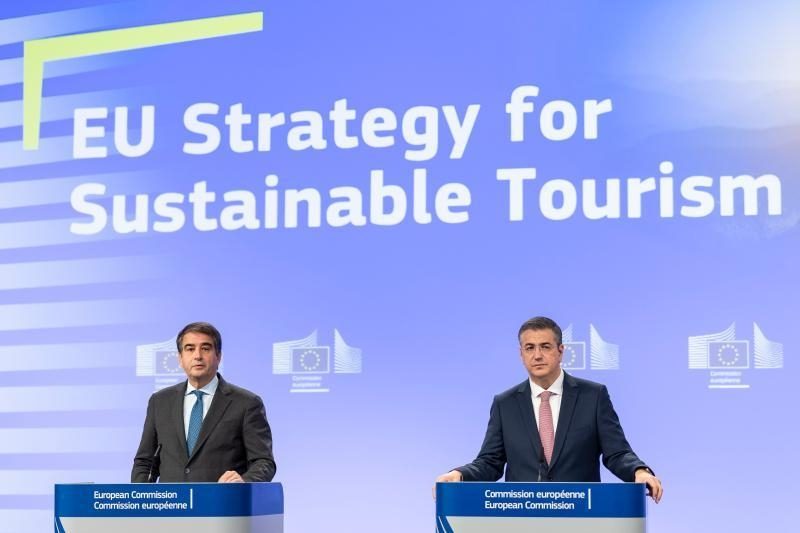
For decades, Europe has been the world's most visited region, yet it never had a unified plan for how to handle all those travelers. That changed on November 4, 2026, when the European Commission adopted its first EU Sustainable Tourism Strategy, a sweeping framework that aims to strengthen tourism businesses, ease pressure on overcrowded hotspots, and spread the benefits of travel to communities that often miss out.
The strategy arrives after multiple postponements throughout the year, and it carries serious weight. Tourism generates around 10% of the EU's gross value added, supports more than 20 million jobs, and encompasses five million businesses, 99% of them small and medium-sized enterprises. Yet the sector has been grappling with labor shortages, climate change, geopolitical instability, and wildly uneven visitor flows. The new plan, outlined in detail on the European Commission's transport page, tries to tackle all of these at once.
Three Pillars, One Vision
The strategy is built around three main pillars: competitiveness, sustainability and resilience, and Europe's international positioning. Investment, governance, and transport connectivity support all three. It builds on earlier work like the Transition Pathway for Tourism and the European Agenda for Tourism 2030, but this is the first time the EU has set a common direction for the entire sector.
Tourism remains primarily the responsibility of national, regional, and local authorities. The Commission's questions and answers document makes clear that the strategy does not harmonize national laws. Instead, it aims to improve coordination where cross-border cooperation can deliver practical benefits.
Balancing the Crowds
One of the most striking facts in the strategy: just 13% of European regions account for half of all nights spent in Europe. That lopsided distribution is at the heart of the plan. For destinations like Barcelona, Venice, or Amsterdam, overtourism has become a daily challenge, affecting housing, infrastructure, and residents' quality of life. Meanwhile, other regions with real tourism potential struggle to attract visitors outside a short peak season.
The Commission plans to introduce an EU Model for Tourism Management, a proposed Council recommendation, and a Toolbox for Balanced Tourism. These tools are designed to help destinations manage visitor flows, encourage travel throughout the year, and spread activity toward places that receive fewer visitors. As Executive Vice-President Raffaele Fitto put it, the goal is not simply to attract more tourists to the same destinations, but to create more value and spread the benefits more widely.
This approach connects tourism policy to territorial development. Stronger local businesses, better services, and employment opportunities can help people build futures in their own communities, including rural, island, coastal, and mountain regions. For travelers, that could mean more reasons to explore beyond the usual capitals and coastal resorts. If you are looking for inspiration, our guide to seven European cities where Halloween gets a local twist shows how smaller destinations are already carving out their own identities.
Skills, Data, and Simpler Rules
For tourism businesses, the strategy promises support with some of their most persistent operational challenges. An EU Tourism Academy will help develop training, attract talent, and strengthen the skills needed for the sector's clean and digital transitions. The planned EU Tourism Observatory and Common European Tourism Data Space aim to improve access to information for businesses, destinations, and policymakers. Better use of data and artificial intelligence could support decisions on visitor demand, services, and destination management.
The strategy also acknowledges the role of active mobility, including cycling tourism, as a key enabler of sustainable travel. The European Cyclists' Federation welcomed the recognition but noted that proposals for a European economic impact study on cycling tourism and an improved digital ecosystem for promoting Europe as a cycling destination had not been fully addressed, as reported by EuroVelo. Still, the inclusion of cycling in the strategy signals a shift toward lower-impact travel options.
What This Means for Travelers
For the average traveler, the strategy could translate into more balanced tourism flows, which might mean fewer crowds at peak times and more options for off-season travel. It could also lead to better-managed destinations, with improved infrastructure and services in places that have long been overlooked. The emphasis on year-round travel might encourage you to consider a shoulder-season trip to a lesser-known region, which can be both more affordable and more rewarding.
Europe's visa maze has long been a hurdle for many visitors, and the strategy's focus on connectivity and crisis preparedness might eventually ease some of those friction points. For now, the practical takeaway is that the EU is finally treating tourism as a strategic priority, not an afterthought. That could mean more investment in sustainable infrastructure, better data for travelers, and a more even spread of visitors across the continent.
As the strategy moves from paper to practice, the real test will be implementation. The academies, networks, and management tools it proposes will require further development and funding. But the direction is clear: Europe wants to remain the world's leading tourism destination while ensuring that the benefits of travel are shared more widely. For travelers, that could mean a more thoughtful, more rewarding way to explore the continent.