The race to own the skies just got more complicated. Delta Air Lines, America's largest airline by revenue, has announced a sweeping partnership with Amazon to bring high-speed satellite internet to its planes. The deal positions the Seattle tech giant as a rival to Elon Musk's Starlink service and marks a significant realignment in how airlines are approaching connectivity above the clouds.
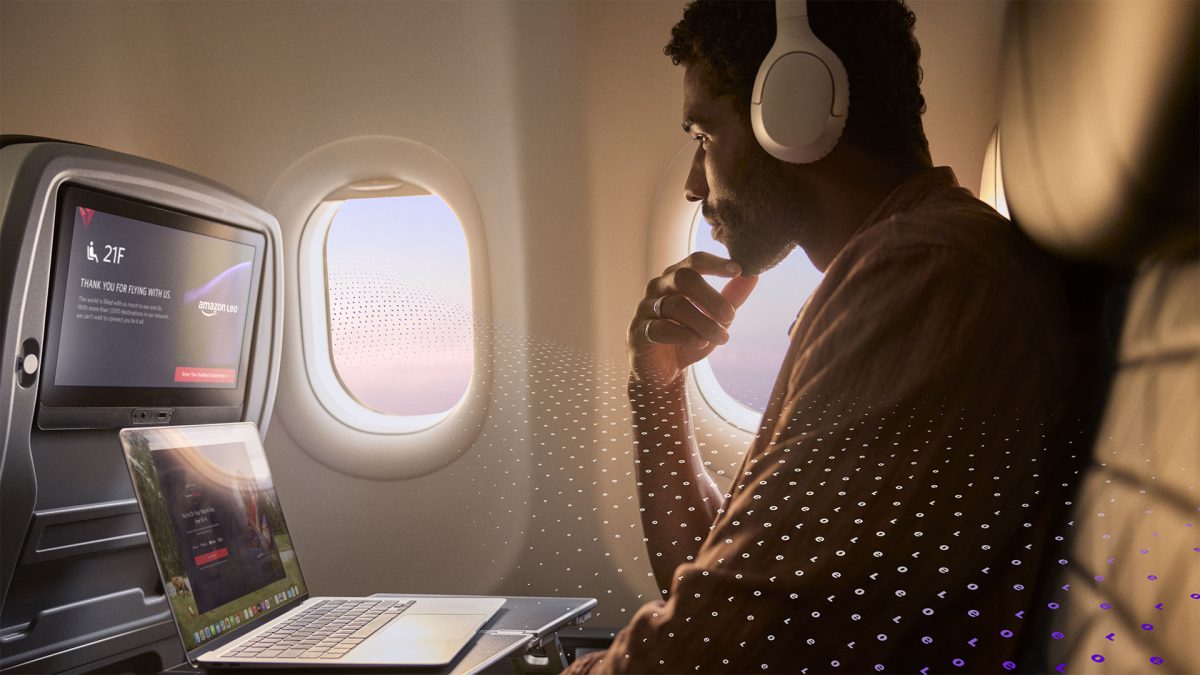
Starting in 2028, Delta will begin installing Amazon Leo satellite receivers on 500 aircraft across its fleet. The system uses a specialized antenna called Leo Ultra to pull data from Amazon's network of low Earth orbit satellites. For the tens of millions of passengers who fly Delta annually, this means faster, more reliable Wi-Fi on both domestic and international routes. Ed Bastian, Delta's CEO, framed the deal as part of the airline's global expansion, calling Amazon "a global leader that shares our ambition to build what's next."
The partnership runs deeper than just Wi-Fi. Delta already relies on Amazon Web Services (AWS) for much of its backend operations, so this represents a natural extension of an existing relationship. The airline plans to integrate Leo with its Delta Sync platform, the entertainment and service system that passengers interact with on their seatbacks. Andy Jassy, Amazon's CEO, emphasized that Leo's speed and reliability will transform the in-flight experience, noting that passengers increasingly expect to stay connected no matter where they are.
Why Amazon won, and what it means for Starlink
On paper, Starlink has long been positioned as the premium option for in-flight connectivity. The service is fast, widely praised for its reliability, and already operating on planes across the industry. Yet Delta's choice suggests that factors beyond raw speed matter in the boardroom. Cost-effectiveness, integration with existing systems, and the leverage of a broader tech partnership all played roles. Bastian's comment about getting "the fastest and most cost-effective technology available" hints that Amazon's offer may have simply been too good to pass up.
The timing is noteworthy. Amazon Leo is coming to Delta with a plan to install the service on hundreds of aircraft across its fleet, beginning with that initial 500-plane rollout. Meanwhile, nearly every other major U.S. carrier has already signed deals with SpaceX for Starlink. United, Southwest, Alaska, and Hawaiian Airlines are all in Musk's camp. So are international heavyweights like British Airways, Emirates, and Qatar Airways. That leaves Delta and JetBlue as the notable holdouts.
The situation highlights growing tension in the aviation sector. Earlier this year, Ryanair, Europe's largest airline by passenger volume, publicly sparred with Musk over Starlink, citing concerns that the system adds weight and fuel consumption to aircraft. CEO Michael O'Leary claimed the added costs simply weren't worth the benefit. Whether Delta and JetBlue share those concerns remains unclear, but the choice to pursue Amazon's alternative gives them options should those worries prove real.
What passengers should expect
The rollout timeline matters if you're a frequent Delta flyer. The first aircraft won't receive Leo Ultra until 2028, which means at least another two years of whatever connectivity Delta currently provides. The full deployment across the entire fleet will take considerably longer, so don't expect universal access across Delta immediately. That said, once installation begins, the experience should improve noticeably for those flying on equipped aircraft.
For travelers booked on competing airlines, the question becomes whether Starlink's current advantage will hold up. If Amazon's Leo proves equally fast and more cost-effective, the pressure on Musk's service could mount. If you're the type of passenger who values seamless streaming and video calls at 35,000 feet, you'll want to track how Leo performs once it launches.
Delta's bet on Amazon represents more than just a business decision. It's a signal that in aviation's connectivity wars, the winner won't necessarily be the first entrant or the most famous name. Sometimes it's the company that builds the best relationships and understands how to integrate new technology into existing operations. For passengers, that competition is ultimately good news. The more seriously airlines take connectivity, the better your in-flight experience becomes.