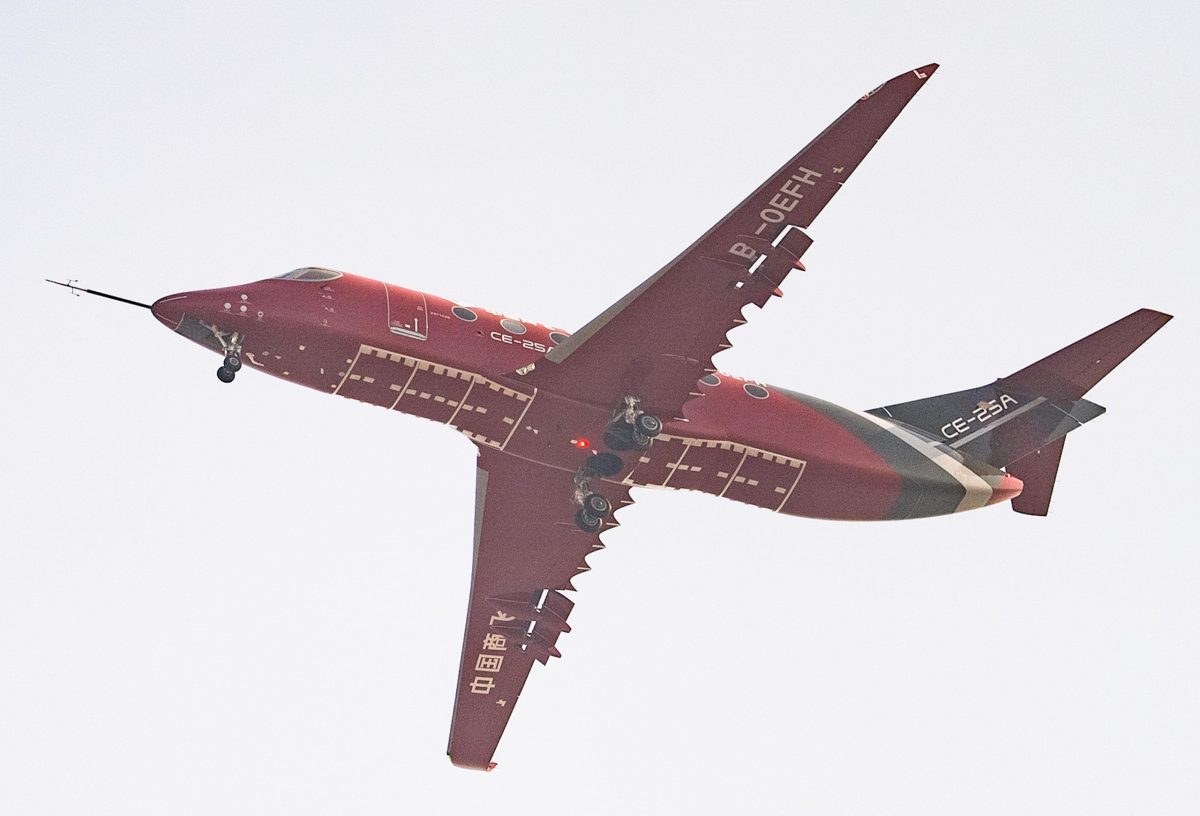
China has crossed a new threshold in electric aviation. On Saturday, November 14, the CE-25A, a bright red commuter plane developed by the Commercial Aircraft Corporation of China (COMAC), completed its first crewed test flight. The aircraft lifted off from Binzhou in eastern China's Shandong Province and stayed airborne for 16 minutes and 38 seconds, covering about 60.4 kilometers. The entire test, from start to finish, took just under an hour.
Two pilots and a flight test engineer were on board the 10-tonne aircraft. According to state media, all systems operated normally and every performance indicator met expectations. That's a major milestone for China's electric aviation ambitions, especially since the plane's earlier test flight in February was unmanned.
The CE-25A looks like something out of a sci-fi movie. Ten electric ducted fans sit above the wings, five on each side, giving it an insect-like silhouette. The name breaks down simply: C for China and COMAC, E for electric propulsion, 25 for China's Part 25 airworthiness standard, and A for the first in the series. It's designed for short inter-city hops, carrying up to 19 passengers at a cruising speed of 300 kilometers per hour, with a range of 400 kilometers and a cruising altitude of 2,400 meters.
COMAC didn't build this alone. It teamed up with Contemporary Amperex Technology Co. (CATL), one of the world's biggest battery makers, and Shanghai Jiao Tong University, among others. The plane has now logged 19 unmanned tests and this first crewed flight. The Civil Aviation Administration of China has accepted its application for type certification, a key step toward commercial service, though regulatory approval is still pending.
This flight is part of a broader push by China to become a major player in aviation, both conventional and electric. The country is also working to reduce its reliance on Western suppliers for its C919 passenger jet, encouraging local companies to develop everything from sealants to paints. And beyond planes, China is testing flying cars, like the prototypes from XPeng, which recently got clearance for takeoff by 2027. You can read more about that in our piece on XPeng's flying car.
China isn't the only one chasing electric flight. In Europe, Sweden's Heart Aerospace has unveiled the ES-36, a 36-seat hybrid-electric regional plane that can fly 200 kilometers on battery power alone, with service planned for 2031. Dutch researchers are pushing for European legislation to speed up the transition to electric aviation and build the necessary infrastructure.
For travelers, the promise of electric planes like the CE-25A is quieter, cleaner short-haul flights. Imagine hopping between regional cities without the noise and emissions of traditional jets. It's still early days, but the first crewed flight is a concrete step toward that future. If you're curious about other aviation shifts, check out how Cyber Monday beat Black Friday for flight deals or what Storm Charles did to flights in Portugal.
For now, the CE-25A remains a test aircraft, not a ticket you can book. But with type certification in the works, commercial service could arrive within a few years. That would put China at the forefront of a new era in regional air travel.