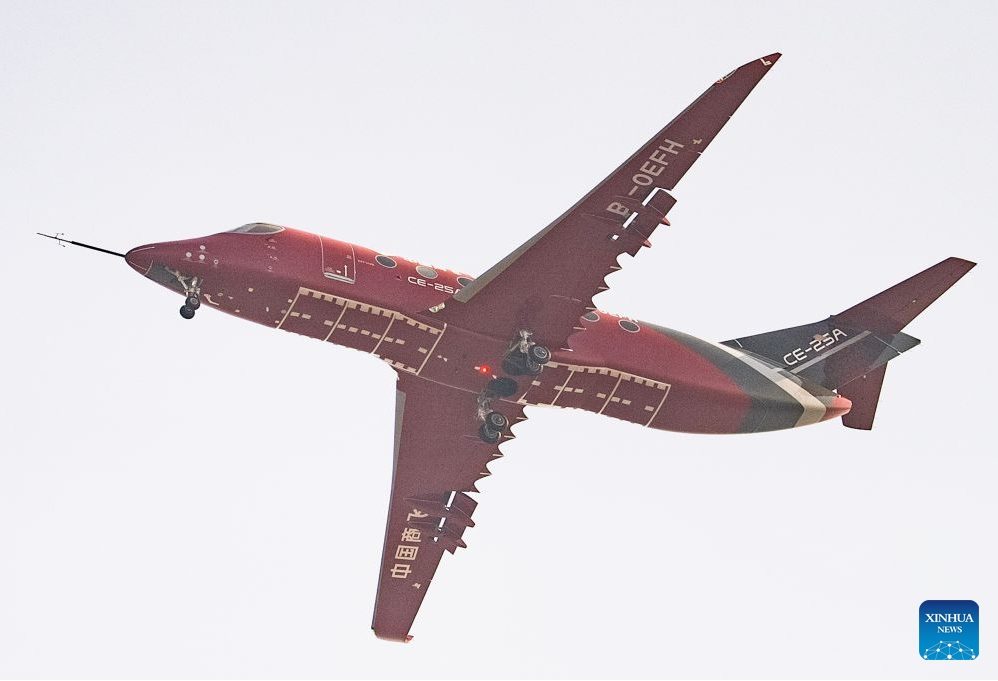
China just took a big step toward cleaner skies. On November 14, the CE-25A, a ten-ton electric passenger plane developed by COMAC, completed its first crewed flight over Binzhou in Shandong Province. Two pilots and a flight test engineer were on board for the 16-minute, 38-second journey, covering about 60 kilometers. The whole test, from takeoff to landing, wrapped up in under an hour.
The plane looks like something out of a sci-fi movie. Ten electric fans sit above the wings, five per side, giving it a bug-like silhouette that turns heads. That design is part of what makes it so quiet and efficient. The CE-25A is built for short inter-city hops, carrying up to 19 passengers at a cruising speed of 300 kilometers per hour, with a range of 400 kilometers. Think of it as a zero-emission alternative for routes that are too long to drive but too short for a conventional jet.
This was not the plane's first time in the air. It flew unmanned back in February, and since then it has completed 19 autonomous tests. Saturday's crewed flight was the real proof of concept. The development team said all systems operated normally and every performance indicator met expectations. The Civil Aviation Administration of China has accepted its type certification application, a key step toward commercial service, though final approval is still pending.
COMAC did not build this alone. It teamed up with CATL, one of the world's biggest battery makers, and Shanghai Jiao Tong University. That partnership matters because battery technology is the biggest hurdle for electric aviation. If the CE-25A succeeds, it could open the door for a whole new class of regional travel.
China is pushing hard on electric aviation as part of a broader strategy to lead in aerospace. The country is also working to reduce its reliance on Western suppliers for its C919 passenger jet, encouraging local companies to develop everything from sealants to bolts. And it is not stopping at planes. XPeng's flying car is cleared for China takeoff by 2027, a separate but equally ambitious project that blends road and air travel.
China is not alone in this race. In Europe, Sweden's Heart Aerospace recently unveiled the ES-36, a 36-seat hybrid-electric regional plane that can fly 200 kilometers on battery power alone, with service planned for 2031. Dutch researchers are pushing European authorities to speed up electric aviation infrastructure and regulations. The momentum is building globally.
For travelers, the promise is simple. Shorter, quieter, cleaner flights between nearby cities, with less time spent in security lines and more time actually exploring. Imagine hopping from Shanghai to Hangzhou or from Milan to Rome on a plane that hums instead of roars. The CE-25A is designed for routes of about 400 kilometers, which covers a lot of popular regional connections.
Of course, commercial service is still a ways off. The plane needs full certification, and airlines need to figure out how to integrate electric aircraft into their networks. But the test flight is a clear signal that the technology is moving from concept to reality. China's first crewed electric flight is a milestone, and it is one that could reshape how we think about short-haul travel.
If you are planning a trip to China, keep an eye on this story. Electric planes could eventually make regional travel easier and more sustainable. And while you are at it, check out China's museums that just swept a global ranking or new flights making Montenegro easier to reach. The future of flight is changing, and it is starting to look a lot more electric.