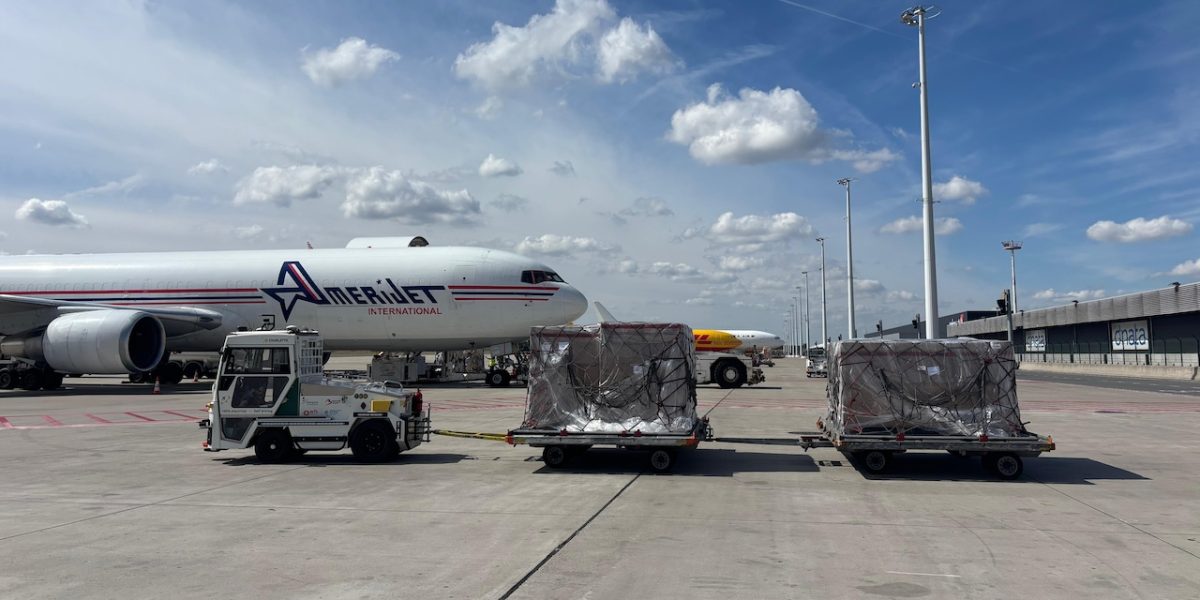
Picture this: cargo trailers gliding across the tarmac at Brussels Airport with no human driver, no steering wheel, no one shouting directions. Welcome to the future of airport operations, which arrived a lot sooner than most of us expected.
The Belgian hub is currently running trials of autonomous electric tow tractors in its cargo zone, moving freight between warehouses and aircraft aprons along four carefully mapped routes. These aren't your typical airport tugs. Each vehicle uses satellite navigation and laser sensors to map its environment in real time, spot obstacles, and adjust course without human intervention. The trials run during off-peak hours under controlled conditions because, well, safety doesn't take shortcuts.
Why robots make sense in cargo
Here's the appeal for airport operators: efficiency, sustainability, and the ability to support human workers rather than replace them. Brussels Airport CEO Arnaud Faust put it plainly: "The aviation and logistics sectors are evolving rapidly." Testing autonomous tech now means the airport can understand what actually works in its specific environment before scaling up across the entire operation.
This isn't the first time Brussels has kicked the tires on self-driving vehicles. The airport already successfully tested a fully autonomous electric shuttle zipping around the airside in 2025, and another shuttle running from the terminal to staff parking areas. Each trial feeds real-world data back into the system, making the next iteration smarter and more reliable.
The tractors are part of something much bigger: the European Stargate programme, a sprawling coalition of 22 partners working under Brussels Airport's leadership to transform how European airports operate. The initiative covers everything from on-site electric vehicles to green energy generation shared with neighboring communities, plus better multimodal transport access.
Safety first isn't just marketing speak
Jean-Claude Bailly, CEO of Navya Mobility (the company behind the autonomous systems), stressed that "safety and reliability are paramount" in the design phase. The collaboration involves the airport itself, WFS Cargo, and Charlatte Autonom, all focused on creating technology that performs flawlessly in the unpredictable, complex environment of a working airport.
For travelers, this matters more than you'd think. Autonomous cargo handling means faster turnarounds, fewer emissions per shipment, and smoother operations when delays aren't in the picture. A well-oiled cargo operation indirectly helps passengers too, whether it's connecting flights departing on time or perishable goods arriving fresher.
What comes after the trial?
The real test is whether this tech can scale. Airports operate in chaos, with unexpected ground vehicles, weather changes, and sudden operational pivots. The tractors must handle it all. Brussels is essentially asking: what happens when we roll out dozens of these robots? How do they interact with human workers? What regulatory hoops do we need to jump through?
Beyond autonomous vehicles, Brussels Airport is also doubling down on broader sustainability. The airport's fourth-year environmental initiative is currently seeking green project proposals from the community, offering grants up to 10,000 euros for ideas that benefit both people and the planet. The deadline for applications is September 16, 2026.
For a city like Brussels, increasingly connected to global travel routes and a hub for European logistics, these investments signal something important: airports aren't just places you pass through anymore. They're becoming laboratories for cleaner, smarter infrastructure. The next time your cargo arrives on schedule or a flight departs without delay, a quiet robot might deserve some of the credit.