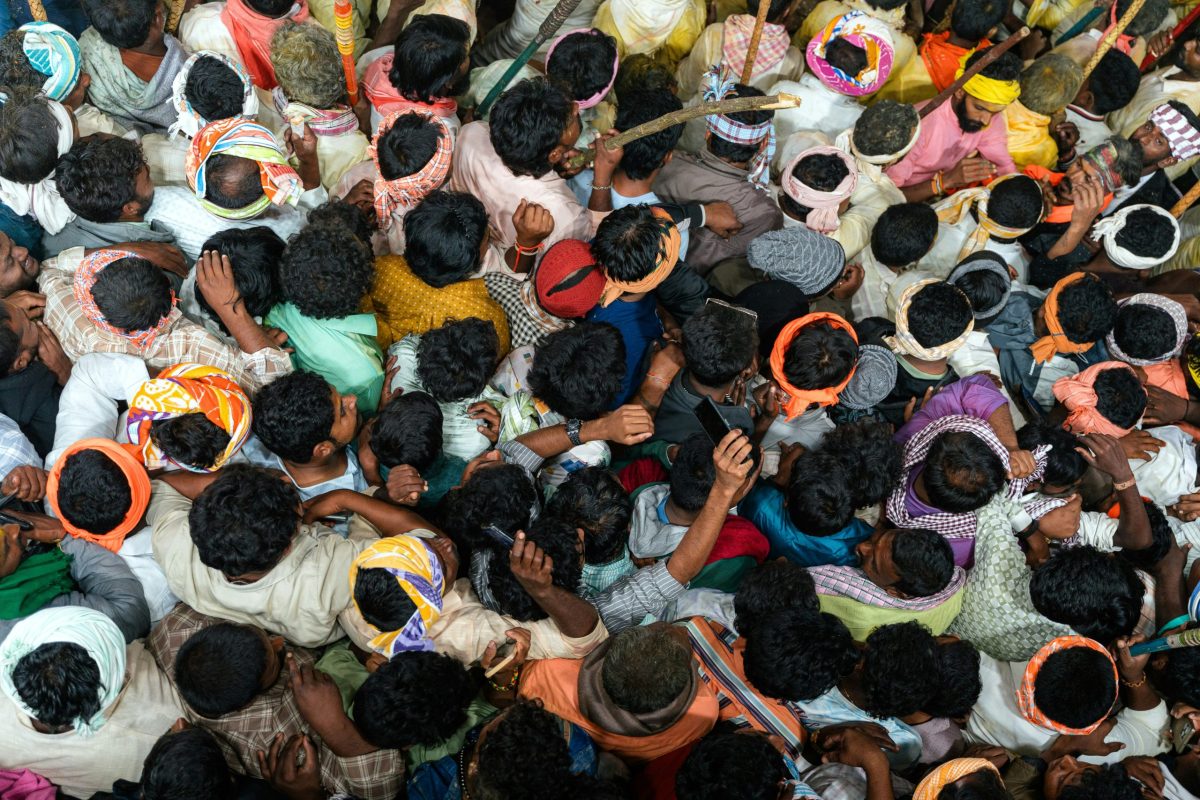
Friday the 13th came and went in November 2026, and the world did not end. That might sound like a low bar for good news, but for anyone who remembers the so-called Doomsday study, it is worth a moment of relief. In 1960, physicist Heinz von Foerster and his colleagues published a paper claiming that on that exact date, Earth's human population would become infinite. Not metaphorically. Mathematically. Their model, based on two thousand years of population growth, showed the numbers doubling faster and faster until they hit a vertical asymptote. The result, they wrote, would not be starvation. Our great-great-grandchildren would be squeezed to death.
The prediction was wrong, obviously. But the story of why it was wrong is more interesting than the headline. Von Foerster deliberately ignored the messy realities of fertility rates, disease, food supply, and war. He wanted a clean curve. Real life, as it turns out, is not a clean curve. Birth rates in developed countries plummeted after the postwar baby boom. The United Nations now projects that the global population will peak at around 10.3 billion in 2085 and then start to decline. Many wealthy nations are more worried about aging populations and shrinking workforces than they are about overcrowding.
For travelers, this is not just an abstract demographic footnote. It changes where people go, how they get there, and what they find when they arrive. Population decline is reshaping tourism in real time, from the depopulated villages of rural Spain that are reinventing themselves as slow travel destinations, to the Japanese towns offering free houses to anyone willing to move in. The places that once feared being overrun are now courting visitors with open arms. The places that were never on the map are suddenly the ones with space to breathe.
Of course, the end of the world has not been cancelled entirely. The Doomsday Clock, maintained by the Bulletin of the Atomic Scientists, sits at 85 seconds to midnight as of January 2026, the closest it has ever been. Climate change, nuclear proliferation, pandemics, and the unchecked rise of artificial intelligence all remain on the table. The news cycle still feels like a series of increasingly urgent alarms. But the failure of the 1960 prediction is a reminder that the future is not a straight line. It is a tangle of choices, accidents, and stubborn human behavior.
For those planning trips in the coming months, the practical takeaway is simple. The world is still here, and it is still worth exploring. But the way we travel is changing. Getting there is often the hardest part, as any frequent flyer will tell you. And the rules keep shifting, whether it is new refund regulations in Europe or health screening requirements at US airports. The savvy traveler in 2026 is the one who stays flexible, reads the fine print, and remembers that the apocalypse has a habit of not showing up.
So what does the failed Doomsday prediction actually teach us? It teaches us that humanity is not a mathematical formula. We are messy, adaptable, and occasionally irrational. We change our minds. We have fewer babies when we feel optimistic, and more when we feel scared. We invent new technologies and abandon old ones. We make mistakes and we correct them. The only certainty is that the future will not look like the past, and that is exactly why travel remains so compelling. Every trip is a small bet that the world will still be there when you arrive, and that it will surprise you.
As for von Foerster, he was not entirely wrong. He was right that population growth could not continue forever. He was right that resources are finite. But he underestimated the human capacity to change course. The planet is crowded, yes, but it is not infinite, and neither are we. The best response to a Doomsday prediction that fails is to go out and see the world while it is still here. People are not giving up travel, they are just getting smarter about it. And that, perhaps, is the most human thing of all.