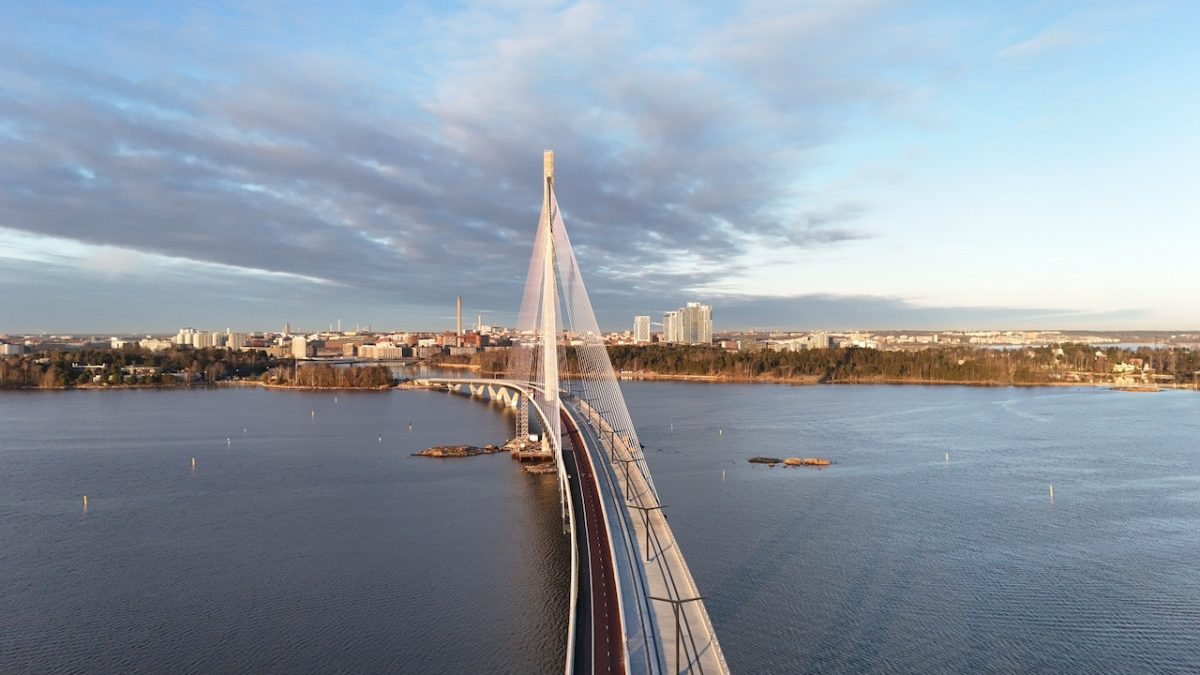
Helsinki pulled off something genuinely rare last month: it opened a bridge that made people actually want to visit it on opening weekend. Some 50,000 visitors showed up for the debut of Kruunuvuorensilta, a structure so ambitious it claims the title of Finland's longest pedestrian crossing at nearly 1.2 kilometers across. But the length is only part of the story.
The bridge also towers 135 meters high, beating Finland's tallest residential building by exactly one meter (architects were petty about this, apparently). It stretches across water to connect the waterfront neighborhood of Kruunuvuorenranta with the island of Korkeasaari, the district of Laajasalo, and central Helsinki. Mayor Daniel Sazonov called it "a distinctive new identity" for the city's skyline, and based on the opening weekend rush, residents seem to agree.
Engineering Meets Northern Winters
Here's where Kruunuvuorensilta gets genuinely clever. Finland's winters are brutal, which means icing is a real threat to safety and accessibility. The bridge's designers solved this with stay cables that the wind keeps in constant, slight motion. That movement prevents ice from forming in the first place. Add in a special coating, and the bridge literally shivers away ice flakes as they develop. It's the kind of practical-meets-witty approach you'd expect from a country famous for both hard winters and better design than most places deserve.
The structure won't just survive winter. It's built for 200 years of operation, with a carbon footprint of approximately 129,000 metric tons of CO2 equivalent over 50 years. Most of that burden came from construction itself, but the project used low-emission materials and renewable energy to trim emissions wherever possible.
What This Bridge Actually Changes
Before Kruunuvuorensilta opened in 2024 (after starting construction in 2021 and costing around 326 million euros), getting between these neighborhoods meant a detour of nearly six kilometers. Now it's a straight shot across. By 2030, planners expect the bridge to handle roughly 23,000 tram trips and 3,750 cycling trips daily, once the light rail system under development is finished.
This isn't random infrastructure. It fits squarely into Helsinki's long-term bet on sustainable mobility. Right now, about 41 percent of all journeys in the city happen on foot, 25 percent via public transport, and 11 percent by bike. Only 20 percent of trips involve cars. Kruunuvuorensilta tilts those numbers even further away from driving, which seems to be the entire point.
The bridge comes alive after dark too. Different colors of LED lighting activate at different times of day, turning the structure into something between infrastructure and art installation. It's quintessentially Finnish, really: taking something functional and making it a reason to leave your apartment at night.
Why Helsinki Keeps Winning at City Design
This bridge isn't an anomaly in Helsinki's recent planning. Earlier this year, the city reopened one of the Nordic region's oldest indoor swimming pools, a building that layers Classicism with Art Deco styling. It's now both a working lap facility and a living museum of Finnish sauna culture. That's the city's approach: build infrastructure that also tells you something about who lives there.
For travelers planning a Nordic visit, the bridge itself has become a destination. The opening weekend crowd proves that people will travel specifically to see serious architecture if it's actually bold. It's the kind of landmark that makes you rethink what a city can do with space and engineering. If you're heading to Finland, add it to your list. The views alone are worth the walk.