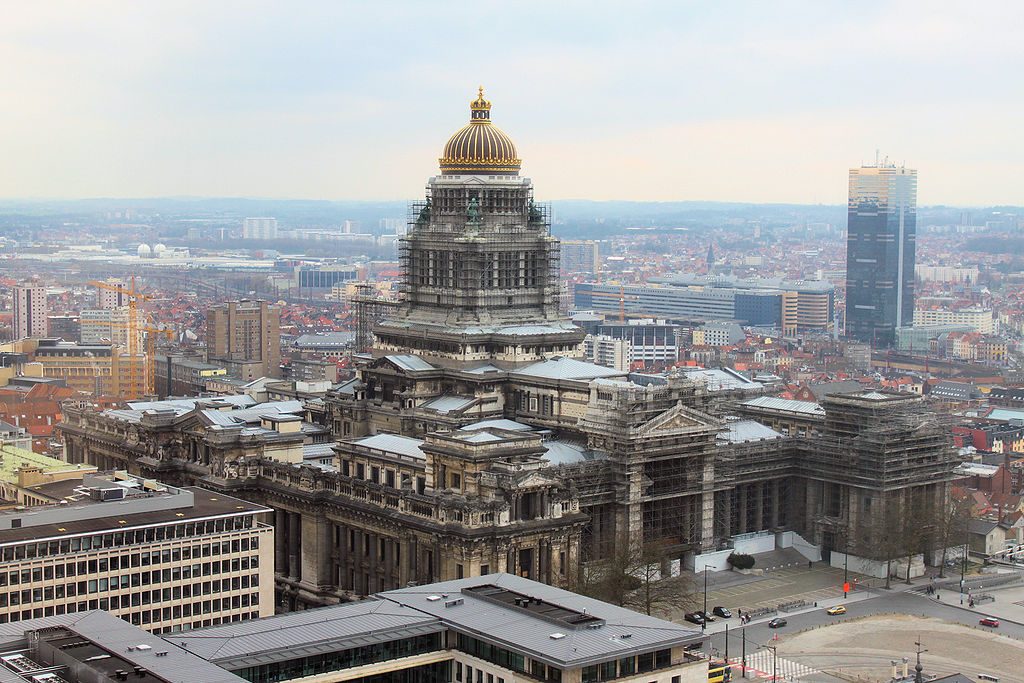
There's a peculiar moment in Brussels' architectural history when a building becomes less famous for its architecture and more famous for the construction equipment hiding it. The Palais de Justice experienced exactly that absurdity for nearly four decades. But this month, after three years of painstaking restoration work and a price tag of €31.7 million, the city's most monumental courthouse finally emerged from its metal cocoon, revealed to daylight in all its 19th-century grandeur.
The facade overlooking Place Poelaert was officially unveiled to crowds that included Federal Justice Minister Annelies Verlinden and dozens of architects and craftspeople who made the restoration possible. What they revealed wasn't just a building. It was a time capsule of ambition. The Palais de Justice, completed in 1883, remains one of the world's largest courthouses, occupying 80,000 square metres of prime real estate high above the city. Its dome and ornate stone work sit deliberately on Brussels' royal axis, symbolically connecting the country's executive, legislative and judicial branches in a straight line. It's hard to overstate the architectural significance here.
How Scaffolding Became Accidental Scenery
The first metal framework went up in 1984, meant as a temporary measure. Twenty years later, another section was added to protect against falling stones. Then something peculiar happened: nobody could agree on how to pay for permanent repairs. Funding disputes dragged on. Restoration plans stalled. The scaffolding stayed. Eventually, the support structure itself needed reinforcement before actual restoration could even begin. For locals, it became a running joke, then a source of embarrassment, then just part of the landscape. Many residents under 40 had never seen the building without its industrial disguise.
The restoration work that finally happened was meticulous almost to the point of obsession. Teams inspected, cleaned and repaired every section of natural stone and decorative element, aiming to preserve original materials wherever possible. Replacement stones came from the same quarries as the originals: Comblanchien limestone from Burgundy and Belgium's prized pierre bleue (blue limestone) from Soignies. Workers replaced 140 windows and 60 doors. Four marble statues representing figures from Greek and Roman legal history (Lycurgus, Demosthenes, Cicero and Ulpian) were restored alongside the monumental bronze entrance doors. Even the 3,500 square metres of natural stone flooring received attention.
The Technical Challenge Nobody Expected
Some restoration work pushed craftspeople into genuinely creative territory. Two corner stones weighing four tonnes each needed replacement 28 metres above ground. That's roughly eight storeys up, requiring acrobatic precision and nerves of steel. The peristyle, zinc roofs and decorative elements underwent similar attention, combining what architect Isolde Verhulst called a blend of "cutting-edge techniques with centuries-old craftsmanship." The main entrance will open to the public in September, along with a new accessible entrance for visitors with reduced mobility.
If Brussels feels easier to explore these days, that's partly because Brussels just became way easier to reach from Abu Dhabi, with improved international connections making the city a sharper destination for European art and architecture tourism.
The Long Road Ahead
Here's the catch: this is phase one of a project expected to run until 2035, possibly 2040. Scaffolding still wraps other sections. A second restoration phase targeting the dome starts in 2027. The remaining facades will follow in sequence. Given the building's track record with delays, optimism feels premature. But Justice Minister Verlinden called the completion of this first section a "success," one that offers "hope and perspective for the future of the building, and, by extension, for the justice department." She added that the public deserves to experience the justice system in a building whose appearance actually reflects the dignity of the institution itself.
For travelers visiting Brussels, the Palais de Justice isn't just courtroom drama. It's an extraordinary expression of 19th-century European confidence and ambition, built when architects believed buildings should announce power and permanence to everyone passing below. Now you can finally see it without industrial interference. That alone makes 2024 the right time to visit Belgium's capital, if only to stand in Place Poelaert and appreciate what happens when a city refuses to let its architectural heritage disappear into bureaucratic neglect. The scaffolding is gone. The real show has finally begun.