Every autumn, forests put on a show. You walk a trail in October, and the maples are on fire, the beeches have gone gold, and the whole thing feels intimate, almost private. But pull back far enough, and that private spectacle becomes something else entirely. From orbit, entire mountain ranges shift color like a slow-motion tide.
In 2024, the European Space Agency and NASA's Earth Observatory published satellite images that capture this transformation across three continents. The views are striking not just for their beauty but for what they reveal about how autumn actually works on a planetary scale.
Europe's beech forests turn to gold
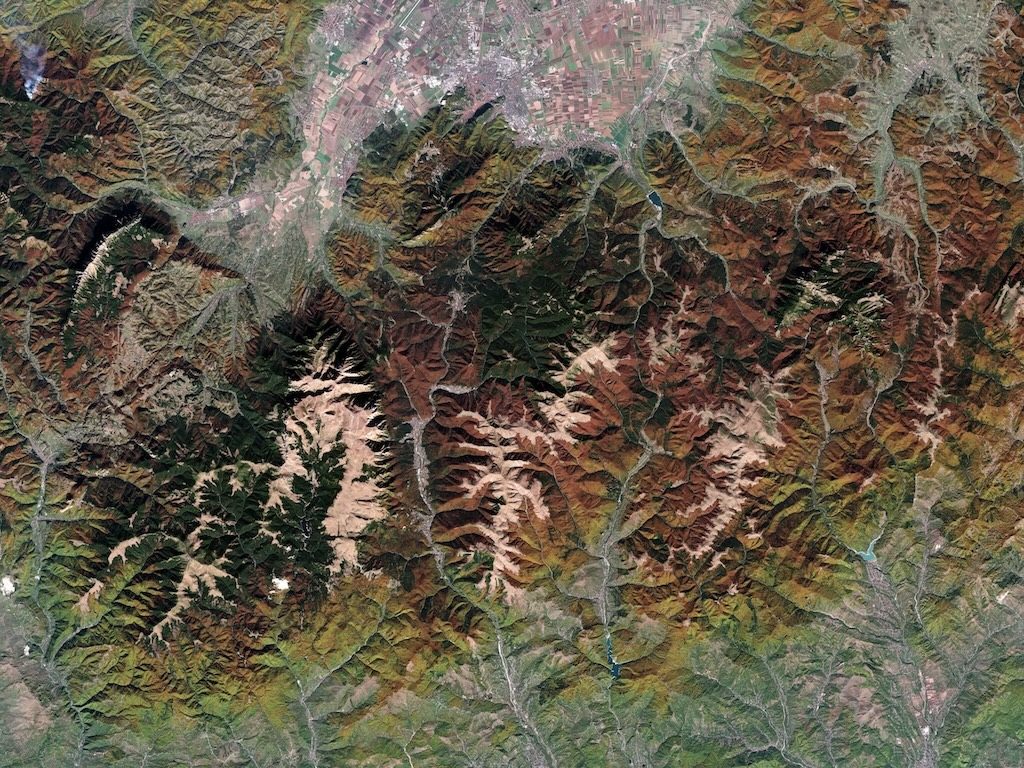
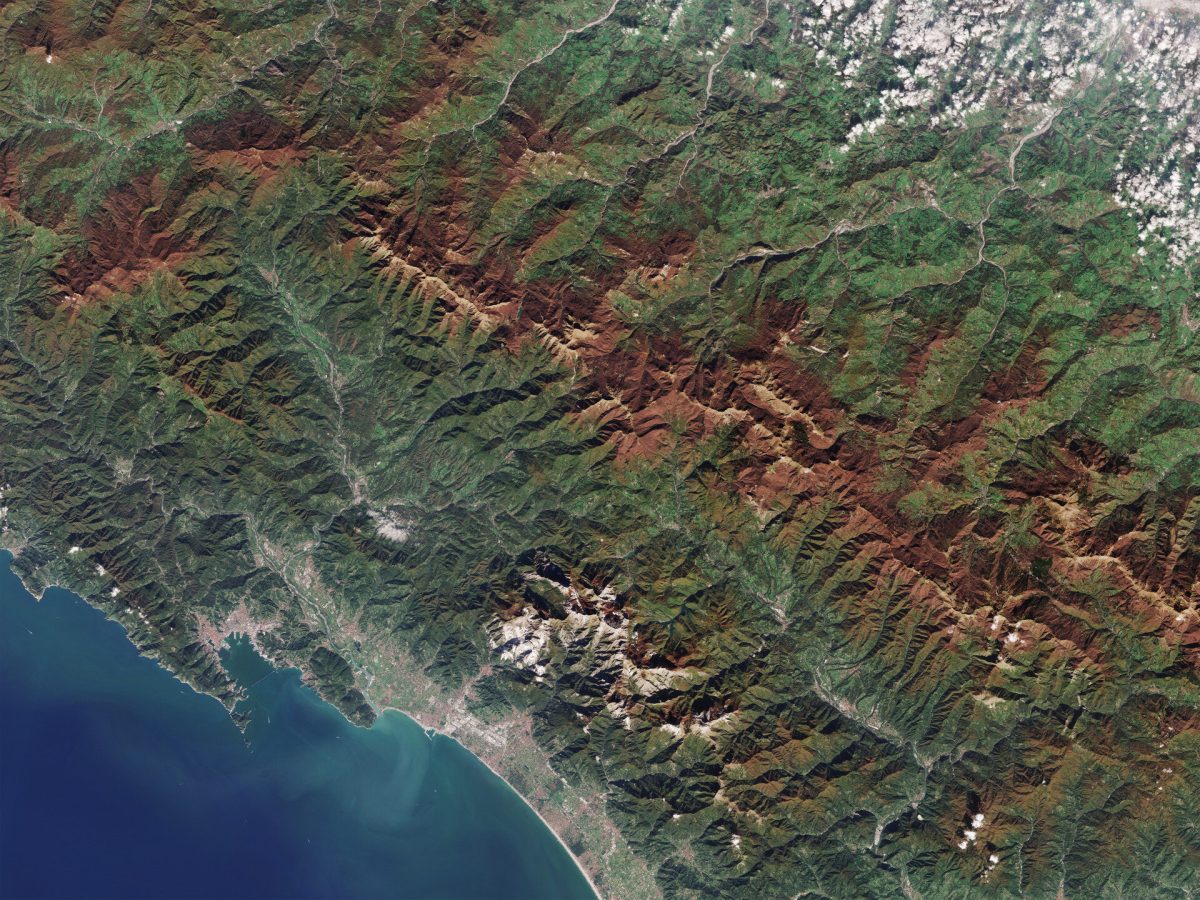
The Copernicus Sentinel-2 mission tracked autumn foliage in three European regions: Italy's Tuscan-Emilian Apennines, the mountains along the North Macedonia–Greece border, and Romania's southeastern Carpathians. In October 2024, the images show forests shifting from green to golden-brown.
All three regions share a common tree: European beech, Fagus sylvatica. Its autumn foliage forms expansive gold and bronze canopies visible from orbit. Along the North Macedonia–Greece border, the colors spread across the Baba Mountains and Pelister National Park toward northern Greece's Verno/Vitsi mountains. Beech dominates at higher elevations, while oak takes over at middle and lower altitudes. The ESA's Sentinel-2 images make the transition look almost like a weather system moving through.
Michigan's mitten gets colorful
Across the Atlantic, Michigan's Lower Peninsula offers another distinctive autumn scene. Nicknamed "the mitten" because of its shape, it appears in an image captured by the NOAA-20 satellite on 19 October 2024 and published by NASA's Earth Observatory.
Maples bring reds and oranges to the northern Lower Peninsula, while aspen and larch add yellow. Evergreen conifers provide a green backdrop. The timing varies by location and year, but Michigan's autumn colors generally begin appearing in mid to late September and can linger into late October. If you're planning a leaf-peeping trip, this is the window you want.
Mongolia's larch forests go yellow before the snow
Around Lake Hövsgöl in northern Mongolia, the seasonal shift is especially clear in NASA's comparison images. Views captured on 17 August and 26 September 2024 show green forests becoming golden, with snow already visible on nearby mountain ridges.
The surrounding forests consist mainly of Siberian larch, Larix sibirica. Unlike evergreen conifers, these trees turn yellow and shed their needles in autumn. Autumn is brief in this part of Mongolia. Ice can begin forming on Lake Hövsgöl as early as November and persist into June, leaving a short window between the forests' golden display and the long winter ahead.
Why leaves change color at all
Shorter days and falling temperatures prompt many deciduous trees to slow and eventually stop producing chlorophyll, the pigment responsible for their green color. As it breaks down, other pigments become more visible, creating the shades associated with autumn. From space, those individual chemical changes aggregate into something you can see from hundreds of miles up.
If you're chasing autumn colors this year, the satellite view offers a useful reminder. The window is short, and it moves. Whether you're hiking in the Apennines, driving Michigan's back roads, or planning a trip to Mongolia's lake country, timing matters. And if you're looking for a different kind of autumn adventure, the racecation trend is reshaping how people plan fall travel. For something more grounded, Balmoral Castle opens its autumn gardens for a rare five-week season. And if you'd rather see the planet from above yourself, space tourism's only player is asking you to wait until 2027.