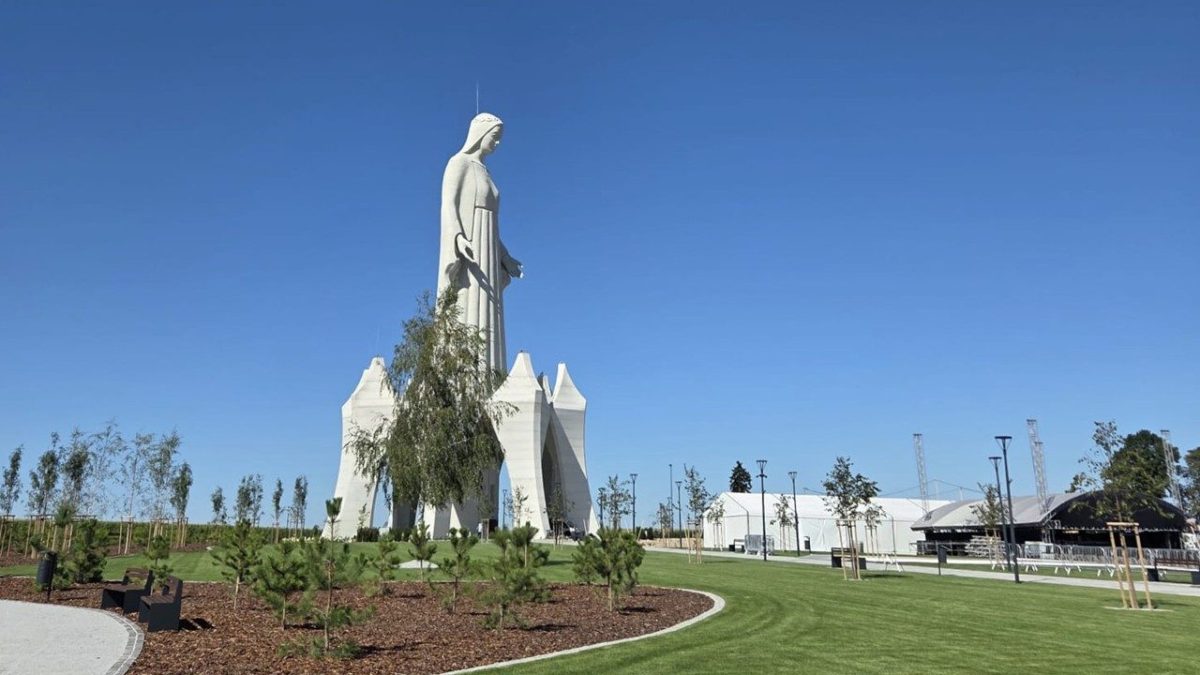
On August 15, the small agricultural village of Konotopie in central Poland became home to something that defies its size and setting. A 55.6-metre concrete statue of the Virgin Mary now rises above the fields, so tall that it dwarfs Rio de Janeiro's famous Christ the Redeemer by nearly 18 metres. The village, which had fewer than 150 residents before the monument's completion, didn't build this for quiet reflection alone. Local officials are betting it transforms their corner of Poland into a destination.
The timing was deliberate. The blessing took place on the Feast of the Assumption, one of Catholicism's most important dates. Bishop Krzysztof Wętkowski consecrated the statue and spoke of lifting eyes upward, toward Mary and toward God. Helicopters scattered red roses over crowds while priests in white celebrated mass and traditional folk dancers performed. It felt less like a small village event and more like a national moment.
The driving force behind this monument came from Roman Karkosik, a millionaire investor who made his fortune in Poland's chaotic 1990s by betting on undervalued companies. Together with his wife, Grazyna, he spent roughly 100 million zloty (about 23.2 million euros) to see this vision materialize. Their request was specific: Mary should stand taller than Poland's existing Jesus Christ the King of the Universe statue in Swietbodzin, which measures 33 metres. Mission accomplished, with room to spare.
Among the attendees was Lech Walesa, the 82-year-old former Polish president and Nobel Peace Prize winner who led the Solidarity movement that helped topple communist rule. Walesa posted a photo of himself before the statue later, with the sun creating a halo effect above Mary's head. "This is the end of my path," he said at the ceremony. "I started with the Virgin Mary and I end with the Virgin Mary." For Walesa, faith had always been inseparable from his fight for freedom, and the monument seemed to close a chapter of his life.
The construction itself proved trickier than expected. The project took 18 months and required sculptor Adam Jakub Matejkowski to create the original two-metre model. Finding a company capable of producing the concrete mould became the real bottleneck. No Polish suppliers could manage it, so Karkosik's team sourced the material from Italy instead. Once completed, the statue gained an observation deck built into its crown-shaped pedestal, positioned 15 metres above ground and free for visitors to access.
Grażyna Karkosik framed the monument as more than religious architecture. "The statue will be for all people," she said. "Each of us coming to see it will think more deeply about their own lives, not only about God." The couple also described their investment as an expression of gratitude to God, living as they do in a restored 18th-century palace just two kilometres away.
What makes this particularly significant is the context. Poland remains one of Europe's most Catholic countries, with 70 percent identifying as Catholic and 30 percent attending Sunday mass. Yet religiosity has dropped sharply among younger generations, a decline that worries church leaders. Wiesław Mering, a Polish Catholic prelate who attended the ceremony, told the Guardian the trend "hurts" him. He sees the Mary statue as a counterweight to that decline, a physical reminder that faith hasn't abandoned Poland.
Local authorities already expect the monument to draw both pilgrims and tourists. The mayor of nearby Kikoł noted that investor interest was building, particularly from restaurant owners sensing opportunity. Konotopie may never rival major European pilgrimage sites, but it's no longer just another quiet village. The statue claimed the title of Europe's tallest Virgin Mary after outranking a statue in Miribel, France, though it still stands dwarfed by the 98-metre Mother of All Asia tower in the Philippines.
For travelers interested in religious architecture, unusual monuments, or the intersection of faith and rural tourism in modern Europe, Konotopie has suddenly become a destination worth plotting. The monument opens a window into how Poland processes its Catholic identity today, particularly after decades of communism that tried to erase it entirely.